

Resumo:
- Predictive maintenance detects equipment failures before they happen using real-time sensor data and analytics.
- Implementing PdM can reduce downtime by up to 50% and extend asset life significantly.
- Success depends on organizational readiness, staff buy-in, cybersecurity, and iterative learning.
Most operations managers work on the assumption that a well-timed service schedule keeps equipment healthy. The reality is more unsettling: a significant proportion of costly breakdowns occur not when maintenance is overdue, but precisely between those scheduled checks. Vibration patterns shift, temperatures drift, and metal fatigue accumulates invisibly while inspection logs show everything as normal. Predictive maintenance predicts failures before they occur by using real-time sensor data, AI-driven analytics, and continuous condition monitoring to close that dangerous gap. This article covers what predictive maintenance is, how the technology works, the measurable benefits it delivers, and a practical roadmap for getting started.
Índice
- The basics of predictive maintenance
- How predictive maintenance technology works
- Key benefits: reducing costs, downtime, and asset failure
- Key challenges and expert tips for implementation
- Application: steps to implement predictive maintenance
- Beyond hype: why predictive maintenance succeeds or fails
- Put predictive maintenance into action with smart asset management tools
- Perguntas mais frequentes
Principais conclusões
| Ponto | Detalhes |
|---|---|
| Definition of PdM | Predictive maintenance uses real-time data and AI to forecast equipment failures before they disrupt operations. |
| Proven business benefits | Firms adopting PdM achieve up to 50 percent less downtime and significant cost savings within months. |
| Tech and expertise blend | Technology alone is not enough; expertise and continuous improvement are essential for PdM success. |
| Implementation strategy | A phased, data-driven rollout with leadership backing and team training delivers reliable results. |
The basics of predictive maintenance
Traditional maintenance falls into two broad categories. Reactive maintenance waits for something to fail and then repairs it, which is cheap to plan but expensive in practice because unplanned stoppages carry penalty costs, urgent procurement fees, and production losses. Preventive maintenance follows fixed schedules regardless of actual equipment condition, which is an improvement but still wastes resources on assets that are running perfectly well while occasionally missing failures that develop quickly between intervals. Reading a solid preventive maintenance guide helps clarify where that approach succeeds and where it leaves gaps.
Predictive maintenance (PdM) is a proactive strategy that uses real-time data from sensors, AI, and analytics to predict equipment failures before they happen, allowing teams to intervene at precisely the right moment. It is neither schedule-driven nor failure-driven. Instead, it is condition-driven, meaning work orders are generated when data signals that intervention is genuinely required.
The three main data streams that feed a PdM programme are:
- Vibration analysis: Detects imbalance, misalignment, bearing wear, and structural fatigue in rotating machinery such as motors, pumps, and fans.
- Thermal monitoring: Infrared sensors and thermocouples flag abnormal heat signatures in electrical panels, gearboxes, and process equipment.
- Oil and fluid analysis: Chemical sampling reveals contamination, viscosity breakdown, and early-stage wear particles in lubricants before mechanical damage becomes visible.
Acoustic emission monitoring, current signature analysis, and ultrasonic testing also feature in more advanced PdM programmes, particularly for high-value assets.
| Data source | What it detects | Typical equipment |
|---|---|---|
| Vibration sensors | Bearing wear, imbalance, misalignment | Motors, compressors, turbines |
| Thermal cameras | Hotspots, electrical faults | Switchgear, conveyor drives |
| Oil analysis | Contamination, viscosity loss | Gearboxes, hydraulic systems |
| Acoustic sensors | Leaks, arcing, crack propagation | Pressure vessels, pipework |
| Current analysis | Winding faults, load anomalies | Electric motors, drives |
Pro Tip: Even a basic early warning system built around vibration and temperature thresholds can reduce unplanned downtime by flagging developing faults weeks before a failure event occurs. Starting simple builds team confidence before expanding to more complex analytics.
How predictive maintenance technology works
Sensors are only the starting point. The real capability of PdM comes from what happens to the data once it is collected, and understanding that process helps operations teams make better decisions about technology investment.
Predictive maintenance leverages real-time sensor data and analytics through a structured workflow that moves from raw measurement to actionable insight. The process runs as follows:
- Data collection: Sensors installed on critical assets continuously sample operating parameters at defined intervals, often multiple times per second for vibration signals.
- Data transmission: Readings are transmitted via wired or wireless networks, including industrial IoT protocols such as MQTT or OPC-UA, to an on-premise gateway or cloud platform.
- Pre-processing and feature extraction: Raw signals are cleaned, normalised, and broken into meaningful features such as RMS amplitude, frequency spectra, and temperature gradients.
- AI and machine learning analysis: Algorithms trained on historical failure data identify deviations from normal operating baselines and assign probability scores to specific failure modes.
- Alert generation: When a parameter crosses a predefined threshold or a model flags an anomaly, a prioritised alert is sent to the maintenance team, specifying the asset, the suspected fault, and the estimated time to failure.
- Planned intervention: Technicians schedule the repair or replacement during a planned window, minimising production disruption and allowing for parts procurement in advance.
O papel de AI in asset management has matured considerably in recent years. Early PdM systems relied on static threshold alerts, which generated high rates of false positives and quickly lost credibility with maintenance teams. Modern machine learning models, particularly those using anomaly detection and pattern recognition, are far more discriminating. They learn what “normal” looks like for each individual asset under varying load conditions, seasonal temperatures, and production rates, making their predictions considerably more reliable.
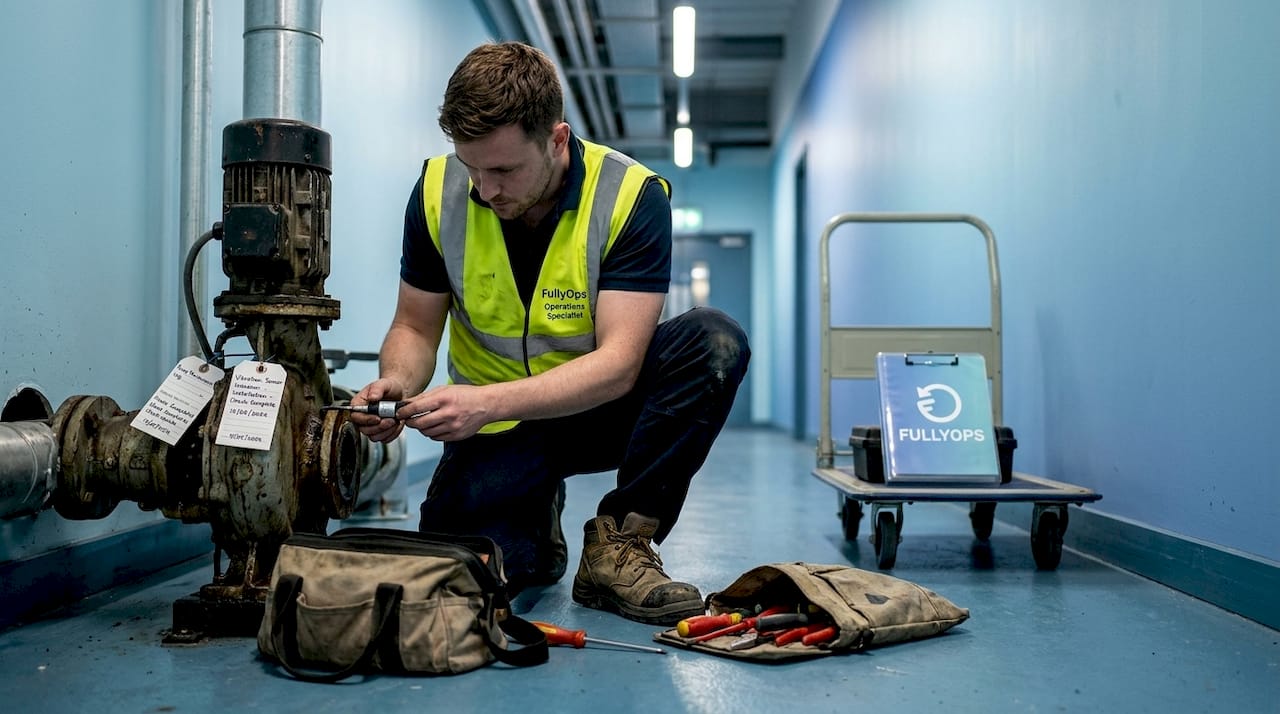
Edge computing has added another dimension by processing data locally on the asset or at a gateway device rather than transmitting everything to the cloud. This reduces latency, lowers bandwidth costs, and keeps the system operational even during network interruptions. Exploring automation for asset efficiency reveals how edge-enabled automation fits into broader maintenance programmes, particularly in HVAC and process industries.
Studies indicate that well-implemented PdM programmes can achieve up to 50% downtime reduction compared with purely reactive approaches, a figure that reflects both the elimination of catastrophic failures and the optimisation of planned maintenance windows.
Key benefits: reducing costs, downtime, and asset failure
The business case for predictive maintenance is now well-supported by benchmark data from large-scale industrial deployments. What was once speculative is increasingly measurable.
Benchmark results show 30 to 50% less downtime, 18 to 40% reduction in maintenance costs, 20 to 40% extension of asset service life, and an ROI of 250% with a payback period of 12 to 18 months for organisations that deploy PdM effectively. These figures are not outliers; they reflect outcomes across manufacturing, utilities, and process industries where continuous operation is financially critical.
“Organisations that implement predictive maintenance strategically report payback periods of 12 to 18 months and ROI figures approaching 250%, driven by the compound effect of fewer failures, lower parts consumption, and extended asset life.”
For operations managers, the benefits translate into five concrete operational improvements:
- Reduced unplanned downtime: Faults are caught in the early degradation phase, allowing work to be scheduled rather than scrambled.
- Lower maintenance spend: Resources are directed only where and when they are actually needed, eliminating unnecessary preventive replacements.
- Extended asset life: Intervening before secondary damage occurs preserves the structural integrity of components that would otherwise be destroyed by a cascade failure.
- Improved safety: Early fault detection reduces the probability of catastrophic failures that put personnel at risk.
- Better spare parts management: Advance notice of required interventions allows procurement teams to source parts at standard prices rather than emergency rates.
Understanding the full potential of reducing maintenance costs through condition-based strategies is an important step for any maintenance administrator building a business case for investment. Similarly, tracking efficiency trends in asset management helps contextualise where PdM fits within the broader evolution of industrial operations.
The financial argument is compelling, but the operational argument is arguably more important. A single unplanned failure on a critical production line can eliminate weeks of maintenance savings in a single event. PdM fundamentally changes the risk profile of the asset base.
Key challenges and expert tips for implementation
No technology programme is without obstacles, and PdM is no exception. Understanding the challenges before committing budget prevents costly missteps and sets realistic expectations with stakeholders.
PdM works best with domain experts, hybrid models, and edge computing, but faces persistent challenges around cybersecurity, integration with legacy systems, and the organisational discipline required to act on alerts consistently.
“Cybersecurity is an underappreciated risk in predictive maintenance programmes. Sensor networks and cloud analytics platforms extend the attack surface of industrial systems, requiring deliberate security architecture from the outset.”
The most common pitfalls in unsuccessful PdM rollouts include:
- Data silos: Sensor data that is not integrated with the CMMS (computerised maintenance management system) or ERP creates disconnected information that teams cannot act on efficiently.
- Legacy system incompatibility: Older control systems and PLCs were not designed to transmit data to modern analytics platforms, requiring middleware or protocol translation layers.
- Alert fatigue: Poorly calibrated models generate excessive false positives, causing technicians to dismiss alerts and ultimately defeating the purpose of the system.
- Insufficient domain expertise: Technology vendors may provide the platform, but understanding what the data means for a specific machine type requires engineering knowledge that must reside within the organisation.
- Lack of leadership commitment: PdM requires cultural change. Without clear ownership and executive support, programmes stall when initial implementation costs arise.
- Cybersecurity gaps: Connected sensor networks must be protected against both external intrusion and internal data integrity risks.
Exploring how optimising maintenance with cloud solutions address integration challenges gives a practical view of how modern platforms bridge legacy infrastructure with analytics capability.
Pro Tip: Invest in structured training that teaches maintenance technicians not just how to use the PdM platform but how to interpret what the data means in the context of specific machines. A technician who understands both the technology and the equipment is far more valuable than one who can only read a dashboard.
Application: steps to implement predictive maintenance
A phased approach to PdM implementation reduces financial risk and allows teams to build knowledge incrementally rather than committing to full-scale deployment before the organisation is ready.
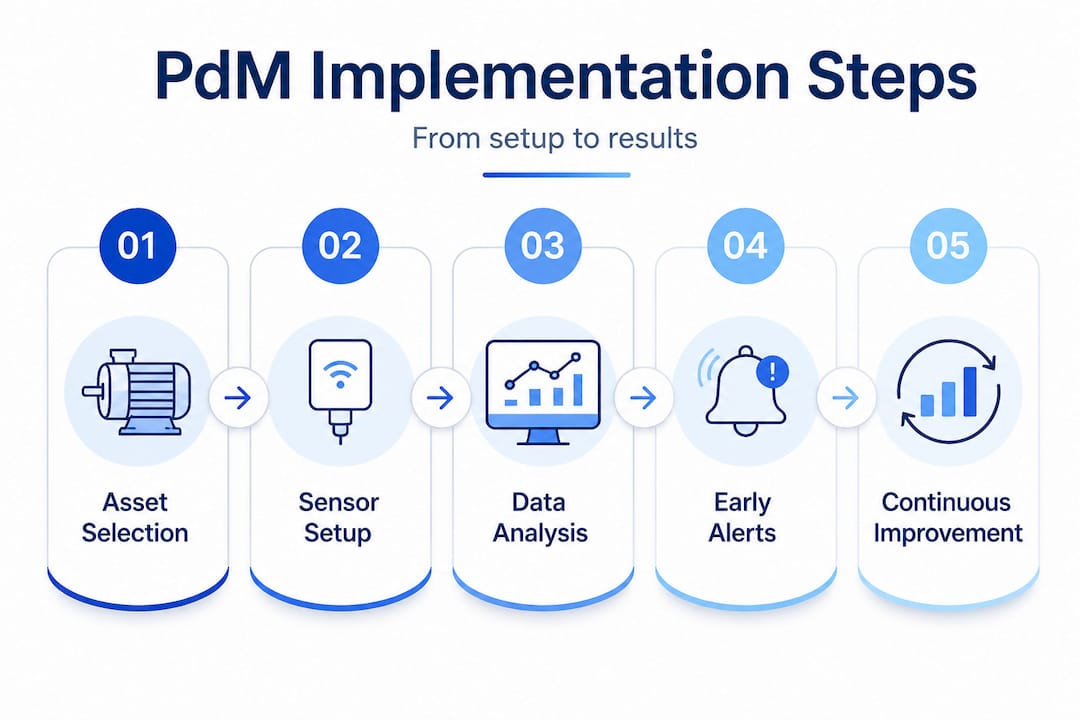
Successful PdM requires strong integration and expert interpretation at every stage of the rollout. The following steps provide a reliable framework:
- Assess asset criticality: Rank assets by failure consequence, production impact, and failure frequency to identify the highest-priority candidates for initial sensor deployment.
- Establish baseline data: Before fitting predictive sensors, gather historical maintenance records, failure modes, and current condition assessments to inform model training.
- Pilot on selected assets: Deploy sensors and analytics on a small number of high-impact machines. This generates early results, builds team familiarity, and validates the chosen technology before broader investment.
- Integrate with existing systems: Connect the PdM platform to your CMMS or work order system so that alerts automatically generate maintenance tasks without manual re-entry.
- Upskill the maintenance team: Provide structured training on data interpretation, alert response protocols, and the engineering context behind the monitored parameters.
- Review and refine models: After the pilot period, assess model accuracy, retrain algorithms with newly collected data, and adjust alert thresholds based on technician feedback.
- Phase the wider rollout: Expand sensor coverage progressively, prioritising the next tier of critical assets and applying lessons learned from the pilot.
Forte maintenance reporting reliability is essential throughout this process, because the data generated by PdM programmes is only actionable when reporting structures ensure the right people receive the right information at the right time.
Pro Tip: Start the pilot on your highest-impact, highest-failure-cost assets rather than the easiest ones to instrument. Early wins on critical equipment build executive confidence and secure continued investment for the full programme.
Beyond hype: why predictive maintenance succeeds or fails
After working through the technical foundations and implementation steps, it is worth pausing to address something that most PdM guides avoid: the majority of predictive maintenance programmes that underperform do so not because the technology failed but because the organisation was not ready for it.
Technology is a necessary condition for PdM. It is not a sufficient one. The real impact on asset management comes when AI-generated insights are received, trusted, and acted upon by people who understand both the data and the machines it describes. Organisations that treat PdM as a software installation project almost always struggle. Those that treat it as a discipline, requiring iterative learning, cultural adjustment, and sustained leadership attention, consistently achieve the benchmark results cited earlier.
The single most overlooked factor is staff buy-in at the technician level. Experienced engineers who have managed equipment for years can be sceptical of algorithmic alerts, particularly early in a programme when false positives are still being filtered out. Dismissing that scepticism is a mistake. Engaging technicians in the interpretation of results, and genuinely incorporating their feedback into model refinement, converts sceptics into advocates and significantly accelerates the programme’s maturity.
The organisations that sustain PdM success beyond the initial pilot phase share a common characteristic: they treat every alert, whether it leads to a confirmed fault or a false positive, as a learning event. They document what the data showed, what the technician found, and how the model should be adjusted. That iterative loop is what separates a PdM programme that plateaus from one that continuously improves.
As one industry practitioner put it plainly: “The biggest risk is treating PdM as plug-and-play; it is a discipline, not a product.” That framing should inform every budget conversation, vendor selection, and training plan associated with predictive maintenance adoption.
Put predictive maintenance into action with smart asset management tools
If this article has clarified what predictive maintenance is and why it matters, the practical next step is ensuring your asset management infrastructure can support it. FullyOps provides tools that connect work order management, operational analytics, and maintenance reporting within a single platform, making it considerably easier to act on the alerts that a PdM programme generates. Explore resources on alocação eficiente de recursos to see how structured asset workflows reduce the friction between data and action. Review the full landscape of Tipos de sistemas de gestão de ativos to understand where PdM integration fits within your existing infrastructure. For a forward-looking view of where the industry is heading, the 2026 asset efficiency trends analysis provides useful strategic context for operations teams planning their next investment cycle.
Perguntas mais frequentes
What types of equipment benefit most from predictive maintenance?
Assets with high failure costs or continuous operation requirements, such as pumps, turbines, compressors, and HVAC systems, see the greatest gains because sensor data from these assets directly prevents costly unplanned stoppages.
How long does it take to realise ROI from predictive maintenance?
Savings and measurable benefits typically emerge within 12 to 18 months after implementation, with payback typically within this window driven by reductions in emergency repair costs and unplanned downtime.
What is the biggest challenge in predictive maintenance adoption?
Integration with legacy control systems and maintaining cybersecurity across expanded sensor networks are the two chief obstacles, as both integration and cybersecurity challenges require deliberate planning before sensor deployment begins.
Do you need AI expertise to implement predictive maintenance?
Dedicated AI expertise is not always required in-house, but collaborating with both domain engineers and analytics specialists ensures reliable model outputs, as PdM success relies on domain expertise alongside advanced analytics capability.
How is predictive maintenance different from preventive maintenance?
Predictive maintenance triggers interventions based on real-time asset condition data, while preventive maintenance follows fixed time or usage intervals regardless of actual equipment health, a distinction clearly outlined in proactive, data-driven PdM approaches versus periodic scheduling.
Recomendado
- Passos essenciais de manutenção preventiva: maximize a fiabilidade
- Dicas essenciais de manutenção preventiva para operações fiáveis