

TL;DR:
- SaaS platforms improve field team productivity by enhancing scheduling, coordination, and first-time fix rates. They reduce travel time and costs through real-time updates, route optimization, and better resource allocation. Successful adoption depends on workflow alignment, staff training, and offline capabilities, not just technology features.
Field teams in industrial maintenance are often more capable than the systems supporting them. Even highly skilled technicians lose hours each week to poor scheduling, paper-based job sheets, and fragmented communication. SaaS field service management software changes this picture measurably, reducing travel time by 15 to 20% and lifting team productivity by 15 to 25%. This article covers how SaaS platforms improve scheduling, first-time fix rates, and team coordination, while also addressing the practical realities of adoption. If you manage field operations and want concrete results, not just promises, this guide is written for you.
Índice
- How SaaS transforms scheduling and resource allocation
- Boosting first-time fix rates and cutting repeat visits
- Centralised communication and real-time coordination
- Cost savings, benchmarks, and practical challenges
- Why simply ‘going digital’ isn’t enough: hard truths about SaaS adoption
- Take your field team performance to the next level
- Perguntas mais frequentes
Principais conclusões
| Ponto | Detalhes |
|---|---|
| Faster, smarter scheduling | SaaS tools reduce travel and admin time, so field teams spend more time on the job. |
| Higher first-time fix rates | Real-time data access helps teams fix issues immediately, reducing costly return visits. |
| Smoother communication | Centralisation streamlines updates and coordination, slashing email and phone chaos. |
| Proven cost savings | Companies adopting SaaS see up to 26% service cost reduction compared to manual operations. |
How SaaS transforms scheduling and resource allocation
Outdated scheduling methods create predictable problems. Job sheets get lost, technicians are double-booked, and dispatchers spend hours on the phone resolving clashes that a live calendar would prevent in seconds. The administrative burden alone can consume a significant portion of an operations manager’s working week, leaving little time for strategic decisions.
SaaS platforms address this directly by providing live scheduling dashboards, automated job assignments, and dynamic route optimisation. When a job is logged, the system can instantly identify the nearest available technician with the right skill set and assign the task without manual intervention. Updates are pushed in real time, so every team member sees the same picture at the same time.
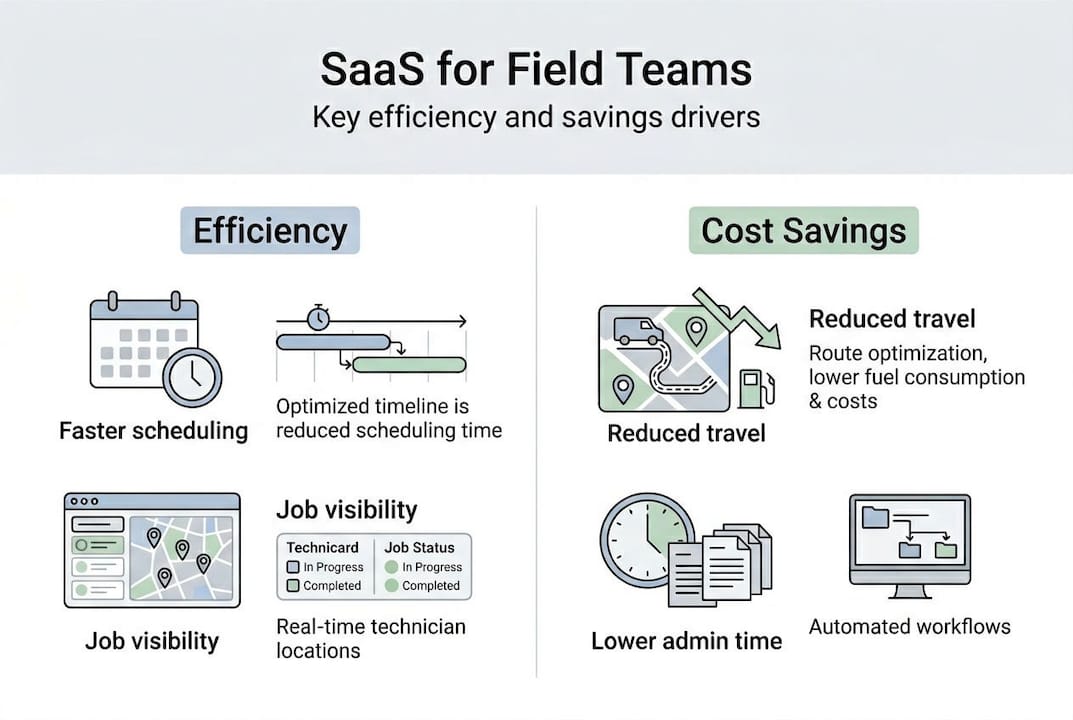
The numbers support this shift. Productivity gains of 15 to 25% are typical for field teams that adopt SaaS scheduling tools, alongside a 15 to 20% reduction in travel time. These are not marginal improvements. For a team of twenty technicians, a 20% reduction in travel time translates directly into more jobs completed per day and lower fuel costs.
| Métrica | Manual scheduling | SaaS scheduling |
|---|---|---|
| Average travel time per job | 45 minutes | 34 to 38 minutes |
| Job overlap incidents per week | 8 to 12 | 1 to 2 |
| Admin hours spent on scheduling | 10 to 15 hours | 3 to 5 hours |
| Technician utilisation rate | 60 to 65% | 78 to 85% |
For operations managers reviewing a field service scheduling guide, the table above illustrates where the gains are concentrated. Admin time drops sharply, and technician utilisation rises because the system fills gaps that manual processes miss.
Pro Tip: Enable automated route suggestions within your SaaS platform and review the first two weeks of data carefully. Teams often discover that 30% of their longest journeys were avoidable with smarter sequencing.
Key resource allocation features found in leading SaaS solutions include:
- Live availability calendars that update instantly when jobs are created, modified, or cancelled
- Skill-based auto-assignment that matches technician competencies to job requirements
- Dynamic route optimisation that accounts for traffic, priority, and proximity
- Capacity forecasting that flags resource shortfalls before they become operational problems
- Mobile notifications that keep technicians informed of schedule changes without dispatcher calls
To optimise field service management effectively, these features need to work together rather than in isolation.
Boosting first-time fix rates and cutting repeat visits
Better allocation saves time, but the next leap in efficiency is ensuring field teams achieve the fix on the first visit. First-time fix rate (the percentage of jobs resolved without a return visit) is one of the most important key performance indicators in field operations. A low rate signals wasted labour, dissatisfied clients, and rising costs.
SaaS platforms improve this metric by giving technicians the information they need before they arrive on site. Remote diagnostics allow engineers to assess fault conditions in advance. Instant access to equipment manuals, service histories, and parts catalogues means technicians arrive prepared rather than reactive. Inventory visibility tells them whether the required part is in their van or needs to be sourced before travel.

Real-time data access reduces return visits by 15 to 20% and boosts first-time fix rates across field operations. The gap between top and bottom performers is striking:
| Performance tier | Average first-time fix rate |
|---|---|
| Top SaaS adopters | 88% |
| Industry average | 74% |
| Bottom quartile | 60% |
“Industry benchmarks show top field service teams achieve 88% first-time fix rates versus 60% for bottom performers, a gap that directly reflects the quality of information available to technicians at the point of service.”
Understanding the advantages of field service software becomes clearer when you trace how a technician actually uses these tools on a job. Here is the typical sequence:
- Receive the work order on a mobile device with full asset history, fault codes, and previous interventions attached
- Review remote diagnostics before departure to confirm the likely fault and required parts
- Check parts availability in real time against van stock and warehouse inventory
- Access equipment manuals and wiring diagrams directly within the platform on site
- Log the repair with photos, notes, and time stamps as the work progresses
- Close the work order digitally, triggering automatic client notification and invoice generation
Pro Tip: Platforms that support photo uploads and structured work order documentation significantly reduce miscommunication between field and office teams. Require technicians to attach at least one photo per closed job as standard practice.
Centralised communication and real-time coordination
Once field teams are equipped for rapid fixes, efficient communication is the next lever for operational efficiency. Before SaaS, information lived in silos. One technician knew the site layout, another held the client contact details, and the dispatcher had the schedule on a whiteboard. Pulling this together for a single job required multiple phone calls and often resulted in errors.
Centralised, cloud-based communication platforms eliminate these silos by making all relevant information available to every authorised user in real time. Status updates, shift changes, job escalations, and client notes are visible across the team without anyone needing to chase them down.
Centralised communication cuts coordination time by 25 to 30% and reduces admin work by 20%. For a team handling fifty jobs per day, this represents a substantial recovery of productive time.
“The shift from fragmented communication to a single platform does not just save time. It removes the category of errors that occur when people are working from different versions of the same information.”
Real-time coordination improvements that SaaS platforms deliver include:
- Instant job status updates visible to dispatchers, managers, and clients simultaneously
- Automated shift handover notes that eliminate verbal briefings and the errors they introduce
- Escalation alerts that notify supervisors when a job exceeds its expected duration
- Client communication triggers that send automated updates at key job milestones
- Integrated reporting that compiles daily performance data without manual data entry
For operations managers exploring team management strategies, centralised communication is often the change that delivers the fastest visible improvement in day-to-day operations.
Cost savings, benchmarks, and practical challenges
After understanding communication improvements, it is time to ground these gains with numbers and practical realities. The business case for SaaS in field operations is well supported by current research. Up to 26% in service cost savings is achievable for teams that scale knowledge effectively across their workforce.
| Area | Without SaaS | With SaaS |
|---|---|---|
| Service cost per job | Baseline | Up to 26% lower |
| Admin hours per week | 15 to 20 hours | 8 to 10 hours |
| Team productivity | 60 to 65% utilisation | 78 to 85% utilisation |
| Return visit rate | 30 to 40% | 12 to 20% |
One practical concern that operations managers raise frequently is connectivity. Many industrial sites, particularly in manufacturing, utilities, and remote infrastructure, have unreliable internet access. SaaS platforms often support offline modes with automatic sync, meaning technicians can access work orders, log repairs, and update job status even without a live connection. Data synchronises automatically when connectivity is restored.
This is an important capability to verify before selecting a platform. Not all SaaS solutions handle offline access equally well, and the difference matters significantly in practice.
Best practices for a successful SaaS rollout include:
- Pilot with a small team first before organisation-wide deployment to identify workflow gaps early
- Involve technicians in platform selection so the interface reflects how work actually happens on site
- Map existing workflows before configuring the system, not after
- Schedule structured training rather than relying on self-directed learning
- Set clear KPIs before go-live so you can measure improvement objectively
Pro Tip: When evaluating SaaS vendors, ask specifically about offline capability and integration with your existing ERP or asset management systems. These two factors determine whether the platform will work in your environment, not just in a demonstration.
Reviewing field service management trends for 2026 shows that offline resilience and API integration are now baseline expectations, not premium features.
Why simply ‘going digital’ isn’t enough: hard truths about SaaS adoption
Having reviewed the tangible benefits and benchmarks, a candid observation is warranted. Many operations teams adopt SaaS, see modest results, and conclude that the technology was oversold. In most cases, the platform was not the problem.
SaaS adoption is a culture shift, not a software purchase. The teams that achieve the 26% cost reductions and 88% first-time fix rates are not simply using better tools. They have reorganised their workflows around those tools, trained their people properly, and involved technicians in the selection process from the start. Teams that skip these steps often end up with a digital version of their old paper process, which is neither faster nor cheaper.
The most common mistake is evaluating platforms by their feature lists rather than by how well they fit actual field workflows. A platform with fewer features but a better match to your team’s daily reality will outperform a feature-rich system that nobody uses correctly.
Investing in increasing field service profitability requires treating change management as seriously as the technology itself. The organisations that do this consistently are the ones that appear in the top quartile of every benchmark study.
Take your field team performance to the next level
The evidence is clear: SaaS platforms deliver measurable gains in scheduling efficiency, first-time fix rates, coordination, and cost control for industrial field teams. FullyOps is built specifically for operations managers who need these results without the complexity of enterprise software. From work order management and resource allocation to inventory tracking and performance analytics, the platform covers the full operational picture.
Explore the tutorial de atribuição de recursos to see how FullyOps handles deployment in practice, or review the range of asset management systems suited to industrial maintenance. For teams focused on long-term operational reliability, the gestão do ciclo de vida dos activos capabilities provide a structured approach to maximising asset value. Contact the FullyOps team to arrange a tailored demonstration for your operation.
Perguntas mais frequentes
How does SaaS specifically reduce travel time for field teams?
SaaS platforms apply optimised route planning and real-time schedule updates that eliminate unnecessary journeys, with travel time reductions of 15 to 20% reported consistently across adopting teams.
Can SaaS systems work when field teams have limited internet connection?
Most SaaS solutions include offline modes with syncing, allowing technicians to access work orders and log updates in low-connectivity environments, with data synchronising automatically once a connection is restored.
What measurable gains can operations managers expect from SaaS adoption?
Typical results include a 15 to 25% rise in productivity, a 15 to 20% fall in return visits, and up to 26% service cost savings for teams that scale knowledge effectively across their workforce.
How fast can field teams see results from implementing SaaS?
Most teams observe tangible improvements in scheduling accuracy, coordination speed, and first-time fix rates within a few weeks of completing a structured rollout and training programme.
What are the biggest hurdles in switching to SaaS for field teams?
The main challenges are staff resistance to new tools, verifying offline capability for remote industrial sites, and ensuring workflows are properly mapped and adapted before the platform goes live.
Recomendado
- Gestão de serviços no terreno: Otimizar e aumentar a eficiência - FullyOps
- 4 dicas para aumentar a rentabilidade dos serviços no terreno - FullyOps
- 6 Principais Vantagens do Software de Serviço no Terreno para a Eficiência
- Top AI tools for plumbers: boost efficiency and revenue in 2026