

TL;DR:
- Industrial IoT connects sensors and assets with software to enable real-time data analysis in industrial settings. Its architecture prioritizes local edge processing for time-critical tasks while leveraging cloud analysis for long-term insights. Successful deployment depends on unified IT and OT governance, focusing on data quality, safety standards, and organizational collaboration.
Industrial IoT (IIoT) is defined as a network of interconnected sensors, instruments, and industrial assets integrated with software to enable real-time data collection and analysis across industrial operations. The standard industry term is the Industrial Internet of Things, commonly abbreviated as IIoT. Analysts project IIoT will contribute $15 trillion to global GDP by 2030. That figure reflects not a distant possibility but a structural shift already under way in manufacturing, energy, logistics, and utilities. For operations managers and asset managers, understanding what industrial IoT is and how it works is the first step toward capturing those gains.
What is industrial IoT and how does it work?
IIoT architecture operates across four distinct layers, each serving a specific function. The device layer contains sensors, actuators, and machines that capture physical data such as temperature, vibration, pressure, and flow rates. The network layer transmits that data using communication protocols including MQTT, OPC-UA, and 5G, routing it either to cloud platforms or to local edge nodes. The service layer applies analytics, machine learning models, and rules engines to interpret the data. The application layer presents results through dashboards, alerts, and work order systems that operations teams act upon.
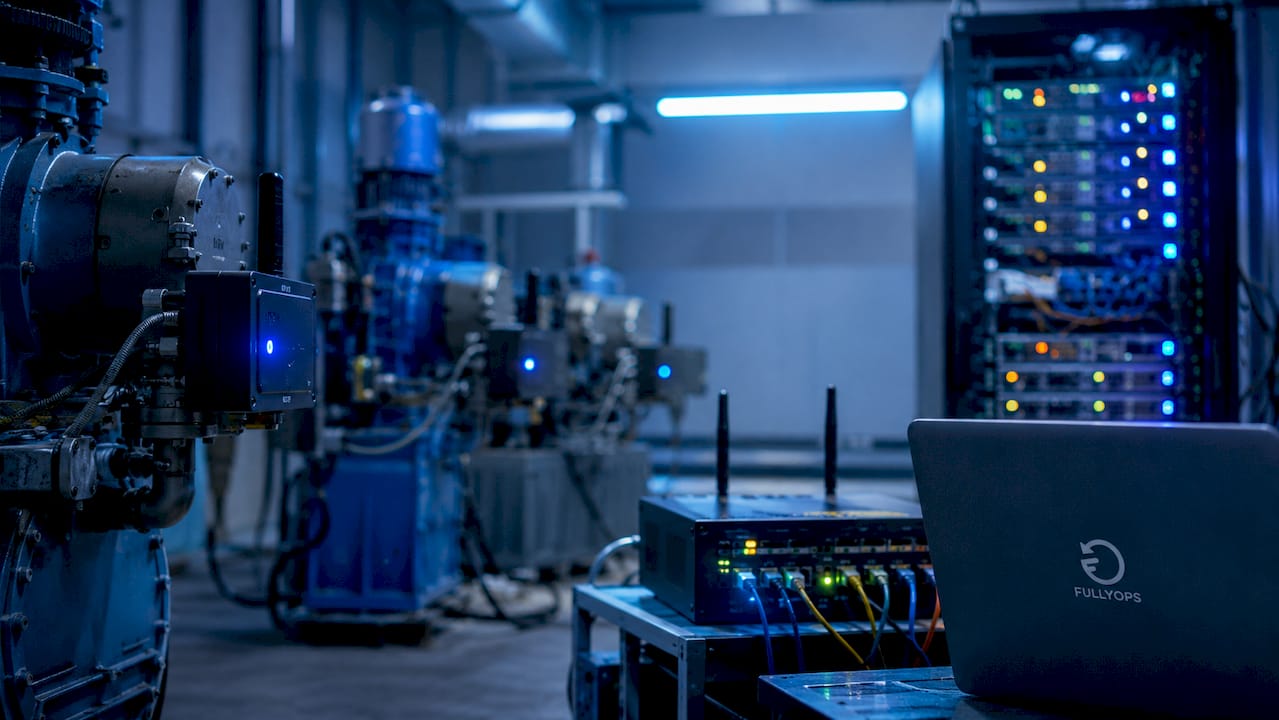
The most consequential architectural decision in IIoT is where data processing happens. Edge-first analytics process data locally on devices rather than sending everything to a central cloud. This reduces latency to milliseconds, cuts bandwidth costs, and keeps time-critical industrial control loops intact. A simple device-to-cloud model cannot meet the response requirements of a CNC machine or a high-speed packaging line.
Supporting technologies include cybersecurity frameworks such as IEC 62443, which governs industrial network security, and cloud platforms that store historical data for trend analysis. Edge computing and cloud computing are not competing approaches. They work together: edge handles real-time control, cloud handles long-term analytics and reporting.
Pro Tip: When selecting an IIoT architecture, map your latency requirements first. If any process requires a sub-second response, that workload belongs at the edge, not in the cloud.
| Layer | Function | Example technologies |
|---|---|---|
| Device | Captures physical data | Sensors, PLCs, actuators |
| Network | Transmits data | MQTT, OPC-UA, 5G, Ethernet |
| Service | Analyses and interprets data | ML models, rules engines |
| Application | Presents insights to users | Dashboards, work order systems |
How does IIoT differ from consumer IoT and traditional OT?
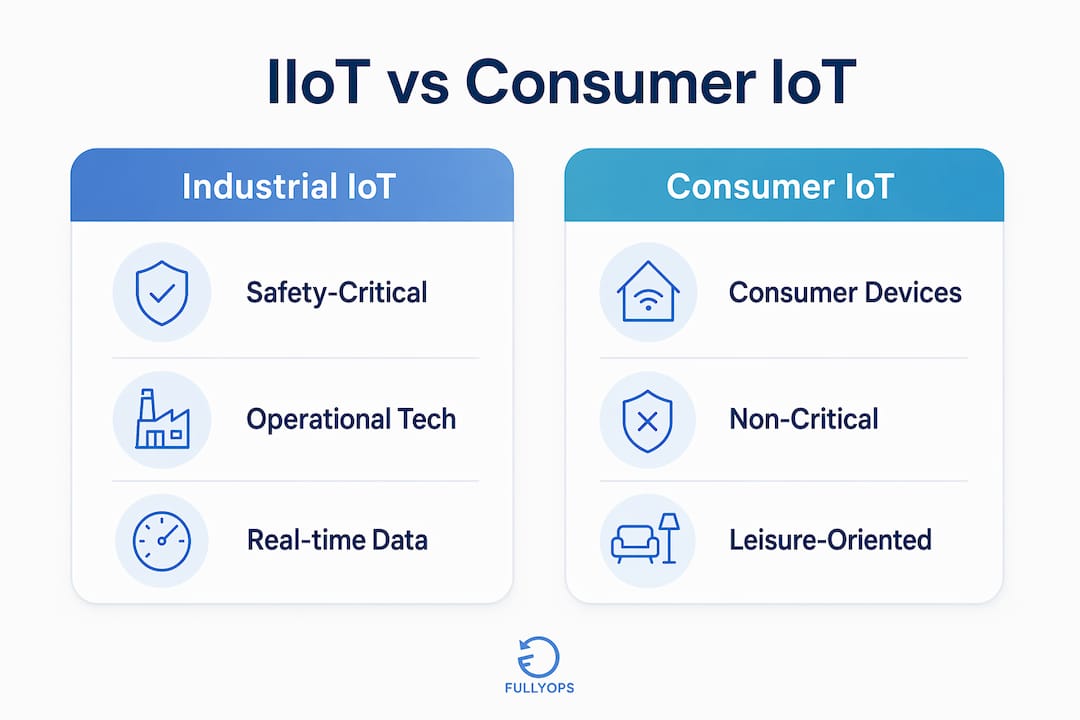
The distinction between IIoT and consumer IoT is not merely technical. It is operational and safety-critical. IIoT systems operate in high-reliability industrial environments where failures or latency can be life-threatening. A smart thermostat failing causes discomfort. A sensor failure on a gas pipeline or a steel press can cause injury, environmental damage, or production loss worth millions.
Traditional operational technology (OT), including Distributed Control Systems (DCS) and SCADA systems, managed industrial processes for decades in isolation. IIoT evolved from DCS, transforming those isolated automation islands into flexible, data-driven systems with enterprise-wide visibility. The shift from closed OT to connected IIoT creates both opportunity and risk.
The key differences between IIoT and its predecessors are:
- Reliability requirements. IIoT systems must maintain uptime standards that consumer IoT devices never face, often targeting 99.99% availability.
- Safety standards. IIoT deployments comply with standards such as IEC 62443 and ISO 13849, which govern functional safety and cybersecurity in industrial environments.
- IT and OT convergence. IIoT bridges operational technology with enterprise IT, creating interoperability challenges that consumer IoT never encounters.
- Data context. Industrial data carries physical meaning tied to process conditions, asset state, and safety thresholds. Consumer IoT data is typically behavioural and preference-driven.
- Lifecycle expectations. Industrial assets operate for 15–30 years. IIoT hardware and software must integrate with machinery that predates modern connectivity by decades.
What are the key benefits and applications of IIoT in industry?
The primary benefit of IIoT is reducing unplanned downtime through predictive maintenance. Sensors monitor asset health continuously, detecting early signs of bearing wear, motor overheating, or hydraulic pressure loss before failure occurs. Maintenance teams receive alerts and can schedule interventions during planned windows rather than reacting to breakdowns. The result is lower repair costs, longer asset life, and fewer production stoppages.
IIoT deployments improve operational efficiency across four primary application areas:
- Predictive maintenance. Continuous asset health monitoring replaces fixed-interval servicing, reducing both over-maintenance and unexpected failures. For industrial inspection equipment, sensor-driven monitoring extends component lifespan by identifying wear patterns before they cause damage.
- Asset tracking and inventory management. Real-time location and condition data for tools, parts, and mobile equipment reduces loss, improves utilisation, and feeds accurate inventory records directly into maintenance workflows.
- Energy management. IIoT sensors track energy consumption at machine level, identifying inefficiencies and enabling automated load-shedding during peak tariff periods. HVAC systems in industrial facilities, for example, use IoT-driven energy controls to cut consumption without compromising process conditions.
- Automated process control. Closed-loop control systems use sensor feedback to adjust process parameters in real time, maintaining product quality and reducing waste without manual intervention.
The competitive advantage of IIoT lies more in enhancing human decision-making with accurate, real-time data than in fully automating industrial processes. Automation handles repetitive adjustments. Humans handle judgement calls, safety overrides, and strategic decisions. IIoT makes both more effective by ensuring neither operates on incomplete information.
What are the main challenges in implementing IIoT successfully?
Most IIoT deployment failures stem from organisational problems, not technology failures. Organisational siloing between IT and OT teams creates conflicting priorities, incompatible data standards, and governance gaps that prevent IIoT data from reaching the people who need it. IT teams prioritise cybersecurity and data governance. OT teams prioritise uptime and process stability. Without a unified governance structure, these priorities collide rather than complement each other.
The second major challenge is data overload. Capturing excessive data without context leads to analysis paralysis. A factory floor generating terabytes of sensor data daily produces no value if analysts cannot distinguish signal from noise. Useful insights depend on filtering data against operational context: asset type, process stage, maintenance history, and safety thresholds.
The third challenge is legacy integration. Integrating legacy machine data with modern analytics platforms requires protocol translation, data normalisation, and often physical retrofitting of older machines with new sensors. Many industrial assets lack native connectivity and require edge gateways to bridge the gap.
Practical guidance for overcoming these barriers:
- Establish a joint IT/OT governance team before selecting any technology. Define data ownership, access rights, and escalation paths from the outset.
- Start with one high-value use case. Predictive maintenance on a critical asset delivers measurable ROI and builds internal confidence before wider rollout.
- Prioritise data quality over data volume. Define which variables matter for each asset and collect only those, with sufficient context to make them interpretable.
- Use edge-first analytics for any process requiring sub-second response. Reserve cloud analytics for trend analysis, reporting, and cross-site benchmarking.
- Invest in IoT asset management platforms that connect sensor data directly to work order workflows, closing the loop between detection and action.
Pro Tip: Before deploying sensors across an entire facility, run a 90-day pilot on three to five assets. Measure alert accuracy, false positive rates, and technician response times. Use those results to calibrate thresholds before scaling.
Key takeaways
Industrial IoT delivers its greatest value when edge-first analytics, unified IT/OT governance, and context-aware data management work together to support human decision-making rather than replace it.
| Point | Details |
|---|---|
| IIoT definition | A network of industrial sensors and assets integrated with software for real-time data collection and analysis. |
| Architecture matters | Edge-first processing reduces latency for time-critical control; cloud handles long-term analytics. |
| Safety-critical distinction | IIoT operates under reliability and safety standards that consumer IoT devices never face. |
| Top applications | Predictive maintenance, asset tracking, energy management, and automated process control deliver the clearest ROI. |
| Biggest implementation risk | Organisational silos between IT and OT teams cause more IIoT failures than sensor or technology issues. |
Why data quality is the real IIoT differentiator
Having worked closely with industrial operations teams across manufacturing and field services, I have seen the same pattern repeat. Organisations invest heavily in sensors and connectivity, then struggle to act on the data they collect. The technology works. The data governance does not.
The teams that get IIoT right do one thing differently: they define what a good outcome looks like before they install a single sensor. They ask which assets cause the most downtime, which failures are most costly, and which process variables actually predict those failures. That discipline produces a focused data model rather than a sprawling data lake.
The other underrated factor is the human layer. IIoT does not replace experienced maintenance engineers. It gives them better information faster. The most effective implementations I have seen treat IIoT as a decision-support system, not an automation replacement. Engineers still make the call. They just make it with real-time vibration data, thermal imaging trends, and maintenance history in front of them rather than a gut feeling and a paper log.
The organisations that will gain the most from IIoT in the next five years are not those with the most sensors. They are those with the clearest operational questions and the governance structures to act on the answers.
— Pedro
How Fullyops connects IIoT data to operational action
Collecting IIoT data is only half the equation. The other half is acting on it through structured maintenance workflows. Fullyops is a field service and asset management platform built for industrial teams that need to close the loop between sensor alerts and technician action. The platform supports digital work orders, real-time intervention tracking, and asset lifecycle management in a single interface. For operations managers building an IIoT-enabled maintenance programme, the resource allocation tutorial on the Fullyops site provides a practical framework for aligning sensor-driven insights with workforce planning and asset prioritisation.
FAQ
What is the industrial IoT definition?
Industrial IoT (IIoT) is a network of interconnected sensors, instruments, and industrial assets integrated with software to enable real-time data collection, analysis, and operational control. It is the industrial application of Internet of Things technology, built to meet safety-critical and high-reliability requirements.
How does IIoT differ from consumer IoT?
IIoT operates in safety-critical environments where failures can be life-threatening, and it must comply with industrial standards such as IEC 62443. Consumer IoT focuses on user convenience and does not face the same reliability, safety, or lifecycle requirements.
What are the main benefits of industrial IoT in manufacturing?
The primary benefits are reduced unplanned downtime through predictive maintenance, improved asset utilisation through real-time tracking, lower energy costs through automated controls, and better decision-making through context-aware operational data.
What is the biggest challenge in deploying IIoT?
Organisational siloing between IT and OT teams is the leading cause of IIoT deployment failure, ahead of sensor or connectivity issues. Unified governance and shared data standards are the most effective countermeasures.
What is edge computing’s role in IIoT?
Edge computing processes data locally on or near industrial devices, reducing latency to milliseconds and enabling real-time control. It is the preferred architecture for any IIoT application where a delayed response could affect process quality or safety.