

TL;DR:
- Data integration unifies data from multiple sources into a single, reliable view, enabling more accurate decision-making. It reduces manual effort, improves data quality, and supports AI by providing a clean, consistent foundation. Overcoming cultural resistance and establishing ongoing governance are essential for long-term success.
Data integration is the process of combining data from multiple, separate sources into a single, unified view that teams can trust and act on. For business leaders, understanding why data integration is important is not an academic exercise. It is the difference between making decisions on reliable information and making them on guesswork dressed up as reporting. Fragmented systems, isolated spreadsheets, and disconnected databases are the norm in most organisations, and they carry a real cost in time, accuracy, and missed opportunity. This guide covers the operational, analytical, and strategic case for integration, including the challenges you will face and the practices that make it work.
Why is data integration important for operational efficiency?
Data integration directly reduces the manual effort that consumes your team’s time. Automating manual data handling saves teams dozens of hours per month. Those hours are not trivial. They represent analysts re-keying figures, managers waiting for reports, and technicians reconciling conflicting records before they can act.
The operational benefits extend beyond time savings. When data flows automatically between systems, errors caused by manual entry drop significantly. Standardisation across sources means that a work order in one system matches the corresponding asset record in another, without anyone having to check. This is particularly relevant for organisations managing field operations, where delays caused by data mismatches translate directly into downtime.
Integrated data environments allow departments to work more effectively by replacing isolated spreadsheets with governed data layers. The result is faster reporting, fewer correction cycles, and greater confidence in the numbers being used to run the business.
- Time recovery: Automation removes repetitive reconciliation tasks from daily workflows.
- Error reduction: Standardised data formats eliminate discrepancies between systems.
- Faster reporting: Integrated pipelines deliver reports in near real time rather than days.
- Operational continuity: Field teams act on accurate asset data without manual cross-checks.
Pro Tip: Before selecting an integration tool, map every manual data transfer your team performs in a week. The total time spent is almost always higher than leaders expect, and that figure becomes your business case.
How does data integration improve decision-making and data quality?
Unified data creates a single source of truth. Integrated data enables cross-team collaboration by giving every department access to the same validated figures, which eliminates arguments over conflicting numbers and improves transparency across the organisation.

The quality of decisions is directly tied to the quality of data behind them. When finance, operations, and maintenance each pull from separate, unconnected systems, they will inevitably produce different answers to the same question. Leadership then spends time arbitrating between reports rather than acting on them. Integration removes that friction entirely.
Data governance also improves when integration is in place. A unified data layer enforces consistent definitions across the organisation. Customer records, asset identifiers, and cost codes mean the same thing in every system. That consistency is the foundation of reliable analytics.
The practical outcomes for business leaders include:
- Confident reporting: Executives receive one version of performance data, not three competing ones.
- Faster cycle times: Decisions that previously required manual data gathering happen in hours, not days.
- Audit readiness: Governed, integrated data is easier to trace and validate during compliance reviews.
- Reduced rework: Teams stop correcting reports and start using them.
What complexities and cultural challenges affect data integration?
The technical side of data integration is well understood. The cultural side is where most projects stall. The biggest bottleneck in integration projects is cultural resistance, driven by teams that want to maintain control over their own curated departmental data. Shifting the mindset from “data as a department asset” to “data as an enterprise asset” is the single most important success factor.
This resistance is not irrational. Teams build their own spreadsheets and local databases because they need reliable data and the central systems have historically let them down. Acknowledging that history, and demonstrating that integrated data will be more reliable, not less, is how leaders build buy-in.
On the technical side, harmonising data formats such as date conventions, currency standards, and customer definitions is critical. Failure to configure the transformation layer correctly produces what practitioners call “dirty data,” which corrupts analytics and erodes trust in the integrated system.
A structured approach to overcoming these challenges involves four steps:
- Audit existing data sources before writing a single line of integration logic. Understand what each system holds, how it is structured, and who owns it.
- Engage data owners early. Involve department leads in the design process so they see integration as something built with them, not imposed on them.
- Define a shared data dictionary. Agree on standard definitions for key entities, dates, currencies, and identifiers before connecting systems.
- Test the transformation layer thoroughly. Run parallel outputs from the old and new systems until results match consistently.
Pro Tip: Assign a named data steward in each department during an integration project. That person becomes the internal advocate for the new system and the first point of contact when data quality issues arise.
How does data integration enable AI and advanced analytics?
Data integration is a prerequisite for any serious AI or machine learning initiative. Integrated datasets drastically reduce missing data risks and support complex AI applications such as real-time predictive churn modelling. Without a clean, unified data foundation, AI models train on incomplete or contradictory inputs and produce unreliable outputs.
The consequences of skipping integration before deploying AI are costly. Feeding AI fragmented or duplicate data leads to expensive fixes after deployment. Remediating a model that was trained on poor data is significantly harder than building the integration layer correctly from the start.
Top-performing organisations build their AI advantage by investing first in strong integrated data foundations. Better AI results come from clean, unified data rather than from more sophisticated algorithms. That is a counter-intuitive finding for leaders who assume AI performance is primarily a modelling problem.
The AI use cases that depend on integrated data include:
- Predictive maintenance: Models that forecast equipment failure require unified asset history, sensor data, and maintenance records.
- Demand forecasting: Accurate predictions need integrated sales, inventory, and supply chain data.
- Customer analytics: Personalisation models require a complete, deduplicated customer record across all touchpoints.
- Operational risk scoring: Risk models need financial, operational, and compliance data in one place to score accurately.
The role of analytics in operations is growing rapidly, and integration is what makes that analytics layer trustworthy.
What are the best practices for implementing data integration?
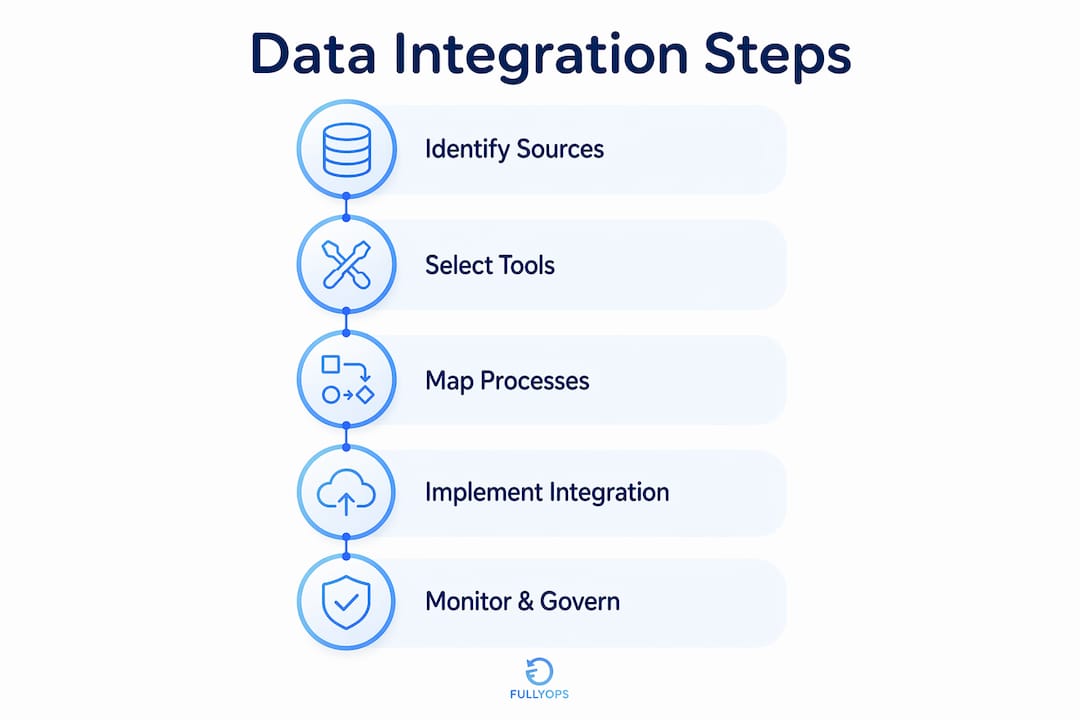
Effective data integration starts with strategy, not technology. Selecting a tool before defining what you need to connect, and why, produces integrations that solve the wrong problems. The planning phase should produce a clear map of data sources, data consumers, and the business decisions that depend on each data flow.
Choosing the right integration approach
Three primary approaches dominate modern data integration practice. Each suits different use cases and organisational maturity levels.
| Approach | How it works | Best suited for |
|---|---|---|
| ETL (Extract, Transform, Load) | Data is extracted, transformed to a standard format, then loaded into a target system | Batch reporting, data warehousing, compliance |
| ELT (Extract, Load, Transform) | Data is loaded raw into a target system, then transformed on demand | Cloud environments, large-scale analytics |
| Streaming integration | Data moves continuously between systems in near real time | Operational dashboards, live monitoring, IoT |
Sustaining data quality over time
Integration is not a one-time project. As organisations grow, new data sources appear and existing ones change. An integration architecture that cannot accommodate new sources without rebuilding from scratch will become a bottleneck. Building for extensibility from the start is a data integration best practice that pays dividends over years, not months.
Ongoing governance is equally important. Automated data quality checks, regular audits of transformation logic, and clear ownership of each data pipeline keep the integrated environment reliable. Without these controls, data quality degrades quietly until a decision is made on figures that no longer reflect reality.
Integrations that drive efficiency in asset-heavy industries follow this pattern: connect, govern, monitor, and extend. Organisations that treat integration as a living capability rather than a completed project consistently outperform those that do not.
Key takeaways
Data integration is a foundational operational capability that reduces manual effort, improves data quality, and enables reliable AI, making it a strategic priority for every business leader in 2026.
| Point | Details |
|---|---|
| Integration reduces manual work | Automating data handling saves teams dozens of hours per month and cuts entry errors. |
| Unified data improves decisions | A single source of truth eliminates conflicting reports and speeds up decision cycles. |
| Cultural resistance is the main barrier | Shifting data ownership from departments to the enterprise is the hardest part of integration. |
| Clean data is an AI prerequisite | AI models trained on fragmented data produce unreliable outputs and costly post-launch fixes. |
| Integration must be maintained | New data sources and changing systems require ongoing governance, not a one-time build. |
What I have learned from watching integration projects succeed and fail
Pedro’s perspective on data integration is shaped by one consistent observation: organisations that treat integration as an IT project almost always underdeliver. The ones that treat it as a business capability, owned by leadership and governed across departments, are the ones that see lasting results.
The misconception I encounter most often is that better tools will solve a data problem that is fundamentally about ownership and process. A well-configured ETL pipeline cannot fix a culture where each department guards its own spreadsheets. The technology is the easy part. The organisational alignment is where the real work happens.
What I would tell any business leader starting this process: define the decision you want to make better before you connect a single system. Integration without a clear use case produces a technically impressive data warehouse that nobody uses. Start with the question, then build the pipeline that answers it.
The trend I am watching most closely in 2026 is the convergence of integration and AI governance. As organisations deploy more AI models, the quality of their integrated data layer will determine the quality of their AI outputs. Leaders who invest in operational efficiency through integration now are building the foundation for AI capabilities that will matter enormously in the next three to five years.
— Pedro
How Fullyops supports data integration for operational teams
Fullyops is built for organisations that need their operational data to work together, not sit in separate systems. The platform connects work order management, asset tracking, maintenance records, and operational analytics into a single environment, so field teams and managers always work from the same information. For leaders focused on reducing maintenance costs and improving resource allocation, Fullyops provides the integrated data layer that makes those improvements measurable and repeatable. The platform also connects with external systems, including ERP solutions, so your operational data does not live in isolation. If you are building the case for integration in your organisation, the Fullyops feature set gives you a practical starting point.
FAQ
What is data integration in simple terms?
Data integration is the process of pulling data from multiple separate systems into one unified view. It allows teams to work from a single, consistent set of information rather than reconciling conflicting reports from different sources.
What are the main benefits of data integration?
The primary benefits include reduced manual data handling, improved decision-making through a single source of truth, better data quality, and the ability to support AI and advanced analytics reliably.
Why does data integration matter for AI initiatives?
AI models require clean, complete, and unified data to produce reliable outputs. Fragmented or duplicate data fed into AI systems leads to poor model performance and costly post-deployment fixes.
What is the biggest challenge in data integration projects?
Cultural resistance is the most common barrier. Teams accustomed to managing their own data are reluctant to share it, and overcoming that resistance requires clear leadership, early stakeholder involvement, and demonstrated reliability of the integrated system.
What is the difference between ETL and ELT?
ETL transforms data before loading it into the target system, making it well suited for structured reporting and compliance. ELT loads raw data first and transforms it on demand, which works better in cloud environments handling large-scale analytics.
Recommended
- Role of Data in Asset Lifecycle: Driving Efficiency and Cost Savings
- Role of data in equipment reliability: 2026 guide
- Operations Analytics – FullyOps
- How integrations drive efficiency in asset management 2026