

Maintenance activities typically comprise 20-50% of an organization’s total operating budget, making careful planning essential to control costs. Unplanned equipment failures inflate expenses and disrupt production schedules, leaving operations managers scrambling for reactive solutions. A structured maintenance planning process shifts your approach from reactive firefighting to proactive management, dramatically improving uptime while controlling costs through maintenance schedules for reliable assets.
Table of Contents
- Introduction To Maintenance Planning
- Prerequisites: What You Need Before Starting Maintenance Planning
- Maintenance Planning Step 1: Define Maintenance Goals
- Step 2: Asset Inventory And Risk Assessment
- Step 3: Plan The Type Of Maintenance Needed
- Step 4 & 5: Plan The Needed Resources And Calculate Budget For Maintenance Tasks
- Step 6: Develop Standard Operating Procedures (sops)
- Step 7: Implement And Monitor Maintenance Plan
- Common Mistakes And Troubleshooting In Maintenance Planning
- Expected Outcomes And Benefits Of Effective Maintenance Planning
- Safety Considerations In Maintenance Planning
- Explore Fullyops Solutions To Streamline Your Maintenance Planning
- Frequently Asked Questions
Key Takeaways
| Point | Details |
|---|---|
| Maintenance planning reduces downtime and controls costs | Structured planning shifts resources from reactive fixes to prevention, reducing unplanned downtime by up to 30%. |
| Clear goals and asset risk assessment are foundational | SMART goals and detailed asset inventories guide prioritization and resource allocation effectively. |
| Resource allocation and budgeting ensure plan reliability | Proper staffing, spare parts inventory, and contingency budgets prevent execution gaps. |
| Standard operating procedures improve safety and consistency | Documented SOPs with lockout/tagout protocols standardize work and reduce accidents. |
| Continuous monitoring enables ongoing maintenance optimization | Tracking KPIs like MTBF and planned maintenance percentage drives continuous improvement. |
Introduction to Maintenance Planning
Maintenance activities typically comprise 20-50% of an organization’s total operating budget, representing one of the largest controllable expenses in manufacturing. When you rely on reactive maintenance, every equipment failure triggers emergency repairs that cost three to nine times more than planned interventions. Unplanned downtime doesn’t just halt production; it cascades through your entire operation, causing missed deadlines, rushed overtime, and expedited parts shipments that drain budgets.
Proactive maintenance planning transforms this costly cycle. By shifting resources toward prevention and scheduled interventions, you gain control over when maintenance occurs rather than letting equipment dictate your schedule. This approach aligns maintenance activities with production goals, minimizes disruptions, and provides predictable budget requirements. Your team moves from crisis management to strategic asset stewardship.
The benefits extend beyond cost control:
- Improved equipment reliability and extended asset lifespan
- Reduced safety incidents through planned, controlled maintenance
- Better workforce utilization with scheduled tasks replacing emergency calls
- Enhanced production planning confidence with predictable maintenance windows
- Data-driven decision making through systematic maintenance schedule tracking
Prerequisites: What You Need Before Starting Maintenance Planning
Successful maintenance planning requires foundational elements in place before you begin developing schedules and procedures. Without these prerequisites, your planning efforts will lack the data and resources needed for effective execution.
You need a comprehensive asset registry documenting every piece of equipment requiring maintenance. This registry must include manufacturer details, installation dates, warranty information, maintenance history, and current condition assessments. Historical maintenance records reveal failure patterns, repair frequencies, and cost trends that inform future planning decisions. Missing or incomplete data creates blind spots that undermine prioritization efforts.
Defined maintenance goals aligned with SMART criteria provide clear direction for your planning activities. Without specific, measurable objectives, you cannot evaluate whether your maintenance program succeeds or fails. These goals should connect directly to broader organizational KPIs like production uptime, quality metrics, and cost management targets.
Additional prerequisites include:
- Skilled maintenance personnel with documented competencies and availability
- Spare parts inventory system tracking critical components and lead times
- Maintenance management software (CMMS) or digital tools for work order tracking
- Management commitment and budget allocation for maintenance activities
- Established communication channels between maintenance, operations, and procurement teams
Pro tip: Start your resource allocation planning by identifying skill gaps in your maintenance team. Training investments made early prevent execution bottlenecks later when specialized tasks arise.
Maintenance Planning Step 1: Define Maintenance Goals
Clear, measurable objectives focus your maintenance planning efforts and provide benchmarks for measuring success. Without defined goals, you cannot determine whether your maintenance program delivers value or simply consumes resources. The SMART framework (Specific, Measurable, Achievable, Relevant, Time bound) ensures your goals drive meaningful improvement.
Specific goals target concrete outcomes rather than vague aspirations. Instead of aiming to “improve equipment reliability,” set a goal to “reduce unplanned downtime on production line A by 30% within six months.” This specificity clarifies what success looks like and guides resource allocation decisions.
Your maintenance goals must align with broader business and production KPIs. If your organization prioritizes on-time delivery, your maintenance goals should target equipment availability during critical production periods. If cost reduction drives strategic planning, focus on optimizing maintenance spend per production unit or extending asset replacement cycles.
Example maintenance goals include:
- Reduce emergency repair work orders by 40% within 12 months
- Increase planned maintenance percentage from 50% to 75% by year end
- Extend average equipment lifespan by 15% through preventive care
- Decrease maintenance costs per production hour by 20% over two years
- Achieve 99.5% equipment availability during peak production seasons
Pro tip: Establish maintenance goals before conducting detailed asset assessments. Your goals guide which assets and systems deserve priority attention during the risk assessment phase, preventing analysis paralysis. The role of managers in maintenance includes translating strategic objectives into actionable maintenance targets.
Step 2: Asset Inventory and Risk Assessment
A detailed asset inventory forms the foundation for effective maintenance prioritization. You cannot plan maintenance for equipment you haven’t documented or properly assessed. Start by cataloging every asset requiring maintenance attention, including age, manufacturer, model, installation date, current condition, maintenance history, and operational criticality.

Risk assessment identifies which assets deserve priority in your maintenance planning. Not all equipment carries equal importance; a primary production line bottleneck requires more attention than redundant support equipment. Evaluate each asset based on failure probability, potential impact on production, safety implications, and replacement cost.
Create a criticality matrix ranking assets from A (mission critical) to C (low impact). A-class assets typically receive the most robust preventive maintenance programs, including condition monitoring and redundant systems. B-class assets warrant regular preventive maintenance on optimized schedules. C-class equipment may run to failure when repair costs remain lower than preventive maintenance investments.
| Asset Classification | Maintenance Approach | Monitoring Frequency |
|---|---|---|
| A (Critical) | Comprehensive preventive + predictive | Daily/Weekly |
| B (Important) | Scheduled preventive maintenance | Monthly/Quarterly |
| C (Non-critical) | Run-to-failure or basic preventive | Annually or As-Needed |
Document the following for each asset:
- Unique asset identifier and location
- Technical specifications and operating parameters
- Maintenance history including failures, repairs, and part replacements
- Current condition assessment with photos or inspection reports
- Criticality rating and risk score
- Recommended maintenance strategy and frequency
Update your inventory regularly as equipment ages, operating conditions change, or new assets enter service. Static inventories quickly become outdated, undermining planning accuracy. The asset maintenance workflow depends on current, accurate asset data for optimal efficiency.
Step 3: Plan the Type of Maintenance Needed
Selecting appropriate maintenance strategies for each asset optimizes resource allocation and maximizes uptime. Different equipment types and operating conditions demand different maintenance approaches. Your asset risk assessment guides these strategy decisions by revealing which assets justify intensive preventive care versus simpler approaches.
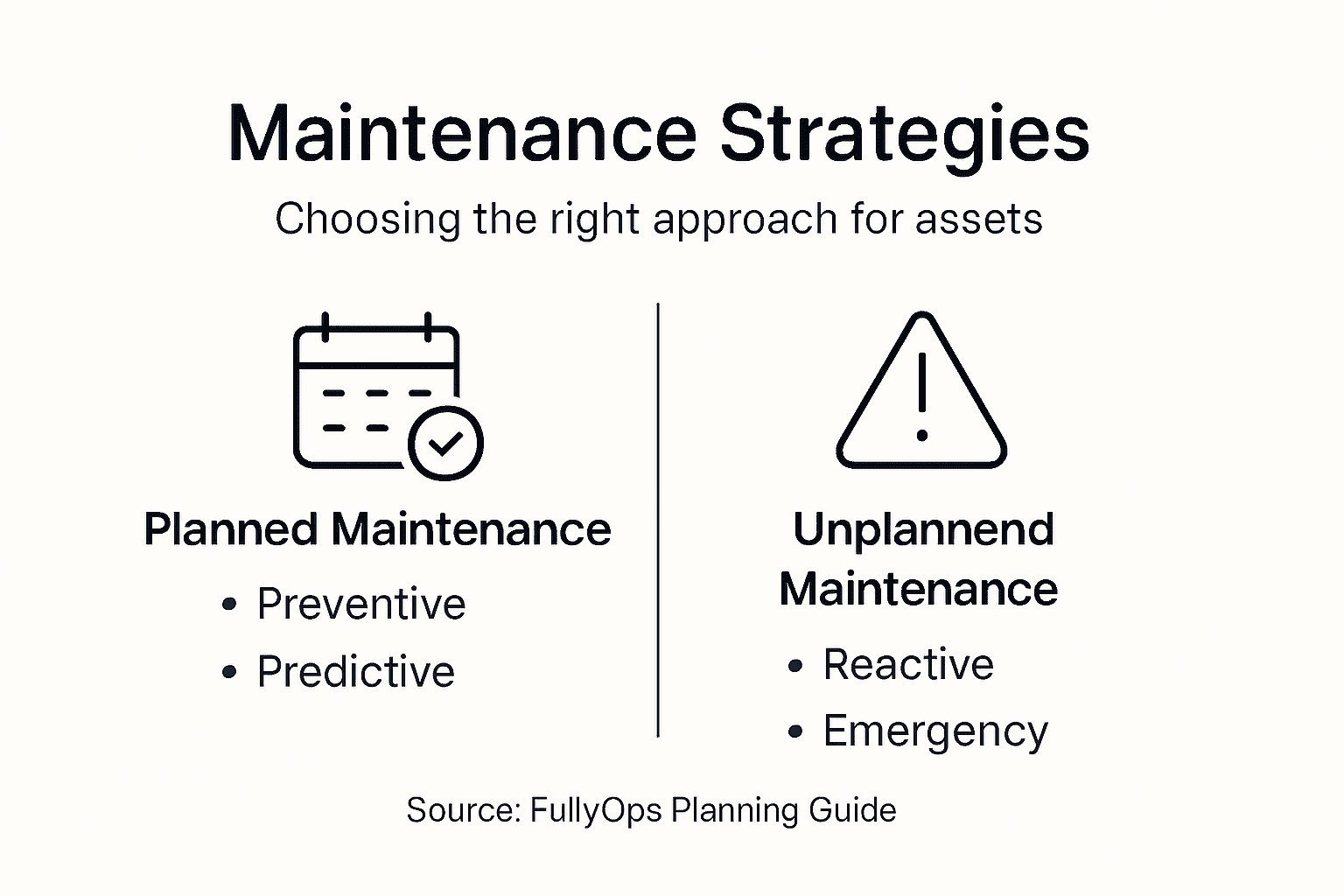
Preventive maintenance follows scheduled intervals based on time, cycles, or operating hours. You perform tasks like lubrication, inspections, and component replacements before failures occur. This approach works well for equipment with predictable wear patterns and high criticality. Calendar-based schedules suit assets with consistent operating conditions, while meter-based schedules better match equipment with variable usage.
Predictive maintenance uses condition monitoring data to identify emerging problems before they cause failures. Techniques include vibration analysis, thermal imaging, oil analysis, and ultrasonic testing. This data-driven approach targets interventions precisely when needed, avoiding both premature maintenance and unexpected failures. Predictive strategies suit high-value assets where monitoring costs justify the investment.
Reactive maintenance addresses failures after they occur. While not ideal as a primary strategy, reactive maintenance makes economic sense for non-critical equipment where failure consequences remain minimal. Run-to-failure approaches work when replacement costs stay lower than preventive maintenance investments over the asset lifecycle.
| Maintenance Type | Best For | Advantages | Limitations |
|---|---|---|---|
| Preventive | Critical assets with predictable wear | Reduces failures, improves planning | May perform unnecessary work |
| Predictive | High-value equipment, variable conditions | Optimizes timing, extends life | Requires monitoring investment |
| Reactive | Low-criticality, low-cost items | Minimizes upfront costs | Unpredictable timing, higher failure costs |
Choose your maintenance mix based on:
- Asset criticality and failure impact
- Historical failure data and predictability
- Available monitoring technology and staff skills
- Cost-benefit analysis of prevention versus repair
- Production schedule flexibility and downtime tolerance
Most effective maintenance programs combine strategies, applying intensive preventive and predictive approaches to critical assets while accepting reactive maintenance for less important equipment. Address preventive maintenance challenges systematically by matching strategies to asset characteristics rather than applying one-size-fits-all approaches.
Step 4 & 5: Plan the Needed Resources and Calculate Budget for Maintenance Tasks
Effective maintenance planning requires careful resource allocation and realistic budgeting to ensure your team can execute scheduled tasks without delays or cost overruns. Resource planning addresses three critical areas: personnel, materials, and tools.
Assess your maintenance workforce capacity and skills against planned task requirements. Identify gaps where specialized training or external contractors become necessary. Schedule preventive maintenance during production downtime when possible, but maintain sufficient staffing for emergency response capabilities. Cross-training technicians improves flexibility and prevents bottlenecks when specific skills become unavailable.
Spare parts inventory management directly impacts maintenance execution. Critical components with long lead times require stock maintenance to prevent extended downtime during failures. Balance inventory carrying costs against stockout risks based on part criticality, supplier reliability, and replacement urgency. Your asset risk assessment identifies which spare parts deserve inventory investment versus just-in-time ordering.
Budget development follows a structured process:
- Estimate labor hours for each planned maintenance task multiplied by labor rates
- Calculate material costs including parts, lubricants, and consumables based on task requirements
- Add tool and equipment costs for specialized testing or repair equipment
- Include contractor expenses for tasks requiring external expertise
- Build contingency reserves (typically 10-20%) for unexpected repairs and emergency work
- Align total budget with organizational financial planning cycles and constraints
Track actual costs against budget throughout the year to identify variances requiring adjustment. Maintenance software provides real-time cost tracking by asset, task type, and time period, enabling proactive budget management. The resource allocation tutorial offers detailed guidance on optimizing workforce and inventory planning for maintenance operations.
Step 6: Develop Standard Operating Procedures (SOPs)
Standardized procedures ensure maintenance work meets consistent quality, safety, and efficiency standards regardless of which technician performs the task. SOPs document step-by-step instructions for each maintenance activity, reducing variability and preventing errors that compromise equipment reliability or worker safety.
Detailed SOPs should include:
- Task scope and objectives clearly stated
- Required tools, materials, and safety equipment listed
- Step-by-step instructions with photos or diagrams where helpful
- Safety precautions including lockout/tagout procedures
- Quality checkpoints and acceptance criteria
- Documentation requirements and sign-off procedures
Safety considerations include ensuring maintenance procedures adhere to industry standards and include lockout/tagout protocols to prevent accidents during machine servicing. Lockout/tagout (LOTO) procedures prevent unexpected equipment startup during maintenance by controlling hazardous energy sources. Every SOP involving powered equipment must specify LOTO steps with equipment-specific energy isolation points.
“Proper lockout/tagout procedures reduce maintenance-related injuries by ensuring equipment remains safely de-energized during service activities, protecting technicians from crushing, electrocution, and other hazards.”
Train all maintenance personnel on relevant SOPs before assigning tasks. Training should include hands-on demonstration, supervised practice, and competency verification. Document training completion for each technician to ensure accountability and track qualification status.
Pro tip: Review and update SOPs annually or after incidents reveal procedure gaps. Involve frontline technicians in SOP development; their practical experience identifies steps that desk-bound planners might miss. Regular updates keep procedures aligned with equipment modifications, new safety requirements, and improved maintenance techniques.
Step 7: Implement and Monitor Maintenance Plan
Execution transforms your maintenance plan from documentation into operational reality. Digital tools streamline implementation by automating work order generation, scheduling, and tracking. CMMS platforms centralize maintenance data, enabling real-time visibility into planned versus completed work, resource utilization, and emerging issues requiring attention.
Monitoring key performance indicators like planned maintenance percentage, mean time between failures (MTBF), and downtime reduction quantifies maintenance success. Implementing maintenance planning using digital CMMS tools enhances work order management, inventory tracking, and data-driven decision-making, improving maintenance efficiency by up to 40%.
Track these essential KPIs:
- Planned maintenance percentage: ratio of scheduled to total maintenance work
- Mean time between failures (MTBF): average operating time between breakdowns
- Mean time to repair (MTTR): average time required to complete repairs
- Equipment downtime hours per production period
- Maintenance cost per production unit or operating hour
- Schedule compliance rate: percentage of planned tasks completed on time
- Work order backlog: accumulated pending maintenance tasks
Regular performance reviews identify trends requiring plan adjustments. Rising MTTR might indicate technician skill gaps or parts availability problems. Declining planned maintenance percentage suggests reactive work is overwhelming your schedule, signaling insufficient preventive investment. Growing backlogs reveal resource constraints that need addressing.
Use performance data to refine maintenance frequencies, adjust resource allocation, and validate strategy choices. Equipment consistently operating beyond expected intervals might allow extended maintenance cycles, freeing resources for other assets. Conversely, assets experiencing repeated failures may require more intensive preventive attention or earlier replacement.
The role of managers in maintenance monitoring includes reviewing KPI dashboards, investigating variances, and authorizing plan modifications based on performance data. Effective maintenance reporting provides actionable insights that drive continuous performance optimization.
Common Mistakes and Troubleshooting in Maintenance Planning
Even well-intentioned maintenance planning efforts stumble when common pitfalls go unaddressed. Recognizing these mistakes early allows course correction before they undermine your entire program.
Unclear or undefined goals cause misalignment between maintenance activities and organizational priorities. Teams work hard but deliver minimal business value when objectives remain vague. Fix this by adopting SMART criteria for all maintenance goals, ensuring every objective specifies measurable targets and deadlines. Link maintenance KPIs directly to production and financial metrics that leadership monitors.
Incomplete asset inventories delay maintenance planning and cause priority misalignment. Missing equipment data prevents accurate risk assessment and resource allocation. Address this through systematic asset audits that verify every piece of equipment appears in your registry with complete technical and historical information. Assign ownership for maintaining data accuracy going forward.
Insufficient spare parts inventory or staffing creates execution gaps that transform planned maintenance into reactive firefighting. When critical parts arrive late or skilled technicians remain unavailable, scheduled tasks slip, and equipment runs unserviced until failure forces emergency action. Solve this by forecasting parts needs based on planned task schedules and maintaining appropriate inventory levels for critical components. Staff capacity planning should account for vacation, training, and expected emergency work, not just scheduled tasks.
Additional common mistakes include:
- Skipping risk assessment and treating all assets equally
- Setting unrealistic maintenance frequencies that overwhelm resources
- Neglecting safety procedures and lockout/tagout protocols
- Failing to document procedures, creating inconsistent work quality
- Ignoring performance data and continuing ineffective practices
Pro tip: Conduct quarterly maintenance planning reviews that evaluate goal progress, resource adequacy, and procedure effectiveness. These structured reviews catch emerging problems before they become crises. Reference planned maintenance troubleshooting guides for detailed problem-solving approaches.
Expected Outcomes and Benefits of Effective Maintenance Planning
A well-executed maintenance planning process delivers measurable improvements across multiple operational dimensions. These benefits justify the time and resources invested in systematic planning.
Structured maintenance planning leads to 20-30% reduction in unplanned downtime, increases asset lifespan by 15%, and improves maintenance efficiency up to 40%. These improvements translate directly to bottom-line impact through reduced emergency repair costs, eliminated production losses, and deferred capital expenditures for equipment replacement.
Your organization gains:
- Reduced unplanned downtime: Proactive maintenance prevents 20-30% of unexpected failures, keeping production running smoothly
- Extended asset lifespan: Proper care extends equipment life by approximately 15%, delaying expensive replacements
- Improved maintenance efficiency: Digital tools and standardized procedures boost productivity up to 40%
- Lower maintenance costs: Planned work costs substantially less than emergency repairs requiring overtime and expedited parts
- Enhanced production reliability: Predictable maintenance windows enable better production scheduling and on-time delivery
- Improved safety performance: Structured procedures and proper lockout/tagout reduce maintenance-related injuries
- Better budget predictability: Planned maintenance provides stable, forecasted costs rather than unpredictable emergency expenses
Statistics show: Manufacturing operations implementing structured maintenance planning achieve average cost savings of 12-18% on total maintenance spend within the first year. These savings grow over time as equipment reliability improves and reactive work continues declining.
Beyond financial metrics, effective planning improves workforce morale by reducing crisis-driven work environments. Technicians appreciate structured schedules over constant emergency calls. Management gains confidence in production commitments when equipment reliability becomes predictable. Discover comprehensive benefits of maintenance planning that extend across your entire operation.
Safety Considerations in Maintenance Planning
Safety must remain central to every maintenance planning decision. Maintenance work involves inherent hazards including moving machinery, electrical systems, chemical exposure, and confined spaces. Proper planning mitigates these risks through comprehensive safety protocols integrated into every procedure.
Compliance with OSHA regulations and ISO safety standards ensures your maintenance program meets legal requirements and industry best practices. These standards specify training requirements, protective equipment, hazard communication, and emergency procedures that protect workers from injury. Regular safety audits verify ongoing compliance and identify improvement opportunities.
Safety considerations include ensuring maintenance procedures adhere to industry standards and include lockout/tagout protocols to prevent accidents during machine servicing. LOTO procedures prevent the approximately 120 annual workplace fatalities and 50,000 injuries caused by unexpected equipment startup during maintenance activities.
Essential safety planning elements include:
- Documented lockout/tagout procedures for every piece of powered equipment
- Personal protective equipment (PPE) requirements specified in each SOP
- Hazard analysis for each maintenance task identifying potential risks
- Emergency response procedures for common maintenance incidents
- Regular safety training for all maintenance personnel including refresher courses
- Incident investigation and corrective action processes
- Safety performance metrics tracked alongside maintenance KPIs
“Effective maintenance safety programs view safety as integral to operational excellence rather than separate compliance activity. Organizations achieving superior safety performance integrate hazard controls directly into maintenance procedures rather than treating safety as an afterthought.”
Train technicians to recognize hazards including electrical, mechanical, chemical, and ergonomic risks. Competent personnel identify unsafe conditions before starting work and stop tasks when unexpected hazards appear. Regular safety meetings reinforce the message that no maintenance task justifies risking worker health. Review maintenance safety protocols to ensure your program meets current standards.
Explore FullyOps Solutions to Streamline Your Maintenance Planning
Transforming maintenance planning from manual spreadsheets to intelligent digital systems accelerates the benefits discussed throughout this guide. FullyOps provides comprehensive tools designed specifically for operations managers seeking to optimize maintenance workflows and asset performance.
Our resource allocation tutorial for asset management guides you through workforce planning, inventory optimization, and budget development using data-driven approaches. The platform’s asset lifecycle management solutions track equipment from acquisition through disposal, ensuring optimal maintenance investment decisions at every stage. When you’re ready to transform maintenance with digital work orders, FullyOps provides mobile-friendly tools that streamline task assignment, completion tracking, and performance reporting. Discover how these solutions help operations managers reduce downtime, control costs, and achieve the 20-30% efficiency improvements that structured maintenance planning delivers.
Frequently Asked Questions
What are the first steps to start maintenance planning?
Start by collecting comprehensive asset data and maintenance history to establish your baseline. Then define SMART maintenance goals aligned with organizational KPIs like uptime targets and cost control objectives. Ensure availability of skilled personnel and relevant software tools before proceeding with detailed planning activities.
How can I measure the success of my maintenance plan?
Track key performance indicators such as planned maintenance percentage, mean time between failures (MTBF), downtime reduction, and workload backlog to measure success. Use data from CMMS tools for accurate monitoring and decision making. Compare current performance against your initial baseline and defined goals to quantify improvement.
What are common mistakes to avoid in maintenance planning?
Avoid unclear or undefined goals by using SMART criteria to specify measurable objectives. Keep asset inventory complete and up to date through regular audits. Ensure spare parts availability and train staff on SOPs to improve safety and quality. Don’t treat all assets equally; prioritize based on criticality and risk assessment.
Why is safety important in maintenance planning?
Safety protocols prevent accidents during machine servicing and ensure regulatory compliance with OSHA and ISO standards. Implementing lockout/tagout procedures and comprehensive training reduces workplace hazards that cause approximately 120 annual maintenance fatalities. Proper safety integration protects workers while avoiding costly violations and production disruptions.
How long does it take to see results from maintenance planning?
Most organizations observe measurable improvements within three to six months of implementing structured maintenance planning. Initial gains appear in reduced emergency work and improved schedule compliance. Longer-term benefits like extended asset lifespan and 20-30% downtime reduction become evident over 12-18 months as preventive strategies mature.
Recommended
- Work Order Management Process to Reduce Downtime
- Master Creating Maintenance Schedules for Reliable Assets
- Asset Maintenance Workflow Guide for Optimal Efficiency
- How to Overcome the Challenges of Adopting Preventive Maintenance: A Five-Step Process – FullyOps
- Optimized Heat Pump Maintenance Workflow for Technicians – CoolFix Appliance & HVAC Service
- Boiler Maintenance Step by Step: Ensure Safe, Efficient Heating – Skan Plumbing & Heating