

Predictive maintenance can reduce unplanned downtime by up to 30%, yet many operations managers mistakenly believe optimization means cutting staff. It doesn’t. Maintenance optimization maximizes asset uptime and performance through data-driven strategies and modern SaaS tools. This guide explains core concepts, compares maintenance strategies, explores how SaaS platforms transform workflows, and provides a practical six-step implementation framework to help you reduce downtime, lower costs, and improve operational reliability.
Table of Contents
- Introduction To Maintenance Optimization
- Comparison Of Maintenance Strategies: Preventive, Predictive, And Prescriptive
- Role Of SaaS In Modernizing Maintenance Processes
- Common Misconceptions About Maintenance Optimization
- Measurement And KPIs In Maintenance Optimization
- Practical Framework For Maintenance Optimization Implementation
- Benefits And Real-World Applications
- Explore FullyOps Solutions To Elevate Your Maintenance
- Frequently Asked Questions About Maintenance Optimization
Key Takeaways
| Point | Details |
|---|---|
| Strategic Impact | Maintenance optimization improves maintenance efficiency, reduces downtime, and lowers operational costs through data-driven approaches. |
| Strategy Evolution | Preventive, predictive, and prescriptive maintenance differ significantly in sophistication, technology requirements, and effectiveness. |
| Technology Enablement | SaaS solutions enable real-time work order management, inventory tracking, and workflow automation for modern maintenance operations. |
| Performance Tracking | Accurate KPIs like MTBF and MTTR are essential for measuring success and driving continuous improvement. |
| Implementation Roadmap | A structured six-step framework guides industrial managers from assessment through continuous improvement for successful adoption. |
Introduction to Maintenance Optimization
Maintenance optimization is a data-driven, technology-enabled strategy that leverages analytics, automation, and integrated systems to maximize asset performance and operational reliability. Rather than treating maintenance as a reactive cost centre, optimization transforms it into a strategic function that directly impacts your bottom line.
The core objectives are clear. Maintenance optimization leverages predictive analytics to reduce unplanned downtime by up to 30%, lower operational costs through better resource allocation, and improve overall maintenance efficiency. This approach ties directly into comprehensive asset management and operational reliability across your facility.
Key benefits include:
- Significant reduction in unplanned equipment failures and production interruptions
- Lower maintenance costs through optimized resource allocation and inventory management
- Extended asset lifecycles by addressing issues before they become critical failures
- Improved workforce productivity through streamlined work order management processes
- Enhanced safety compliance and reduced risk of catastrophic equipment failures
- Better decision-making through real-time data visibility and performance analytics
Predictive analytics forms the foundation of modern maintenance optimization. By analyzing historical performance data, sensor readings, and operational patterns, you can forecast potential failures and schedule interventions at the optimal time. This proactive approach replaces reactive firefighting with planned, cost-effective maintenance activities.
For industrial operations managers in North America, maintenance optimization isn’t optional anymore. Competitive pressures, aging infrastructure, and labour shortages make it essential. The good news? Modern automation and optimization consulting and SaaS platforms make implementation more accessible than ever, even for mid-sized facilities. When you integrate optimization principles with effective maintenance schedules, you create a sustainable framework for long-term operational excellence.
Comparison of Maintenance Strategies: Preventive, Predictive, and Prescriptive
Understanding the three core maintenance strategies helps you choose the right approach for your operation’s maturity level and resources.
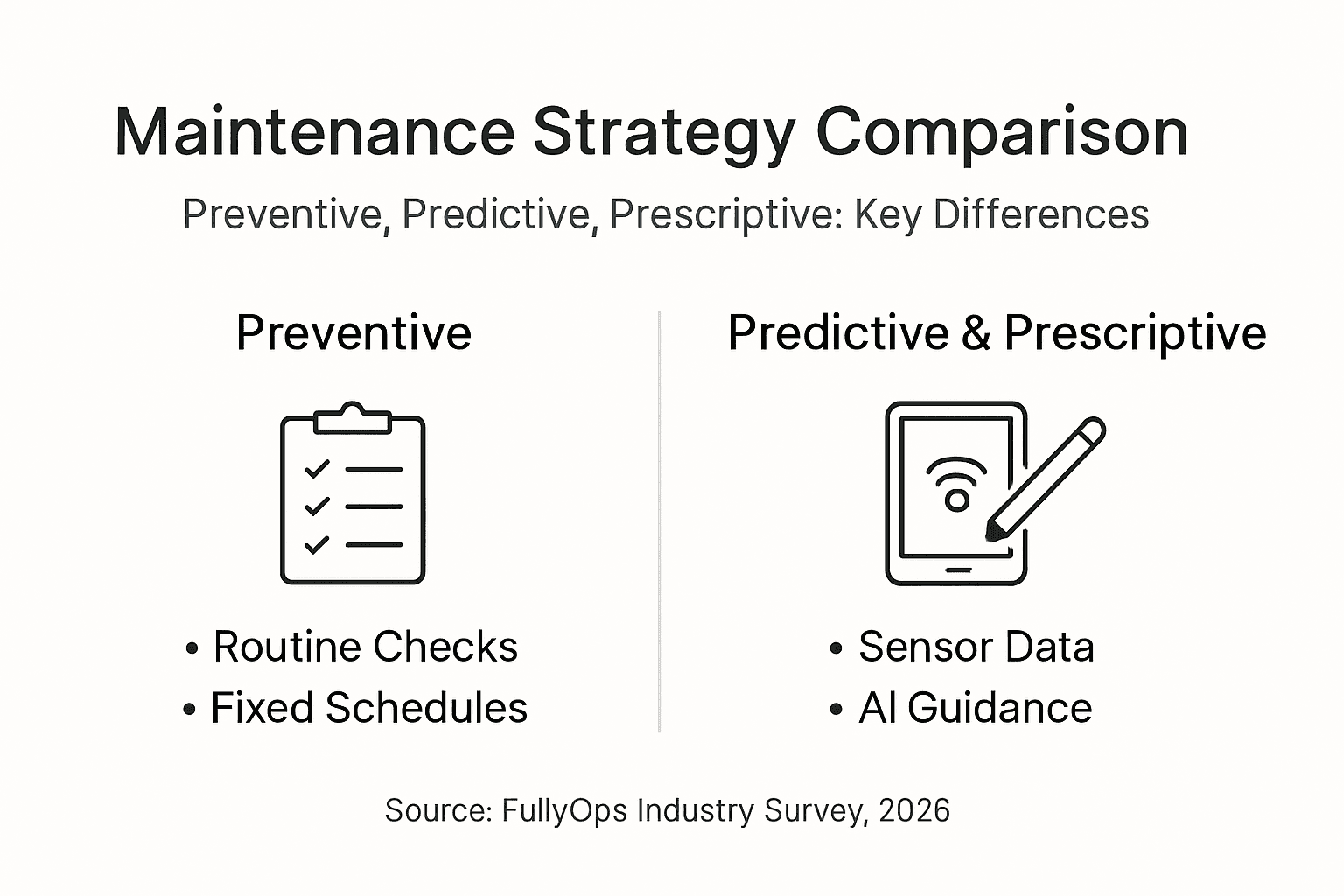
Preventive maintenance involves scheduled inspections and component replacements based on time intervals or usage thresholds. It’s straightforward to implement and requires minimal technology investment. However, preventive maintenance is less cost-effective compared to predictive and prescriptive strategies because it often leads to premature part replacements and doesn’t account for actual equipment condition.
Predictive maintenance uses data analytics, sensor technology, and condition monitoring to forecast failures before they occur. By analyzing vibration patterns, temperature fluctuations, oil quality, and other indicators, you can schedule maintenance only when needed. This approach requires investment in sensors, data infrastructure, and analytics software but delivers substantial ROI through reduced downtime and optimized maintenance timing.
Prescriptive maintenance takes prediction one step further by using artificial intelligence and machine learning to recommend specific corrective actions. It doesn’t just tell you when a failure might occur but prescribes exactly what to do about it. Some advanced systems can even automate corrective actions, triggering work orders or adjusting operating parameters automatically.
| Strategy | Technology Level | Implementation Complexity | Primary Benefit |
|---|---|---|---|
| Preventive | Low to Medium | Simple | Reduces catastrophic failures through routine maintenance |
| Predictive | Medium to High | Moderate | Optimizes maintenance timing based on actual equipment condition |
| Prescriptive | High | Complex | Automates decision-making and corrective actions using AI-driven insights |
The key differences lie in data requirements and technological sophistication. Preventive maintenance relies on manufacturer recommendations and historical experience. Predictive maintenance requires real-time monitoring and analytics capabilities. Prescriptive maintenance demands advanced AI algorithms and integrated systems that can both analyze data and execute responses.
Many operations managers face challenges when adopting preventive maintenance, let alone more advanced strategies. The transition requires cultural change, training, and technology investment.
Pro Tip: Start by assessing your current data collection capabilities and team readiness. Smaller plants with limited sensor infrastructure should perfect preventive maintenance first, then gradually introduce predictive elements as data maturity improves. Larger facilities with existing IoT investments can often leapfrog directly to predictive or prescriptive approaches.
Role of SaaS in Modernizing Maintenance Processes
Modern SaaS platforms have transformed how operations managers execute and optimize maintenance workflows. These cloud-based solutions eliminate the need for expensive on-premise infrastructure while providing enterprise-grade capabilities that were once accessible only to large corporations.

SaaS platforms in operations enable real-time work order management, allowing you to create, assign, and track maintenance tasks from any device. Technicians receive instant notifications on mobile devices, update job status in the field, and attach photos or notes directly to work orders. This eliminates paper-based systems and communication delays that plague traditional maintenance operations.
Inventory tracking becomes seamless with integrated SaaS solutions. You can monitor spare parts levels in real-time, set automatic reorder points, and link inventory consumption directly to work orders. This visibility prevents stockouts of critical components while reducing excess inventory carrying costs.
Integration capabilities represent perhaps the most significant advantage. Modern SaaS platforms connect with ERP systems, SCADA networks, IoT sensor platforms, and accounting software through APIs. This centralization eliminates data silos and provides a single source of truth for maintenance performance. When your digital work orders automatically pull asset histories, spare parts availability, and technician schedules, decision-making becomes faster and more accurate.
Key SaaS features that drive maintenance optimization include:
- Automated workflow routing based on asset type, priority, or technician skillset
- Mobile-first interfaces that work offline and sync when connectivity returns
- Customizable dashboards displaying real-time KPIs and performance metrics
- Predictive analytics modules that identify patterns in maintenance data
- Document management for storing manuals, safety procedures, and compliance records
- Resource management tools that optimize technician scheduling and workload balancing
SaaS platforms improve productivity by reducing administrative overhead. Technicians spend more time fixing equipment and less time hunting for information or filling out paperwork. Managers gain transparency into maintenance operations without micromanaging, and executives can track performance metrics that directly tie maintenance activities to business outcomes.
Pro Tip: Before selecting a SaaS solution, carefully evaluate integration capabilities and scalability. Ensure the platform can connect with your existing systems and accommodate future growth. Request detailed API documentation and ask about customization options specific to your industry’s requirements.
Common Misconceptions About Maintenance Optimization
Several persistent myths prevent organizations from fully embracing maintenance optimization. Clearing up these misconceptions helps you avoid strategic mistakes and set realistic expectations.
Operations managers often mistakenly believe that maintenance optimization is about reducing headcount, while it actually focuses on maximizing asset uptime and performance. Optimization reallocates labour from reactive firefighting to proactive, value-added activities. Your team becomes more effective, not smaller.
Another common assumption is that all maintenance management software includes predictive capabilities. In reality, predictive maintenance requires specialized AI-driven analytics, sensor integration, and machine learning algorithms. Many traditional CMMS platforms excel at work order management and preventive scheduling but lack true predictive functionality. Always verify specific capabilities before purchasing.
Many believe preventive maintenance is always the most cost-effective approach. While it’s better than purely reactive maintenance, time-based preventive strategies often lead to unnecessary interventions. You replace parts that still have useful life remaining or perform inspections when equipment condition doesn’t warrant it. Predictive strategies optimize intervention timing based on actual need.
Key misconceptions to avoid:
- Optimization eliminates the need for experienced technicians (it actually amplifies their effectiveness)
- Implementing predictive maintenance requires replacing all existing equipment with smart sensors
- Small and mid-sized facilities cannot afford optimization technologies
- Maintenance optimization delivers immediate results without process changes or training
- All downtime can be eliminated through optimization (some planned downtime remains necessary)
“The biggest mistake operations managers make is treating maintenance optimization as purely a technology project rather than a comprehensive process transformation that requires cultural change, training, and sustained commitment.”
Understanding the role of maintenance managers becomes even more critical during optimization initiatives. Managers must champion change, communicate benefits clearly, and provide teams with the training and tools needed to succeed. Technology alone never delivers results without proper implementation and change management.
Measurement and KPIs in Maintenance Optimization
You cannot improve what you don’t measure. Effective maintenance optimization requires tracking specific KPIs that quantify performance and identify improvement opportunities.
Mean Time Between Failures (MTBF) measures average operational time between equipment breakdowns. Higher MTBF indicates better reliability and more effective maintenance practices. Calculate MTBF by dividing total operational time by the number of failures during that period.
Mean Time To Repair (MTTR) tracks average time required to restore equipment to operational status after a failure. Lower MTTR reflects efficient repair processes, better spare parts availability, and skilled technicians. Reducing MTTR directly minimizes production losses from unplanned downtime.
Critical KPIs to monitor:
- Overall Equipment Effectiveness (OEE): Combines availability, performance, and quality metrics into a single score
- Planned Maintenance Percentage: Ratio of scheduled maintenance hours to total maintenance hours
- Maintenance Cost as Percentage of Replacement Asset Value (RAV): Helps identify when replacement becomes more cost-effective than continued repairs
- Schedule Compliance: Percentage of planned maintenance tasks completed on time
- Emergency Maintenance Ratio: Tracks reactive versus proactive work
Using analytics and KPI data to drive continuous improvement:
- Establish baseline measurements for all critical KPIs before implementing changes
- Set realistic improvement targets based on industry benchmarks and your facility’s specific constraints
- Create regular reporting cadences that share KPI trends with maintenance teams and leadership
- Investigate negative trends immediately to identify root causes before problems escalate
- Celebrate improvements and recognize teams that contribute to measurable performance gains
Continuous monitoring forms the backbone of effective optimization. Monthly reviews identify trends that daily snapshots miss. Quarterly deep dives into specific asset classes or maintenance types reveal opportunities for process improvements. Annual strategic reviews ensure your optimization program evolves with changing business needs and technological capabilities.
Practical Framework for Maintenance Optimization Implementation
Implementing a structured maintenance optimization framework involves six key steps including asset criticality assessment, data integration, predictive analytics, workflow automation, performance tracking, and continuous improvement. This roadmap provides operations managers with a clear path from current state to optimized operations.
-
Conduct Asset Criticality Assessment: Identify which equipment has the greatest impact on production, safety, and costs. Focus initial optimization efforts on these critical assets where improvements deliver maximum ROI. Document failure modes, consequences, and current maintenance practices for each critical asset.
-
Integrate Data Systems: Connect maintenance management platforms with ERP, SCADA, sensor networks, and other relevant systems. Centralized data provides the foundation for analytics and informed decision-making. Ensure data quality through validation rules and regular audits.
-
Implement Predictive Analytics: Deploy condition monitoring sensors on critical assets. Build or procure analytics models that identify patterns indicating impending failures. Start with simple threshold alerts before advancing to complex machine learning algorithms.
-
Automate Workflows: Digitize work order processes and implement automated routing based on asset type, urgency, and technician availability. Eliminate manual handoffs and paper-based communication that slow response times.
-
Establish Performance Tracking: Define KPIs aligned with business objectives and implement dashboards that provide real-time visibility. Create regular reporting routines that keep teams focused on measurable outcomes.
-
Drive Continuous Improvement: Schedule regular reviews to analyze performance trends, identify bottlenecks, and adjust strategies. Encourage teams to propose process improvements based on field experience and data insights.
| Step | Rationale | Expected Outcome |
|---|---|---|
| Asset Criticality Assessment | Focuses resources on highest-impact equipment | 20-30% improvement in resource allocation efficiency |
| Data Integration | Eliminates information silos and manual data entry | 40-50% reduction in administrative time |
| Predictive Analytics | Enables proactive maintenance scheduling | 25-30% reduction in unplanned downtime |
| Workflow Automation | Streamlines communication and task management | 30-35% improvement in technician productivity |
| Performance Tracking | Provides visibility into maintenance effectiveness | Data-driven decision-making and accountability |
| Continuous Improvement | Sustains gains and adapts to changing conditions | Ongoing optimization and competitive advantage |
Successful implementation requires certain prerequisites. You need baseline data on current maintenance performance, integrated systems capable of sharing information, and genuine commitment to iterative process improvement. Quick wins build momentum, but lasting transformation takes 12 to 18 months.
Effective resource allocation ensures optimization efforts receive adequate funding, personnel, and executive support. Budget for training, technology, and external expertise as needed.
Pro Tip: Cross-functional collaboration between maintenance, operations, IT, and finance teams is essential. Establish a steering committee that meets monthly to review progress, resolve obstacles, and maintain alignment with business objectives. Consistent data integration practices prevent the fragmentation that undermines optimization initiatives.
Benefits and Real-World Applications
The measurable impact of maintenance optimization extends across multiple dimensions of industrial operations. Maintenance optimization leveraging predictive analytics can reduce unplanned downtime by up to 30%, translating directly into increased production capacity and revenue. Cost savings come from reduced emergency repairs, optimized spare parts inventory, and extended asset lifecycles.
A mid-sized automotive parts manufacturer in Michigan implemented predictive maintenance across their stamping and welding lines in 2025. Within nine months, they achieved a 25% reduction in unplanned downtime and cut maintenance costs by 18%. The facility used vibration sensors and thermal imaging to identify bearing failures and electrical issues before they caused production stoppages. Their investment in predictive technology and process changes paid for itself in under 14 months.
Operational reliability improvements manifest in several ways:
- Fewer emergency shutdowns and rush orders for replacement parts
- More predictable production schedules that improve customer delivery performance
- Reduced safety incidents related to equipment failures
- Lower insurance premiums due to improved risk management
- Better regulatory compliance through systematic maintenance documentation
- Increased asset utilization rates and return on capital investments
Maintenanceefficiency gains free up technicians to focus on high-value activities like root cause analysis, process improvements, and preventive upgrades. Rather than constantly responding to breakdowns, your team proactively enhances equipment reliability.
“Organizations that successfully implement maintenance optimization report not just cost savings and uptime improvements, but also significant gains in team morale as technicians shift from reactive firefighting to proactive, strategic maintenance activities that showcase their expertise.”
The combination of proper optimization tools, structured implementation, and sustained commitment delivers results that transform maintenance from a cost centre into a strategic advantage. These outcomes become achievable when you leverage modern SaaS platforms designed specifically for industrial maintenance operations.
Explore FullyOps Solutions to Elevate Your Maintenance
FullyOps provides comprehensive SaaS platforms that streamline every aspect of maintenance optimization. Our solutions enable real-time work order management, intelligent resource allocation, and seamless integration with your existing systems. Whether you’re starting with preventive maintenance fundamentals or implementing advanced predictive analytics, FullyOps scales with your optimization journey. Explore our detailed asset maintenance workflow guide to see how leading industrial operations are achieving the cost savings and uptime improvements discussed in this article. Start your trial today and discover how modern maintenance management transforms operational performance.
Frequently Asked Questions About Maintenance Optimization
What are the key benefits of maintenance optimization?
Maintenance optimization delivers cost reduction through better resource allocation, improved asset uptime via predictive interventions, streamlined workflows that boost productivity, and enhanced operational reliability. Up to 30% reduction in unplanned downtime has been reported with predictive analytics.
How do predictive and prescriptive maintenance differ?
Predictive maintenance uses data analytics and sensor monitoring to forecast potential equipment failures before they occur. Prescriptive maintenance adds artificial intelligence to recommend specific corrective actions or even automate responses based on those predictions.
Can small plants implement predictive maintenance effectively?
Yes, smaller facilities can start with preventive maintenance and gradually integrate predictive analytics as data collection capabilities improve. Tailored strategies based on available resources and equipment criticality make optimization accessible regardless of plant size.
What KPIs are most important to track?
Key performance indicators include Mean Time Between Failures (MTBF), Mean Time To Repair (MTTR), overall downtime reduction percentages, and maintenance cost savings. Tracking these metrics enables data-driven continuous improvement and demonstrates ROI.
How does SaaS improve maintenance workflows?
SaaS platforms enable real-time work order tracking, mobile access for field technicians, automated inventory management, and seamless integration with ERP systems. These capabilities enhance operational visibility, eliminate paper-based processes, and significantly improve maintenance efficiency.
Recommended
- Work Order Management Process to Reduce Downtime
- Asset Lifecycle Management – FullyOps
- Asset Maintenance Workflow Guide for Optimal Efficiency
- Master Creating Maintenance Schedules for Reliable Assets
- System Tune Up And Maintenance Services Project in Largo FL 33773 Home Therapist Cooling, Heating, and Plumbing