

En resumen:
- Smart maintenance in 2026 combines AI, IoT, edge computing, and machine learning to identify issues early and optimize interventions with minimal manual input. Success depends on phased implementation, data quality, and organizational alignment, not just technology, to reduce downtime and costs significantly. The trend continues toward automation, edge AI, and integrating sustainability metrics, requiring strategic planning and cross-team ownership for effective deployment.
Most maintenance teams are still operating on schedules written before the machines they maintain could talk back. In 2026, that approach is no longer sufficient. What is smart maintenance in 2026? It is the convergence of AI, IoT sensors, edge computing, and machine learning into a system that detects equipment problems before they become failures, recommends the right intervention at the right time, and does so with minimal manual input. This guide explains the core concepts, how the technology actually works, the real benefits and trade-offs, and the emerging trends shaping the future of maintenance for operations managers and maintenance professionals.
Índice
- Principales conclusiones
- What is smart maintenance in 2026
- How smart maintenance technology works in practice
- Benefits and challenges of adopting smart maintenance
- Smart maintenance trends shaping 2026 and beyond
- My perspective on what smart maintenance success actually requires
- Put smart maintenance to work with Fullyops
- PREGUNTAS FRECUENTES
Principales conclusiones
| Punto | Detalles |
|---|---|
| Smart maintenance goes beyond prediction | Modern systems combine predictive and prescriptive analytics to recommend specific actions, not just raise alerts. |
| Phased rollouts produce the best results | Starting with 10 to 20 critical assets and validating data quality before scaling is the proven path to measurable ROI. |
| CMMS integration multiplies the value | Connecting sensor data to your CMMS automates work orders and reduces manual scheduling decisions significantly. |
| Edge computing enables real-time response | Processing data locally at the asset reduces latency and allows near-instant fault detection and response. |
| Challenges are manageable with preparation | Data integration complexity and upfront investment are real, but both are reduced by starting with assets that have clear failure modes and reliable sensor coverage. |
What is smart maintenance in 2026
Smart maintenance is the practice of using real-time data, artificial intelligence, and connected sensor networks to move from reactive or calendar-based interventions to data-driven decisions about when and how to maintain assets. It is not a single product or platform. It is an approach that integrates several technologies into a functioning system.
The spectrum of maintenance maturity looks like this:
- Reactive maintenance: Fix it when it breaks. High downtime costs, unpredictable failure events.
- Preventive maintenance: Maintain on a fixed schedule regardless of actual condition. Wasteful for assets that are healthy, insufficient for those deteriorating faster than the schedule assumes.
- Predictive maintenance: Use sensor data and machine learning models to forecast failures days or weeks ahead, enabling condition-based intervention. This is the foundation of smart maintenance.
- Prescriptive maintenance: Go beyond prediction by generating specific action recommendations that account for operational constraints such as parts availability, labour allocation, and production impact. Prescriptive outputs have shorter action horizons, often hours to near real time, and include detailed operational guidance.
The core components that make this possible are sensor data acquisition (vibration, temperature, pressure, current), edge and cloud analytics platforms, machine learning models trained on historical failure data, digital twins for scenario simulation, and integration with CMMS or ERP systems. The modern CMMS is no longer a passive work order log. In 2026, it functions as a predictive intelligence engine that automates scheduling and prioritises interventions based on asset condition.
How smart maintenance technology works in practice
Understanding the data pipeline is the clearest way to grasp how smart maintenance technology works. The process moves through four distinct stages.
- Sensor data acquisition. Sensors attached to critical assets continuously collect operating parameters. Vibration sensors on motors, thermal cameras on electrical panels, and ultrasonic detectors on pipes all feed raw data into the system in real time.
- Edge processing. Rather than sending all raw data to a central cloud server, edge computing reduces latency by processing data locally at or near the asset. This is particularly important for high-speed rotating equipment where a failure can progress from warning to catastrophic in minutes. Local processing flags anomalies immediately, without waiting for a round trip to the cloud.
- Predictive and prescriptive analytics. Processed data flows into machine learning models that identify patterns associated with failure. Predictive models forecast failure windows days or weeks in advance, giving maintenance teams a planning horizon. Prescriptive models go further by integrating business constraints. Digital twins simulate the impact of delaying a repair by 48 hours, rank intervention options by cost and production impact, and generate a prioritised work order automatically.
- Work order automation and feedback loop. The recommended action is pushed directly to the CMMS, which assigns it to the appropriate technician, checks parts availability, and logs completion data. That completion data feeds back into the model, improving future predictions.
A typical pilot deployment focuses on a defined set of critical assets to validate data quality and model accuracy before scaling. Selecting 10 to 20 pilot assets with 20 to 30 sensor points is a common phased approach. Most organisations complete this validation phase within 60 to 90 days and begin seeing measurable outcomes before the end of the first quarter.
Consejo profesional: When selecting pilot assets, prioritise equipment with clear, well-documented failure modes and existing sensor compatibility. Assets with ambiguous failure histories require far more data to train reliable models and will delay your ROI demonstration.
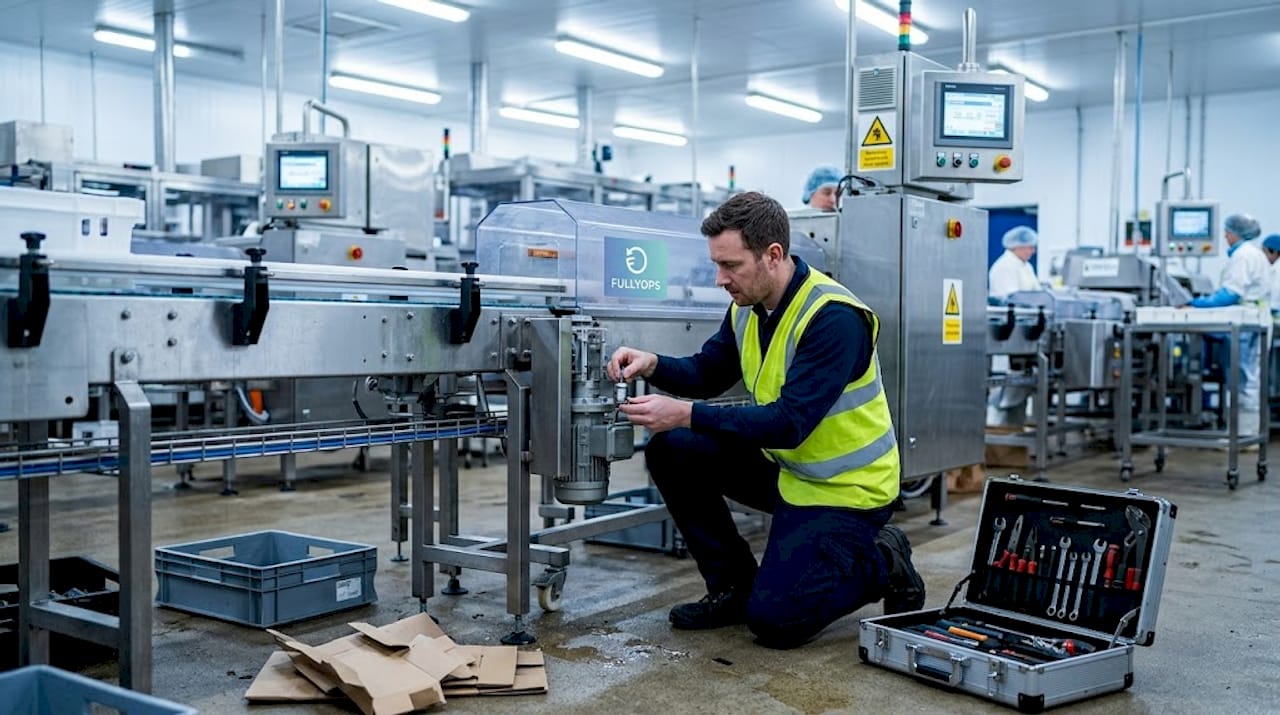
A practical example: a food processing facility deploys vibration sensors on 15 conveyor drive motors. Within the first 90 days, the system flags bearing wear on three units before any audible degradation occurs. Maintenance schedules the replacement during a planned weekend shutdown, avoiding three separate unplanned stoppages that would each have cost four to six hours of production time.
Benefits and challenges of adopting smart maintenance
The business case for smart maintenance technology in 2026 is well established, but it is not without trade-offs. A clear-eyed assessment of both sides is what helps operations managers make sound investment decisions.
What the numbers say
Prescriptive maintenance can reduce unplanned downtime by over 70% and maintenance costs by up to 40%, according to Deloitte estimates. CMMS adoption reduces downtime by 40 to 60% and extends asset lifespan by 20 to 40% when integrated with predictive capabilities. These are not marginal improvements. They represent a structural change in how maintenance resources are deployed.
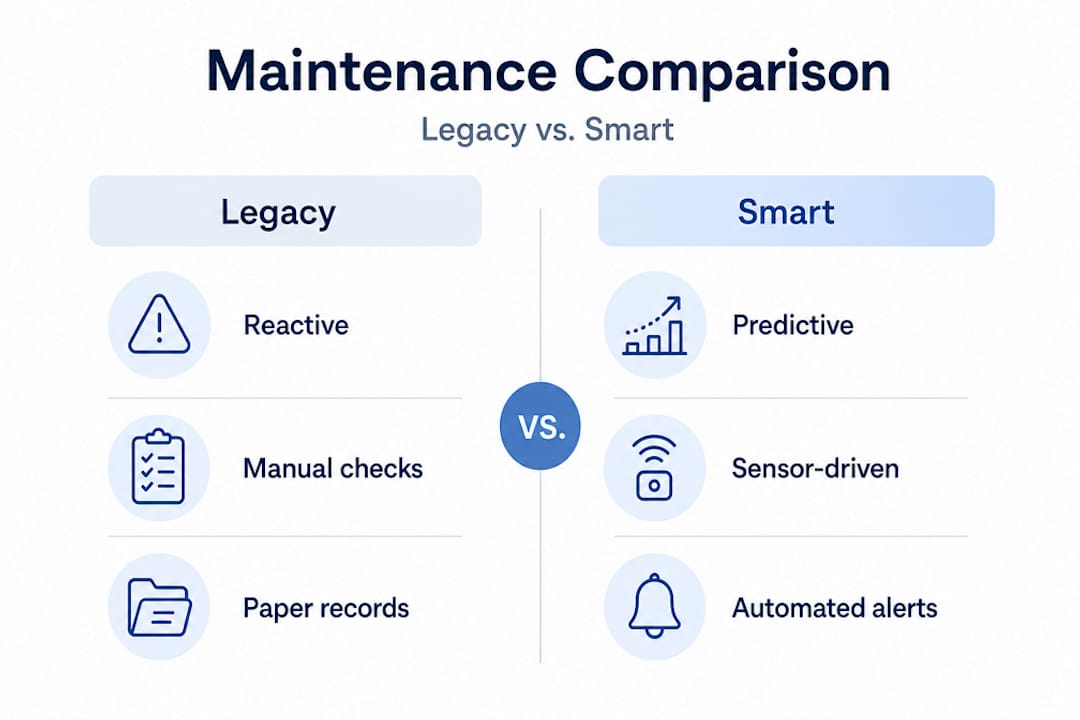
Legacy vs smart maintenance: a direct comparison
| Dimension | Legacy maintenance | Smart maintenance |
|---|---|---|
| Failure detection | After the fact or by fixed schedule | Days or weeks before failure occurs |
| Maintenance trigger | Calendar date or breakdown | Asset condition and operational context |
| Downtime pattern | Unplanned and disruptive | Planned and minimised |
| Inventory management | Overstocked or caught short | Demand-driven and optimised |
| Labour allocation | Reactive deployment | Predictive scheduling and prioritisation |
| Planning horizon | Days at best | Weeks to months |
What makes adoption difficult
Data integration is the most cited challenge. Connecting legacy assets, disparate sensor protocols, and existing CMMS or ERP systems into a coherent data pipeline requires significant technical preparation. Upfront investment in sensors, connectivity infrastructure, and platform licences is substantial, particularly for larger facilities.
Skills are another constraint. Smart maintenance strategies require technicians who can interpret model outputs, not just respond to alerts. Organisations need to invest in training or hire data-literate maintenance engineers.
Consejo profesional: Do not underestimate data quality as a success factor. A predictive model trained on incomplete or inconsistently labelled historical data will generate false positives that erode technician trust and reduce adoption. Invest in data governance before you invest in algorithms.
The phased deployment approach addresses most of these challenges by limiting early complexity, generating early wins that build organisational confidence, and giving teams time to develop the skills and processes needed at scale.
Smart maintenance trends shaping 2026 and beyond
The future of maintenance in 2026 is being defined by several converging developments that operations managers should understand now, before they become standard practice everywhere else.
- Generative AI and natural language interfaces. Maintenance technicians in 2026 can query asset health in plain language. Rather than interpreting dashboard data, a technician can ask “what is the current risk status of pump 7?” and receive a contextual, plain-language summary generated from live sensor readings and historical patterns. This reduces the skill barrier for interpreting complex model outputs significantly.
- Expansion of edge AI. Edge AI reduces dependency on centralised processing and enables faster local decision-making. In 2026, edge devices are increasingly capable of running full inference models, not just data filtering, which means automated shutdown or adjustment commands can be executed at the asset level without cloud latency.
- Asset lifecycle integration and sustainability metrics. Intelligent maintenance solutions are beginning to incorporate carbon and energy consumption data into maintenance decisions. An asset operating at degraded efficiency consumes more energy. Smart systems now flag this as a maintenance trigger, not just a performance observation.
- Market growth trajectory. The predictive maintenance market is projected to grow from USD 13.89 billion in 2026 to USD 23.79 billion by 2031 at a compound annual growth rate of 11.4%. This growth is driven by connected monitoring, edge computing, and AI analytics adoption across manufacturing, utilities, and field services.
- Prescriptive automation becoming standard. The gap between prediction and action continues to close. Automated maintenance systems in 2026 are moving towards fully automated work order generation and parts procurement triggers, reducing human decision latency in the maintenance workflow. Prescriptive systems require three to five times more contextual data than predictive systems, but organisations that invest in that data infrastructure are seeing significantly faster and more precise interventions.
En asset management efficiency trends emerging in 2026 reflect all of these developments, with organisations that adopted AI-assisted scheduling and condition monitoring earlier now reporting compounding returns on that investment.
My perspective on what smart maintenance success actually requires
In my experience working with organisations deploying predictive and prescriptive maintenance systems, the most common failure mode is not technological. It is organisational. Teams invest in sensors and platforms and then discover that nobody owns the data pipeline, nobody has agreed on what a “high priority alert” actually means in operational terms, and the maintenance technicians distrust the model outputs because nobody explained how they work.
What I have consistently found is that the organisations achieving the best results start simpler than they think they need to. They pick one asset class with clear failure modes, build a working feedback loop between sensor data and work order completion, and only then expand. The technology is genuinely capable. The bottleneck is almost always process alignment and cross-functional ownership.
I have also seen operations managers fall into the trap of expecting the system to replace judgement. It does not. The value of predictive maintenance is in giving your team better information faster, not in removing the need for experienced technicians who understand the context behind the data. The best outcomes come from teams that treat model outputs as high-quality inputs to human decisions, at least in the first year of deployment.
The hard truth is that smart maintenance is not a plug-and-play outcome. It is an ongoing capability that improves as your data improves, as your team learns to work with it, and as you iterate on what good looks like for your specific assets and operations.
— Pedro
Put smart maintenance to work with Fullyops
If you are moving from understanding smart maintenance concepts to actually implementing them, Fullyops provides the operational infrastructure to make it practical. The platform connects work order management, asset tracking, and operational analytics into a single interface designed for maintenance teams managing industrial equipment, field assets, and facilities. You can explore maintenance management software options suited to your scale and asset types, or work through the tutorial de asignación de recursos to understand how to structure your team and asset priorities before you begin deploying sensors and models. Fullyops is built for the operations managers who need results, not complexity.
PREGUNTAS FRECUENTES
What is smart maintenance in 2026?
Smart maintenance in 2026 is the use of IoT sensors, AI, edge computing, and machine learning to detect equipment problems before they cause failures, generate specific repair recommendations, and automate work order management based on real-time asset condition rather than fixed schedules.
How is prescriptive maintenance different from predictive maintenance?
Predictive maintenance forecasts when a failure is likely to occur. Prescriptive maintenance goes further by recommending specific actions, accounting for operational constraints such as parts availability and labour, and prioritising interventions based on cost and production impact.
How long does a smart maintenance rollout take?
Most organisations complete an initial pilot phase within 60 to 90 days by focusing on 10 to 20 critical assets. Scaling to full deployment typically follows once data quality and model accuracy are validated during the pilot.
What is the biggest challenge in adopting smart maintenance?
Data integration complexity and data quality are the most significant challenges. Connecting legacy assets and disparate systems into a coherent data pipeline requires preparation, and models trained on incomplete historical data produce unreliable outputs that reduce technician trust.
Is remote monitoring a core part of smart maintenance?
Remote monitoring in maintenance is foundational to the smart maintenance model. It provides the continuous sensor data stream that predictive and prescriptive models depend on, and it enables teams to track asset health across multiple sites without requiring physical presence.