

En resumen:
- Operational efficiency improvement involves systematically optimizing workflows and maintenance practices to enhance output quality while minimizing costs and downtime.
- Implementing these improvements requires baseline data, appropriate process mapping tools, stakeholder engagement, and selecting methodologies like Lean, Six Sigma, or their integration based on specific challenges.
Operational efficiency improvement is the systematic enhancement of workflows and maintenance practices to maximise output quality while minimising cost and downtime. In maintenance and facilities management, this discipline is formally known as operational excellence, and it follows a structured cycle of process mapping, redesign, implementation, measurement, and governance. Leaders who apply this cycle begin by delivering an end-to-end process map, two to five KPIs tied to outcomes such as cycle time and first-pass yield, and a measurement cadence post-rollout. The result is a self-reinforcing system that reduces unplanned downtime, cuts waste, and builds lasting organisational capability.
What does an operational efficiency improvement guide actually require?
Before any methodology is applied, three foundational prerequisites must be in place: accurate baseline data, the right process mapping tools, and genuine stakeholder buy-in. Without these, even the most sophisticated efficiency improvement strategies will produce fragile results.

Process mapping tools are the starting point. LucidChart, Miro, and Microsoft Visio each serve a distinct purpose in visualising maintenance workflows. LucidChart suits distributed teams collaborating in real time. Miro excels at workshop-style process redesign sessions. Visio remains the standard for detailed engineering and facilities documentation. Selecting the wrong tool for your team’s working style creates friction before the work even begins.
KPI selection is equally critical. The most relevant indicators for maintenance and facilities contexts include:
- Tiempo medio entre fallos (MTBF)
- Mean Time to Repair (MTTR)
- Planned Maintenance Percentage (PMP)
- First-pass yield on work orders
- Tasa de cumplimiento del programa
Each KPI must be tied directly to an operational outcome, not just a process activity. Tracking “number of work orders closed” tells you nothing about whether the right work was done at the right time.
Stakeholder engagement is the cultural prerequisite that most organisations underestimate. Engaging frontline teams early in design and testing is the single most reliable way to avoid resistance during rollout. Technicians who help design standard operating procedures are far more likely to follow them consistently.
| Tool / KPI | Category | Primary use in maintenance |
|---|---|---|
| LucidChart | Process mapping | Collaborative workflow visualisation |
| Miro | Process mapping | Workshop redesign and ideation |
| MS Visio | Process mapping | Detailed facilities documentation |
| MTBF / MTTR | KPI | Equipment reliability and repair speed |
| Schedule compliance | KPI | Planned vs. actual maintenance execution |
Consejo profesional: Collect at least 90 days of baseline data before selecting KPIs. Shorter windows produce misleading averages that skew your improvement targets from the outset.
Which methodologies work best for maintenance and facilities?
The three most widely applied frameworks in maintenance and facilities management are Lean, Six Sigma, and their integrated form, Lean Six Sigma. Each addresses a different type of operational problem, and selecting the right one depends on whether your primary challenge is waste, variability, or both.
Lean uses checklists and SOPs to standardise work and eliminate non-value-added steps. In a maintenance context, this means reducing travel time between jobs, eliminating redundant sign-off steps, and standardising parts kitting before a technician reaches the asset. Six Sigma applies statistical root cause analysis to reduce defects and downtime variation. Where Lean removes unnecessary steps, Six Sigma makes the remaining steps more reliable.
The most significant gains come from integrating Lean Six Sigma with proactive maintenance strategies. Research published on Zenodo found that combining Lean Six Sigma with RBI, RCM, and TPM produced a 60% reduction in non-value-added time and a 43% decrease in downtime in a petrochemical maintenance environment. Shutdown efficiency improved from 27% to 49%. These figures represent the upper bound of what is achievable when continuous improvement methodology is applied alongside Reliability-Centred Maintenance and Risk-Based Inspection, rather than in isolation.
| Methodology | Core strength | Typical maintenance use case | Limitation |
|---|---|---|---|
| Lean | Waste elimination | Reducing travel time, parts delays, redundant approvals | Less effective for statistical variability |
| Six Sigma | Defect reduction | Root cause analysis of recurring failures | Requires data maturity |
| Lean Six Sigma | Combined waste and variability | Shutdown optimisation, planned maintenance cycles | Demands cross-functional capability |
| RCM | Failure mode analysis | Prioritising maintenance tasks by consequence | Time-intensive to implement fully |
| TPM | Equipment ownership | Operator-led preventive maintenance | Cultural change required |
Consejo profesional: Do not choose a methodology based on familiarity alone. Map your top three recurring maintenance failures first, then select the framework that directly addresses their root cause type, whether that is process waste, data variability, or equipment ownership gaps.
For facilities managers exploring proactive maintenance approaches, integrating RCM with Lean principles offers a practical path to shifting from reactive to planned work without a full organisational overhaul.
How to implement operational efficiency improvements step by step
A structured rollout is the difference between a one-time project and a self-sustaining improvement system. The 90-day rollout plan developed by Kaizen Institute provides the minimum viable timeline for moving from diagnostics to governance.
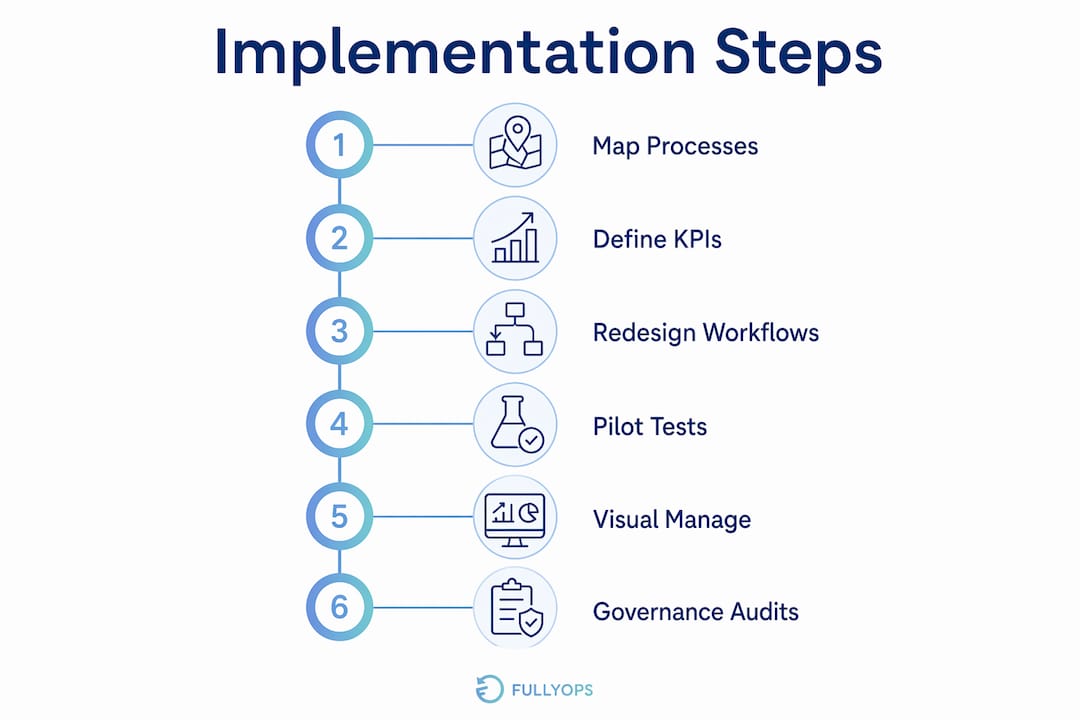
Step 1: Map high-cost and high-volume processes. Identify the five maintenance processes that consume the most labour hours or generate the most unplanned work. These are your highest-leverage targets. Use LucidChart or Miro to produce a current-state process map that every stakeholder can review and annotate.
Step 2: Define two to five outcome-focused KPIs with baseline metrics. Avoid the temptation to track everything. Two well-chosen KPIs with accurate baselines outperform ten poorly defined ones. MTTR and schedule compliance are the most actionable starting points for most facilities teams.
Step 3: Redesign workflows using standard operating procedures and checklists. Standard work is the foundation of every other improvement. Without it, daily management systems and governance structures have nothing stable to measure against. This is why standard work must precede governance and dashboard implementation.
Step 4: Execute changes in phases with pilot tests and feedback loops. Run your redesigned workflow on one asset class or one facility zone before full deployment. Collect technician feedback after two weeks and adjust the SOP before scaling. This prevents large-scale rollout of a process that works in theory but fails in practice.
Step 5: Establish a measurement cadence and visual management boards. Obeya rooms, the dedicated visual management spaces used by GE Aerospace and other manufacturers, boost output by 15% and reduce defects by 20% by making daily performance visible to the entire team. SQDIP metrics (Safety, Quality, Delivery, Inventory, Productivity) provide a structured daily review framework that keeps teams focused on the right priorities.
Step 6: Implement layered process audits and governance structures. Audits at the team leader, supervisor, and manager levels create accountability without micromanagement. Each layer checks compliance with standard work, not just output numbers.
| Rollout phase | Days | Focus area | Expected output |
|---|---|---|---|
| Diagnostics | 1 to 30 | KPI selection, baseline data, process mapping | Current-state map and gap analysis |
| Standardisation | 31 to 60 | SOP creation, pilot testing, first improvement cycles | Validated standard work documents |
| Governance | 61 to 90 | Audits, visual management, daily routines | Self-sustaining improvement system |
Consejo profesional: Schedule your first layered audit on day 45, not day 90. Early audits surface SOP gaps while there is still time to correct them before governance structures are formalised.
Operational managers looking to connect these steps to maintenance strategy examples will find that the most effective programmes combine scheduled preventive work with condition-based triggers, reducing both over-maintenance and reactive callouts.
What mistakes undermine operational efficiency initiatives?
The most common failure mode in business process optimisation is not a lack of tools. It is applying tools to processes that have not been redesigned. Automating a broken process produces operational noise rather than efficiency gains. The workflow must be corrected before any automation layer is added.
A second critical mistake is implementing governance before standard work is established. Daily management boards, KPI dashboards, and audit schedules all depend on stable, documented processes to function correctly. Organisations that skip straight to governance find their control systems measuring inconsistent activity, which produces misleading data and erodes team confidence in the programme.
The following pitfalls account for the majority of stalled improvement initiatives in maintenance and facilities management:
- Selecting KPIs that measure activity rather than outcomes (e.g., work orders raised vs. MTTR)
- Fragmented, short-term fixes that address symptoms without building cumulative capability
- Resistance from frontline technicians who were not involved in process design
- Over-measuring with more than five KPIs, which dilutes focus and creates reporting burden
- Sequencing governance before standard work, producing fragile operational results
Effective operational improvement reinforces capabilities over time, starting with discovery and problem surfacing. Short-term fixes and fragmented efforts consistently fail to produce lasting gains.
Consejo profesional: When you encounter resistance from a maintenance team, ask them to identify the three steps in their current process that waste the most time. Their answers will tell you where the real bottlenecks are, and their involvement will convert sceptics into advocates.
Sustaining operational gains requires building cumulative capabilities across the organisation, not repeating isolated improvement sprints. The distinction between a programme that lasts and one that fades within six months is almost always a governance and culture question, not a methodology question.
Principales conclusiones
Operational efficiency improvement in maintenance and facilities management requires sequenced execution: standard work first, then measurement, then governance, with methodology chosen to match the specific failure type.
| Punto | Detalles |
|---|---|
| Sequence matters above all | Standard work must be established before governance or dashboards are introduced. |
| Methodology must match the problem | Use Lean for waste, Six Sigma for variability, and integrated RCM for proactive reliability. |
| Baseline data is non-negotiable | Collect at least 90 days of data before setting KPI targets or redesigning workflows. |
| Visual management drives accountability | Obeya-style daily reviews keep teams aligned and surface problems before they escalate. |
| Culture determines sustainability | Frontline involvement in SOP design is the most reliable predictor of long-term adoption. |
What I have learned from watching operational programmes succeed and fail
The organisations that sustain operational efficiency gains share one characteristic that rarely appears in methodology guides: they treat process discipline as a leadership behaviour, not a project deliverable. When a facilities director personally reviews the visual management board each morning, the team understands that the programme is permanent. When that same director stops attending after 60 days, the programme quietly dissolves.
The second lesson is about sequencing. I have seen well-resourced organisations invest heavily in KPI dashboards and governance structures, only to discover that the underlying processes were never standardised. The dashboards measured chaos with precision. The correct order, diagnostics, standard work, measurement, governance, is not a suggestion. It is the load-bearing structure of any durable improvement programme.
The integration of Lean Six Sigma with proactive maintenance frameworks such as Reliability-Centred Maintenance and Risk-Based Inspection is, in my view, the most underutilised approach in facilities management. Most teams apply Lean or Six Sigma in isolation and wonder why gains plateau after the first improvement cycle. The combination of these disciplines is what moves maintenance from reactive firefighting to genuinely proactive asset management.
My final observation is this: operational improvement is not a project with an end date. The organisations that treat it as one will always revert to their previous state within 18 months. The ones that build it into their management operating system, through daily routines, layered audits, and visible metrics, are the ones still improving three years later.
— Pedro
How Fullyops supports your operational efficiency goals
Fullyops is built for exactly the kind of structured, data-driven improvement programme described in this guide. The platform provides real-time work order management, operational dashboards, and resource tracking that give maintenance and facilities teams the visibility they need to execute daily management routines without manual reporting overhead. For teams beginning their improvement journey, the tutorial de asignación de recursos covers how to deploy assets and personnel in alignment with your KPI priorities. Teams further along the maturity curve can explore the top maintenance software comparison to identify the platform configuration that best fits their operational scale and integration requirements.
PREGUNTAS FRECUENTES
What is operational efficiency improvement in maintenance?
Operational efficiency improvement in maintenance is the structured process of mapping workflows, eliminating waste, and applying data-driven methodologies to maximise asset reliability while reducing cost and downtime. It follows a defined cycle of diagnostics, standardisation, measurement, and governance.
Which KPIs should facilities managers track first?
MTTR and schedule compliance rate are the most actionable starting KPIs for facilities teams, as they directly reflect repair speed and planned maintenance execution. Add MTBF and first-pass yield once baseline data is established and standard work is in place.
How long does an operational improvement programme take to show results?
A 90-day rollout is the minimum timeline to move from diagnostics to a self-sustaining governance structure. Measurable KPI improvements typically appear between days 31 and 60, once standard work is validated and the first improvement cycles are complete.
What is the biggest mistake in operational efficiency initiatives?
Automating processes before redesigning them is the most damaging mistake, as it embeds existing inefficiencies into the new system. The second most common error is implementing governance structures before standard work is established, which produces unreliable performance data.
How does Lean Six Sigma apply to facilities management?
Lean Six Sigma combines waste elimination with statistical defect reduction, making it directly applicable to planned maintenance cycles, shutdown management, and work order quality. When integrated with Reliability-Centred Maintenance, it has produced 43% reductions in downtime in industrial maintenance environments.
Recomendado
- What is operational efficiency? A practical guide for leaders
- Optimiza la eficiencia con auditorías de mantenimiento: una guía completa
- Ejemplos de estrategias de mantenimiento para líderes operativos