

En resumen:
- Effective compliance management is a continuous system that aligns business operations with laws and internal policies. Leadership engagement, automation, and proactive monitoring are essential for maintaining regulatory adherence and supporting business growth. Treating compliance as a strategic asset builds trust, reduces risks, and enhances operational performance.
Compliance management is defined as the ongoing organisational process of aligning business operations with applicable laws, regulations, and internal policies to mitigate risk and ensure ethical conduct. In practice, it covers everything from GDPR and HIPAA data protection requirements to SOX financial controls and sector-specific safety standards. Organisations that treat compliance management as a continuous function rather than a periodic review are better positioned to avoid penalties, close deals faster, and build lasting trust with customers and regulators alike. This guide explains the compliance management definition, its core components, the importance of compliance management, and the best practices that separate high-performing programmes from those that fail at the first audit.
What is compliance management and what does it involve?
Compliance management is the structured system an organisation uses to identify its legal and regulatory obligations, implement controls to meet them, and verify those controls are working. The industry term for this system is a Compliance Management System, or CMS. A CMS is not a single tool or policy document. It is an integrated framework of processes, roles, and technologies that operates continuously across the business.

Compliance covers two distinct domains: corporate compliance, which governs adherence to internal policies and codes of conduct, and regulatory compliance, which governs adherence to external laws such as GDPR, HIPAA, and SOX. Both domains require active management. Neglecting either creates exposure.
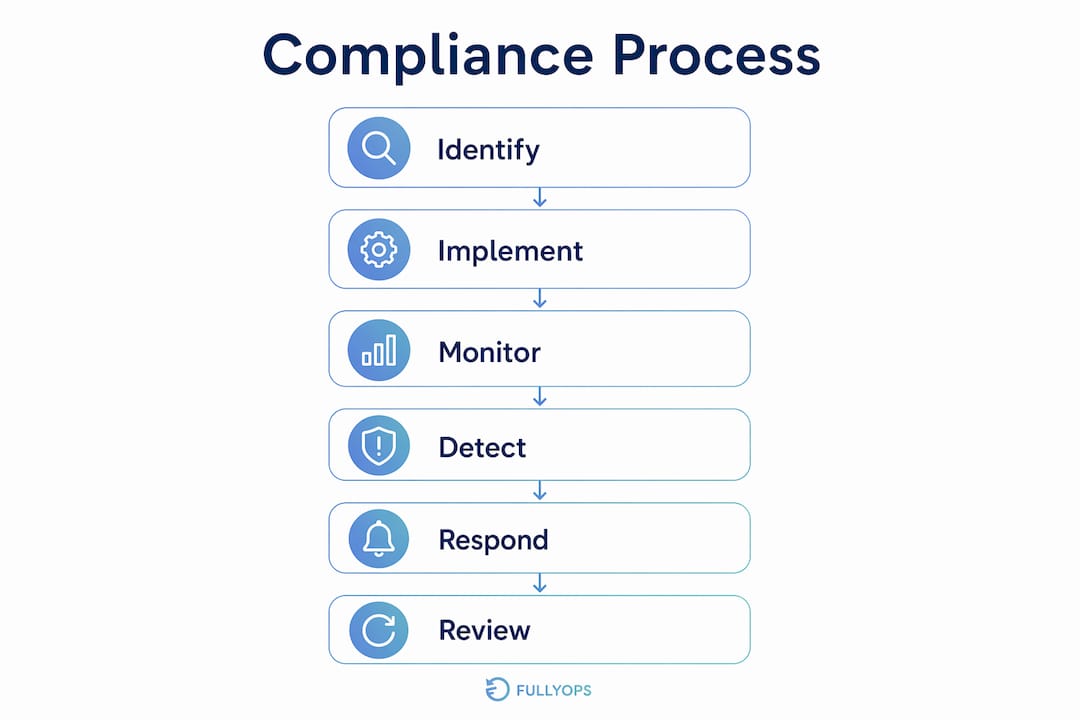
A CMS operates as a continuous cycle with six core stages: identifying obligations, implementing controls, monitoring, documenting, remediating, and reporting. Each stage feeds the next. Identifying a new regulatory obligation, for example, triggers a control implementation review, which in turn generates monitoring requirements and documentation tasks.
Consejo profesional: Embed compliance responsibilities into existing job descriptions and operational workflows from day one. When compliance is treated as a separate department’s problem, the rest of the organisation disengages and gaps appear.
Core components of an effective CMS
A well-structured CMS rests on several interdependent components. Understanding each one helps compliance officers allocate resources where they matter most.
| Component | Función |
|---|---|
| Board oversight | Sets the tone at the top and holds leadership accountable for compliance outcomes |
| Policies and procedures | Translates regulatory obligations into specific, enforceable internal rules |
| Training and awareness | Ensures employees understand their obligations and can act on them |
| Monitoring and testing | Verifies that controls are operating as intended on an ongoing basis |
| Audit and review | Provides independent assurance and identifies gaps before regulators do |
| Complaint response | Creates a channel for employees and customers to raise concerns without fear |
Effective board oversight and a formal compliance programme covering policies, training, monitoring, audit, and complaint response are the minimum regulators expect. This is not optional infrastructure. Regulators treat the absence of a formal CMS as evidence of systemic disregard for compliance obligations.
The distinction between corporate and regulatory compliance matters in practice. Corporate compliance failures, such as breaches of a code of conduct, are typically handled internally. Regulatory compliance failures, such as a GDPR data breach or a SOX reporting error, attract external scrutiny, fines, and in serious cases, criminal liability.
Why is compliance management important for business growth?
Compliance management delivers measurable business value beyond legal protection. Organisations with strong digital trust practices, including cybersecurity, data privacy, and responsible AI governance, see over 10% annual growth on both top and bottom lines. That figure reflects a direct link between compliance maturity and commercial performance.
Compliance is increasingly a business enabler, accelerating deal closure and improving vendor trust. Enterprise procurement teams now routinely require suppliers to demonstrate compliance certifications such as ISO 27001 or SOC 2 before contracts are signed. Organisations without these credentials lose deals to competitors who have them.
The risks of non-compliance are equally concrete. Penalties include:
- Financial fines: GDPR fines reach up to 4% of global annual turnover; SOX violations carry criminal penalties for executives.
- Litigation: Regulatory investigations frequently trigger class action lawsuits from affected customers or shareholders.
- Formal enforcement actions: Regulators can impose operational restrictions, consent orders, or mandatory corporate monitors.
- Reputational damage: Public enforcement actions reduce customer confidence and affect staff retention.
Non-compliance penalties can include litigation, fines, and formal enforcement actions that disrupt operations for years. An effective compliance programme also mitigates penalties and may prevent the imposition of corporate monitors during enforcement investigations. That outcome alone justifies the investment for most organisations.
How to implement compliance management effectively
The most common compliance management mistake is treating the function as an annual event. Compliance management is a continuous operational system, not a project with a start and end date. Organisations that run annual compliance reviews and consider the task complete are accumulating undetected risk between those reviews.
Practical implementation follows a clear sequence:
- Map your obligations. Identify every regulation, standard, and internal policy that applies to your organisation. Use a regulatory inventory tool or engage specialist legal counsel to avoid gaps.
- Assign ownership. Every obligation needs a named owner with the authority and resources to act. Shared ownership without accountability produces nothing.
- Implement controls. Design specific controls for each obligation. Document how each control works, who is responsible, and how it will be tested.
- Automate monitoring. Manual compliance monitoring does not scale. Automation tools that collect evidence continuously and flag anomalies reduce both workload and error rates.
- Train regularly. One-off induction training is insufficient. Quarterly refreshers tied to real incidents or regulatory updates keep compliance knowledge current.
- Review and improve. Schedule formal reviews after audits, incidents, or regulatory changes. Use findings to update controls and policies.
Automation and cross-framework mapping can reduce compliance workload by 40–60%. For organisations managing multiple regulatory frameworks simultaneously, such as GDPR alongside ISO 27001 and SOC 2, cross-framework mapping identifies overlapping controls so the same evidence satisfies multiple requirements. That efficiency gain is the difference between a compliance function that scales and one that collapses under its own administrative weight.
Mature organisations automate evidence collection and maintain audit readiness, which improves their market positioning. Audit readiness is not just about passing audits. It signals to customers, investors, and partners that the organisation is well governed.
Consejo profesional: Create a confidential reporting channel, such as an anonymous hotline or a dedicated email address, and communicate it actively. Employees who feel safe raising concerns are your earliest warning system for compliance failures.
What are the common challenges in compliance management?
The most dangerous compliance failure is not a missed regulation. It is a system that looks compliant on paper but does not function in practice. Leadership disengagement and paper compliance without enforcement lead directly to failed audits and regulatory action.
Common pitfalls include:
- Insufficient resources: Compliance functions that are understaffed cannot monitor, train, or remediate at the pace regulations require.
- Disengaged leadership: When senior leaders treat compliance as a legal department concern rather than a business priority, the rest of the organisation follows their lead.
- Formación inadecuada: Policies that employees have never read or do not understand provide no protection when regulators investigate.
- Reactive posture: Organisations that only act after an incident or audit finding are always behind the regulatory curve.
True compliance management requires active leadership engagement and must avoid a checkbox mentality to succeed. Holland & Knight
Overcoming these challenges requires governance structures that hold leaders accountable, not just compliance officers. Board-level compliance reporting, executive KPIs tied to compliance outcomes, and regular independent audits all create the accountability that paper systems lack. Continuous improvement is not a compliance aspiration. It is the mechanism that keeps a CMS functional as regulations evolve and the organisation grows.
For industrial and field service operations, a lista de verificación de cumplimiento de mantenimiento provides a practical starting point for embedding compliance into day-to-day operational workflows.
Principales conclusiones
Effective compliance management is a continuous operational system that requires board-level accountability, automated monitoring, and cross-framework controls to protect the organisation and drive measurable business growth.
| Punto | Detalles |
|---|---|
| Compliance management definition | A CMS aligns operations with laws, regulations, and internal policies through six continuous stages. |
| Leadership accountability | Board oversight and executive engagement are the foundation of any effective compliance programme. |
| Business growth link | Organisations with strong compliance and digital trust practices see over 10% annual growth on top and bottom lines. |
| Automation reduces workload | Cross-framework mapping and automated evidence collection cut compliance workload by 40–60%. |
| Paper compliance fails | Systems that exist on paper but lack enforcement lead to failed audits and formal regulatory action. |
Compliance as a strategic asset, not a cost centre
I have spent years working with operations and compliance teams across industrial and field service environments, and the pattern is consistent: organisations that treat compliance as a cost to be minimised eventually face a much larger cost when something goes wrong.
The shift I find most significant is the move from viewing compliance as a legal obligation to recognising it as a genuine competitive advantage. When your organisation can demonstrate audit readiness, produce evidence on demand, and show regulators a functioning CMS with board-level oversight, you are not just avoiding penalties. You are signalling to the market that you are a reliable partner.
Leadership culture is the variable that determines whether a compliance system works or merely exists. I have seen well-designed CMS frameworks fail because senior leaders communicated, through their behaviour rather than their words, that compliance was someone else’s problem. Conversely, I have seen lean compliance teams achieve excellent outcomes because their leadership treated every compliance decision as a business decision.
Technology will continue to reshape how compliance management works. Automated monitoring, real-time dashboards, and AI-assisted regulatory tracking are already reducing the manual burden significantly. But technology does not replace the governance structures and cultural commitments that make compliance real. The organisations that will lead in this area are those that integrate compliance with their broader operational performance strategy, treating it as a function that runs alongside operations rather than above or apart from them.
— Pedro
How Fullyops supports compliance in operations management
Fullyops is a field service and asset management platform built for industrial and maintenance-intensive environments. Its work order management, intervention tracking, and operational analytics features create the documented audit trails that compliance programmes depend on. When every maintenance task, resource allocation, and technician intervention is recorded in a centralised system, compliance evidence is generated as a by-product of normal operations rather than a separate administrative exercise. For compliance officers and operations managers looking to align asset management with regulatory requirements, the tutorial de asignación de recursos on the Fullyops platform offers a practical framework for building compliance-ready operational workflows from the ground up.
PREGUNTAS FRECUENTES
What is a compliance management system (CMS)?
A Compliance Management System is the integrated framework of policies, controls, monitoring processes, and governance structures an organisation uses to meet its legal and regulatory obligations continuously. It covers both internal policy adherence and external regulatory requirements such as GDPR, HIPAA, and SOX.
What does compliance management involve on a day-to-day basis?
Day-to-day compliance management involves monitoring controls, updating documentation, delivering training, reviewing incidents, and preparing evidence for audits. It is an operational function, not a periodic project.
How does compliance management reduce business risk?
An effective compliance programme mitigates financial penalties, reduces litigation exposure, and can prevent the imposition of corporate monitors during regulatory investigations. It also protects organisational reputation and supports faster commercial deal closure.
What is the difference between corporate and regulatory compliance?
Corporate compliance governs adherence to internal policies and codes of conduct, while regulatory compliance governs adherence to external laws and standards. Both require active management within a CMS framework.
How can automation improve compliance management?
Automation tools that collect evidence continuously and perform cross-framework mapping can reduce compliance workload by 40–60%, allowing compliance teams to manage multiple regulatory frameworks without proportional increases in headcount.
Recomendado
- ¿Qué es el cumplimiento de mantenimiento? Una guía para gerentes de operaciones
- Cumplimiento en la gestión de servicios: el valor operativo