

En resumen:
- Most organizations leak productivity through unrecognized systemic friction, costing billions annually. Implementing workforce efficiency measures requires assessing current performance, protecting focus time, and leveraging technology alongside process redesign. Sustained improvements depend on continuous monitoring, clear responsibilities, employee engagement, and fostering autonomy rather than micromanagement.
Most organisations are leaking productivity in ways that are difficult to spot until the cost becomes undeniable. Unproductive meetings alone cost businesses $37 billion annually, with employees losing 31 hours per month in sessions that produce little of value. For business leaders and operations managers, applying the right workforce efficiency improvement steps is not about working harder. It is about removing the systemic friction that prevents your team from doing their best work consistently, and building the structures that make high performance the default rather than the exception.
Índice
- Principales conclusiones
- Workforce efficiency improvement steps: where to begin
- Implementing core efficiency improvement steps
- Using technology wisely for workforce productivity
- Sustaining improvements through monitoring and culture
- My perspective on what most leaders get wrong
- How Fullyops supports your efficiency goals
- PREGUNTAS FRECUENTES
Principales conclusiones
| Punto | Detalles |
|---|---|
| Start with a baseline | Assess current performance using KPIs before implementing any changes to avoid misdirected effort. |
| Protect focus time | Scheduling deep work blocks and batching reactive tasks significantly reduces cognitive switching costs. |
| Use technology as an enabler | AI and analytics tools add value only when paired with workflow redesign and proper training. |
| Measure continuously | Track both leading and lagging indicators to catch bottlenecks before they affect output. |
| Connect work to purpose | Linking daily tasks to organisational goals improves engagement and discretionary effort over the long term. |
Workforce efficiency improvement steps: where to begin
Before you change anything, you need to understand precisely where your organisation stands. A data-driven baseline assessment of organisational maturity is the foundation of any credible improvement plan. Skipping this step is the single most common reason implementation efforts fail.
Defining your current state
Start by collecting the KPIs that reflect how your workforce currently operates. Useful starting points include output per team member, average time to complete work orders, meeting hours per week, and rates of rework or error. The goal is to build a factual picture rather than rely on assumptions or anecdotal reports from managers.
Align these measurements with your broader organisational objectives. If the business priority is reducing field service response times, your workforce efficiency metrics should reflect that directly. Misalignment between operational KPIs and strategic goals is a common cause of wasted effort, where teams improve metrics that have no material impact on the outcomes the business actually cares about.
- Map your processes end to end before optimising any individual step. Isolated fixes often shift bottlenecks rather than eliminate them.
- Segment your workforce data by team, role, and function to identify where inefficiency is concentrated rather than applying blanket solutions.
- Review governance structures to confirm that accountability for efficiency is clearly assigned. Improvement without ownership tends not to stick.
- Establish a change management foundation early. Successful workforce optimisation depends far more on organisational design and change management than on technology alone.
Consejo profesional: Use a balanced dashboard that combines lagging indicators (completed output, error rates) with leading indicators (focus time per day, meeting hours consumed) so you can spot bottlenecks before they affect results rather than after.
Once you have your baseline, set SMART goals that are specific enough to be actionable and tied to a realistic timeline. A target like “reduce average work order completion time by 15% within 90 days” is far more useful than “improve team efficiency.”
Implementing core efficiency improvement steps
With a clear baseline established, the next phase involves making concrete changes to how your team works. These steps address the most common sources of friction that reduce output without any single person being at fault.
-
Schedule deep work blocks. Task switching carries a 23-minute cognitive recovery cost every time an employee is interrupted. Protecting the first 90 minutes of the working day for uninterrupted, high-value work is one of the highest-leverage changes any operations team can make. This is not a matter of individual willpower. It requires a deliberate policy that your team agrees to and management actively protects.
-
Batch reactive tasks. Email, approvals, and status updates should be handled in defined windows rather than addressed as they arrive. When employees respond to every notification in real time, their day becomes a series of interruptions with little sustained progress on meaningful work. Designating two or three response windows per day reduces this fragmentation significantly.
-
Eliminate low-value tasks systematically. Removing the bottom 20% of tasks that add no meaningful output produces greater efficiency gains than prioritisation alone. Conduct a task audit with each team: list what people actually do each week, categorise tasks by impact and reversibility, and remove or delegate anything that does not contribute directly to defined goals.
-
Redesign the environment to support single-tasking. Open office layouts, shared notification settings, and unstructured availability norms all increase context switching. Physical and digital environments should be designed to make deep focus the path of least resistance, not something employees have to fight for individually.
-
Clarify responsibilities explicitly. Ambiguity about who owns a task is a significant source of delay and rework. RACI matrices or equivalent accountability frameworks help each team member understand their role in every process without needing to ask. This reduces both the meetings required to clarify ownership and the errors that occur when ownership is assumed rather than stated.
-
Negotiate communication norms organisation-wide. Leaders must set communication standards as policy rather than leaving each employee to manage their own availability. This means defining response time expectations, establishing asynchronous-first norms for non-urgent matters, and giving teams permission to hold focus time without social penalty.
Consejo profesional: When running a task audit, ask each team member to log their activities for five working days before the review meeting. Self-reported data from memory is typically incomplete and biassed toward visible work, whereas logged data reveals the true distribution of time.
Using technology wisely for workforce productivity

Technology is a genuine accelerator for improving employee productivity, but only when deployed against a clearly identified problem. The most common mistake leaders make is purchasing tools before understanding the workflow gaps they are meant to address.
Artificial intelligence offers real value in specific applications:
- Automating repetitive administrative tasks such as scheduling, reporting, and data entry frees technical staff for higher-value work. AI adoption boosts productivity only when paired with workflow redesign and skills training. Without these, the tool adds a layer of complexity rather than removing one.
- Operational analytics platforms allow managers to track team performance in real time, identify which processes are creating delays, and model the impact of proposed changes before full implementation. Fullyops provides this kind of operational visibility for asset-intensive and field service environments, where estrategias de gestión de recursos are closely tied to workforce output.
- Work order management systems reduce the coordination overhead that consumes field team time. When technicians receive clear, complete instructions with the right parts and access information attached, completion rates and first-time-fix rates improve measurably.
The risk of technology overreliance is real. Tools that are poorly configured, inadequately trained, or bolted onto broken processes do not improve efficiency. They add maintenance burden. Piloting solutions in a controlled setting before organisation-wide rollout is the standard best practice for managing this risk, as it allows you to fine-tune configuration and address resistance before scale introduces complexity.
For teams managing multiple field crews or distributed technicians, digital scheduling and dispatch tools that integrate with asset records reduce idle time and eliminate the manual coordination that slows response.
Sustaining improvements through monitoring and culture
Achieving a short-term efficiency gain is straightforward. Sustaining it across changing team composition, growing workloads, and shifting priorities is the harder problem. The following metrics and practices help you maintain and build on initial gains.
| Métrica | What it measures | Review frequency |
|---|---|---|
| Output per employee | Volume of completed, quality-approved work per person | Semanal |
| First-time completion rate | Percentage of tasks or work orders completed without rework | Semanal |
| Focus time per day | Average uninterrupted work hours per team member | Mensual |
| Meeting hours per week | Total time spent in scheduled meetings per team | Mensual |
| Employee engagement score | Team motivation, clarity, and satisfaction indicators | Trimestralmente |
Regular feedback loops are as important as the metrics themselves. Scheduled one-to-ones and team retrospectives give employees the opportunity to surface friction that data alone cannot capture. 62% of employees in wellness programmes report higher productivity levels, which reflects the broader principle that sustained performance depends on employee wellbeing, not just process design.
Connecting daily work to organisational purpose is a frequently underutilised driver of efficiency. Meaningful work increases engagement and discretionary effort in ways that process improvements alone cannot replicate. Operations leaders who communicate clearly why a task matters, and who that work ultimately serves, consistently report stronger and more durable performance gains.
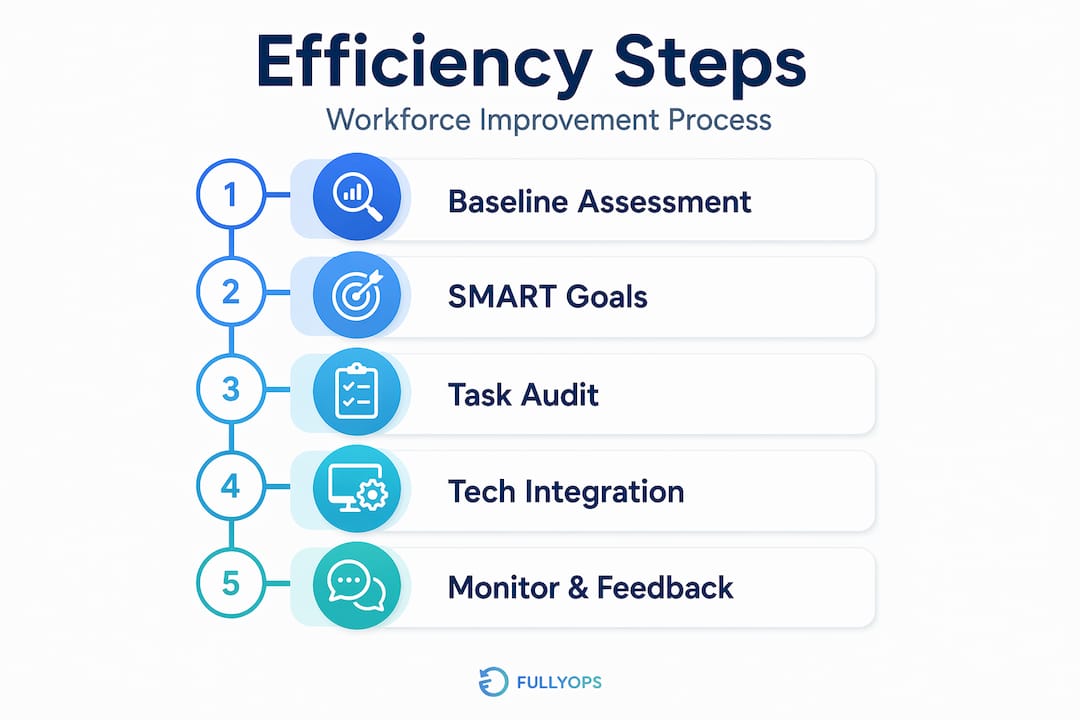
Consider establishing a dedicated continuous improvement team or centre of excellence responsible for reviewing performance data, running improvement cycles, and ensuring that the initial changes do not drift over time as new pressures emerge.
My perspective on what most leaders get wrong
I have observed, time and again, that operations leaders invest heavily in technology and process redesign while underestimating the human and cultural dimensions of workforce efficiency. The tools matter. The processes matter. But neither produces lasting results without addressing why people work the way they do.
Micromanagement is one of the most reliable ways to erode the discretionary effort that separates a functional team from a genuinely high-performing one. When employees feel that their autonomy is limited and their judgement is not trusted, they stop solving problems independently. They wait for instruction instead. That behaviour looks like a performance problem, but it is almost always a leadership problem.
What I have found works consistently well is removing friction rather than adding pressure. Improving output through systemic friction removal and giving teams genuine autonomy over how they achieve defined outcomes produces far more than any productivity monitoring tool. The teams that perform best are usually the ones that understand the purpose of their work, have clear goals, and are left to execute without unnecessary interference.
The workforce efficiency improvement steps that produce the most durable gains are not the most technically sophisticated. They are the ones that make it easier for people to do good work and harder for them to get distracted from it.
— Pedro
How Fullyops supports your efficiency goals
If you are at the stage of translating these workforce efficiency improvement steps into operational tools and measurable processes, Fullyops offers a practical starting point. The platform’s work order management, operational analytics, and resource allocation capabilities are built specifically for asset-intensive and field service environments where team efficiency is directly tied to asset availability and scheduling accuracy.
En tutorial de asignación de recursos walks operations managers through optimising how resources are assigned across tasks and assets, which directly reduces idle time and rework. For a broader foundation, the operational efficiency guide covers the strategic and tactical dimensions leaders need when building a performance improvement programme. Fullyops also provides the reporting and integration capabilities to keep your efficiency gains visible and verifiable over time.
PREGUNTAS FRECUENTES
What are the first workforce efficiency improvement steps to take?
Start with a baseline assessment that maps current KPIs, identifies where time is lost, and aligns efficiency goals with organisational objectives. Without a data-driven starting point, improvement efforts tend to address symptoms rather than root causes.
How do you measure workforce performance effectively?
Use a combination of lagging indicators such as output volume and error rates alongside leading indicators like focus time and meeting hours. Reviewing both weekly and monthly gives you early warning of emerging bottlenecks before they reduce output.
Why does task switching reduce productivity so significantly?
Each interruption carries a 23-minute cognitive recovery period before an employee returns to full focus. When this happens multiple times per day across a team, the cumulative productivity loss is substantial and largely invisible in standard performance reports.
How does employee engagement affect workforce efficiency?
Engagement directly influences discretionary effort, the additional work employees choose to contribute beyond minimum requirements. Teams where individuals understand the purpose of their work and feel their contribution is recognised consistently outperform those operating purely on process compliance.
When should technology be introduced in an efficiency improvement plan?
Technology should be introduced after the baseline assessment and workflow redesign phases, not before. Introducing tools into unmapped or broken processes adds complexity. Once target workflows are defined and piloted, technology accelerates adoption and provides the analytics needed to verify results.
Recomendado
- Cómo mejorar la eficiencia del servicio de campo: 42%, menos tiempo de inactividad
- 7 estrategias probadas de gestión de recursos para la eficiencia de los activos
- What is operational efficiency? A practical guide for leaders
- 7 pasos para una lista de control eficaz de la gestión de órdenes de trabajo