

TL;DR:
- Properly implemented maintenance automation shifts focus from reactive to proactive asset management.
- Automation reduces unplanned downtime, extends asset lifespan, and cuts maintenance costs.
- Challenges include workforce resistance and system integration, which require careful change management.
Automation in industrial maintenance is frequently misunderstood. Many operations managers assume it is primarily about reducing headcount, but the real story is far more nuanced. When applied correctly, automation transforms how maintenance teams work, shifting the focus from reactive firefighting to proactive asset management. For asset-heavy industries facing rising operational complexity and cost pressures, this shift is no longer optional. This article examines what maintenance automation actually means, the concrete benefits it delivers, the tools available, the challenges you will face, and the practical steps to implement it effectively in your organisation.
Table of Contents
- What automation means in modern maintenance
- Key benefits of automation in maintenance
- Common types of maintenance automation solutions
- Challenges of automation in maintenance and how to overcome them
- Best practices for applying automation in your maintenance workflow
- A fresh perspective on automation’s real impact
- Unlock efficiency gains with the right automation partner
- Frequently asked questions
Key Takeaways
| Point | Details |
|---|---|
| Efficiency boost | Automation streamlines maintenance tasks and reduces downtime for all asset-heavy industries. |
| Cost reduction | Automated systems cut unnecessary manual work and enable predictive, cost-effective operations. |
| Strategic adoption | Starting with high-ROI automation areas and strong change management delivers the best results. |
| Right tools matter | The best automation solutions integrate smoothly with your existing maintenance processes for rapid impact. |
What automation means in modern maintenance
Maintenance automation refers to the use of technology to perform, schedule, monitor, or manage maintenance tasks with minimal manual intervention. It is distinct from general industrial automation, which focuses on production processes. Maintenance automation specifically targets the workflows, data collection, and decision-making that keep assets running reliably.
Several enabling technologies underpin this field:
- Sensors and IoT devices that continuously monitor equipment condition, temperature, vibration, and performance in real time
- Computerised Maintenance Management Systems (CMMS) that automate work order creation, scheduling, and reporting
- AI-powered diagnostics that analyse patterns in operational data to predict failures before they occur
- Digital communication tools that connect technicians, managers, and systems without paper-based processes
The areas most commonly automated in maintenance include work order management, preventive maintenance scheduling, asset condition monitoring, parts inventory tracking, and compliance reporting. Automation tools like CMMS are a foundation of digital maintenance, providing the operational backbone that connects people, assets, and data.
For organisations managing large fleets of equipment or complex facilities, automation in asset management represents one of the most impactful investments available. The ability to automatically trigger a work order when a sensor detects an anomaly, for instance, eliminates the lag between a problem appearing and a technician being dispatched.
Statistic: Industries adopting maintenance automation report significant reductions in reactive maintenance costs, with some organisations shifting from 80% reactive to 80% planned maintenance within two years of implementation.
Pro Tip: When identifying where to start with automation, target the processes that consume the most manual effort or generate the most unplanned work. These areas typically offer the highest return on investment and the fastest payback period.
Key benefits of automation in maintenance
Now that you understand what automation is, let’s see the specific value it offers maintenance operations. The gains are measurable, consistent, and well-documented across industries.
| Benefit | Example | Typical metric |
|---|---|---|
| Reduced unplanned downtime | Automated alerts trigger work orders before failure | Up to 70% fewer breakdowns |
| Extended asset life | Scheduled preventive tasks based on usage data | 20-30% longer asset lifespan |
| More predictable costs | Planned maintenance replaces emergency spend | 15-25% reduction in maintenance costs |
| Improved compliance | Automated records and audit trails | Near-100% documentation accuracy |
| Faster technician response | Digital work orders with full asset history | 30-40% reduction in time-to-repair |
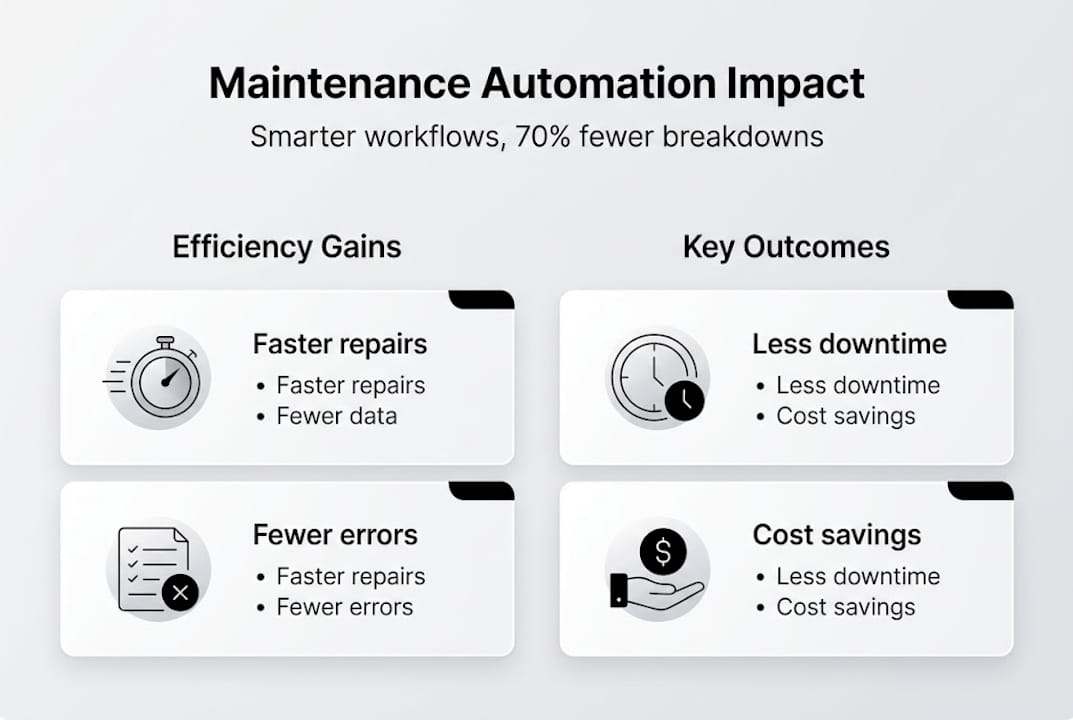
Predictive maintenance enabled by automation can reduce breakdowns by up to 70%, which has a direct and substantial impact on production continuity and operational budgets. For operations managers, this means fewer emergency call-outs, less overtime expenditure, and more consistent throughput.
The shift from reactive to planned maintenance is perhaps the most significant operational change automation enables. When maintenance scheduling strategies are driven by real-time asset data rather than fixed calendars, maintenance becomes genuinely proactive. Teams spend less time responding to crises and more time on value-adding activities.
Field service automation also reduces administrative burden. Technicians spend less time completing paperwork and more time on skilled work, which improves both productivity and job satisfaction.
Pro Tip: Automation’s biggest return comes from integrating predictive condition monitoring with automated scheduling. When a sensor flags an anomaly and the system automatically schedules a technician with the right parts, you eliminate almost all the delays that make unplanned downtime so costly.
Common types of maintenance automation solutions
With clear benefits established, the next step is to understand what automation tools are available for maintenance. CMMS, EAM, and IoT platforms are among the primary tools automating maintenance today, each serving a distinct purpose within a broader strategy.
| Software type | Key features | Best suited for |
|---|---|---|
| CMMS | Work order management, scheduling, reporting | Teams managing planned and preventive maintenance |
| EAM (Enterprise Asset Management) | Full asset lifecycle tracking, procurement, compliance | Large organisations with complex asset portfolios |
| IoT-based monitoring | Real-time condition data, automated alerts | High-value or critical equipment |
| AI-powered analytics | Failure prediction, pattern recognition | Organisations with mature data infrastructure |
| Digital work order platforms | Mobile-first task management, technician dispatch | Field service and multi-site operations |
Understanding the range of asset management systems available helps you match the right tool to your operational context. Not every organisation needs an enterprise-grade EAM on day one.
Here is a structured approach to selecting the right solution:
- Audit your current workflows to identify the highest-friction processes and data gaps
- Define your primary objective, whether that is reducing downtime, improving compliance, or cutting costs
- Shortlist solutions that address your primary objective and integrate with your existing systems
- Request a pilot or trial on a defined asset group or site before committing to full deployment
- Evaluate integration capability as a non-negotiable criterion, particularly for legacy equipment
Pro Tip: Prioritise solutions that offer open APIs or pre-built integrations with your existing ERP or SCADA systems. Integration complexity is one of the leading causes of delayed ROI in automation projects.
Challenges of automation in maintenance and how to overcome them
While the benefits are clear, there are important roadblocks to consider on the path to automation. Understanding these challenges in advance allows you to plan mitigations rather than react to them.
The most common obstacles include:
- Workforce resistance, where technicians and supervisors fear job displacement or distrust new systems
- Poor data quality, where inconsistent historical records undermine predictive models and reporting
- High upfront costs, particularly for IoT infrastructure and software licensing
- Integration with legacy systems, where older equipment lacks the connectivity needed for modern platforms
Workforce resistance and integration complexity are major obstacles to automation adoption, and both require sustained leadership attention rather than one-off training sessions.
“Successful automation projects are 80% about people and process change, and only 20% about the technology itself. Organisations that treat automation as a software purchase rather than an organisational transformation consistently underperform.”
Proven strategies for addressing these challenges include:
- Running a phased roll-out that starts with one site or asset class, demonstrating value before scaling
- Investing in structured training that helps technicians see automation as a tool that makes their work easier, not a threat
- Securing leadership buy-in at the outset, so that resource allocation and change management have executive support
- Maintaining continuous communication with frontline staff throughout the implementation, addressing concerns as they arise
For teams managing efficient technician deployment, automation should be framed as a way to reduce wasted travel time and administrative work, not as a monitoring mechanism.

Best practices for applying automation in your maintenance workflow
Having understood the hurdles, let’s focus on practical tactics for making automation work in your organisation. A structured, evidence-based approach significantly improves outcomes.
Follow these steps to implement automation effectively:
- Assess your current workflows in detail, mapping every manual step and identifying where delays, errors, or inefficiencies occur most frequently
- Identify automation candidates by ranking processes according to frequency, cost of failure, and ease of automation
- Evaluate and pilot solutions on a limited scope, such as one production line or one asset category, to gather real performance data
- Measure outcomes rigorously using KPIs such as mean time between failures (MTBF), planned maintenance percentage, and cost per work order
- Scale up based on pilot results, expanding automation to additional sites or asset classes with a refined implementation approach
A phased, pilot-first approach increases the success rate for maintenance automation projects considerably, as it allows teams to learn and adapt before committing full resources.
When setting up automated schedules, ensure that your scheduling logic reflects actual asset usage data rather than generic manufacturer recommendations. Usage-based scheduling consistently outperforms calendar-based approaches in asset-heavy environments.
Pro Tip: Start your pilot on assets where failure has a high operational impact but where the risk of disruption during implementation is manageable. This maximises the visibility of your results while limiting exposure.
A fresh perspective on automation’s real impact
Most conversations about maintenance automation centre on technology selection: which platform, which sensors, which algorithms. This focus, while understandable, misses the more consequential question of how automation changes the nature of maintenance work itself.
The organisations that extract the most value from automation are not necessarily those with the most sophisticated tools. They are the ones that redesign their processes around the capabilities automation provides and invest in helping their teams use those capabilities confidently. Automation should amplify the reliability and safety contributions that experienced technicians already make, not diminish them.
There is also a strong case for starting smaller than most consultants recommend. Targeting a single, well-defined bottleneck, such as reactive work order generation or parts availability delays, and automating it thoroughly yields faster, more tangible gains than attempting a broad transformation. Managers who track emerging maintenance trends will recognise that the most effective implementations in 2026 share this characteristic: focused scope, clear metrics, and genuine workforce involvement from the outset.
Unlock efficiency gains with the right automation partner
If you are ready to move from insight to action, FullyOps provides a purpose-built platform for operations managers and maintenance coordinators in asset-heavy industries. From resource allocation automation to work order management, real-time asset tracking, and performance analytics, FullyOps is designed to make automation practical rather than aspirational. Explore the range of maintenance automation platforms available through FullyOps to find the configuration that fits your team’s scale and operational complexity. Whether you are running a pilot or scaling across multiple sites, FullyOps offers the integrations and reporting tools to support every stage of your automation journey.
Frequently asked questions
How does automation reduce maintenance costs?
Automation cuts costs by minimising unplanned downtime, optimising resource use, and reducing unnecessary manual tasks. Predictive maintenance enabled by automation can reduce breakdowns by up to 70%, directly lowering emergency repair expenditure.
What are examples of maintenance automation technologies?
Popular solutions include CMMS platforms, IoT sensors, digital work order apps, and AI-based predictive analytics. CMMS, EAM, and IoT platforms are among the primary tools automating maintenance today across industrial sectors.
What is the biggest challenge with automation in maintenance?
The toughest hurdle is often workforce resistance or adapting processes to new technologies. Workforce resistance and integration complexity are major obstacles to automation adoption and require proactive change management strategies.
Can small teams benefit from maintenance automation?
Yes, even small teams gain from improved scheduling, data accuracy, and easier reporting using automation. A phased, pilot-first approach increases the success rate for maintenance automation projects, making it accessible regardless of team size.