

TL;DR:
- Top-performing field service organizations reduce failed visits significantly through high-quality, integrated mobile solutions.
- Mobile tools improve KPIs like first-time fix rate and reduce costs by providing real-time data and asset history access.
- Successful implementation focuses on process redesign, training, system integration, and fostering team adoption.
Failed service visits account for 25% of service expenses, yet top-performing field service organisations consistently demonstrate that this cost is avoidable. The difference between teams that struggle and those that excel often comes down to one factor: the quality and integration of their mobile solutions. For operations managers in industrial settings, the pressure to reduce costs, improve reliability, and keep technicians productive in the field has never been greater. This article examines what modern mobile solutions actually involve, how they affect the metrics that matter most, and what practical steps your organisation can take to capture measurable gains.
Table of Contents
- Understanding mobile solutions in field service management
- Key benefits of mobile solutions for efficiency and reliability
- Features to prioritise in mobile-first field service management
- Real-world results and implementation best practices
- Why effective mobile adoption is about processes, not just tech
- Bring mobile-driven gains to your field service team
- Frequently asked questions
Key Takeaways
| Point | Details |
|---|---|
| Boost efficiency metrics | Mobile solutions can elevate first-time fix rates and reduce repair times when adopted well. |
| Prioritise essential features | Focus on AI-driven scheduling, integration capability, and reporting tools when selecting mobile FSM solutions. |
| Success needs more than tech | Lasting gains require aligning mobile tools with effective processes and team engagement, not just software deployment. |
| Visible cost savings | Top-performing teams using mobile intelligence can cut failed visit expenses by up to 26 percent. |
Understanding mobile solutions in field service management
To understand the potential, let’s first define what modern mobile solutions mean in the field service context. In field service management (FSM), mobile solutions refer to the combination of connected devices, purpose-built applications, cloud infrastructure, and intelligent scheduling tools that enable technicians to work efficiently away from a fixed location. This goes well beyond simply giving engineers a smartphone. It means equipping your workforce with real-time access to asset histories, work order updates, parts availability, and remote expert support, all from wherever the job takes them.
Core technologies involved in a mature mobile FSM setup typically include:
- Mobile applications designed for field service workflows, including job acceptance, status updates, and digital sign-off
- Cloud connectivity that synchronises data between field teams, back-office systems, and management dashboards without delay
- AI-driven scheduling that optimises dispatch based on technician skills, location, and parts availability
- Rugged hardware built to withstand industrial environments, including dust, moisture, and temperature extremes
- Offline access that allows technicians to continue working even when connectivity is intermittent
The main drivers pushing industrial organisations towards these tools are consistent. Operations managers need real-time data to make informed decisions, faster response times to reduce asset downtime, and reliable communication between field and office teams. Without this infrastructure, even experienced technicians are forced to work with incomplete information.
“Mobile intelligence and connected systems are directly tied to significant cost reductions and first-time fix improvements across field service organisations of all sizes.”
The shift towards digital transformation in field service is not a trend reserved for large enterprises. Mid-sized industrial operators are increasingly adopting mobile FSM platforms to remain competitive, reduce administrative overhead, and give their technicians the tools they need to resolve issues on the first visit.
Key benefits of mobile solutions for efficiency and reliability
Now that you know what mobile solutions are, let’s examine why they matter in practice. The impact of mobile tools on field service performance is measurable and well-documented. Three key performance indicators (KPIs) consistently improve when organisations adopt mobile FSM platforms: first-time fix rate (FTF), mean time to repair (MTTR), and cost per service visit.
| Performance tier | First-time fix rate | Estimated cost saving potential |
|---|---|---|
| Top performers (mobile-enabled) | 88% | Up to 26% reduction |
| Average performers | 74% | Moderate improvement |
| Bottom performers (limited mobile) | 60% | Minimal or negative |
Top field service teams using mobile solutions reach an 88% FTF rate, compared to just 60% for bottom performers, and can cut failed visit costs by up to 26%. These are not marginal gains. For an organisation running hundreds of service calls per month, the financial impact is substantial.
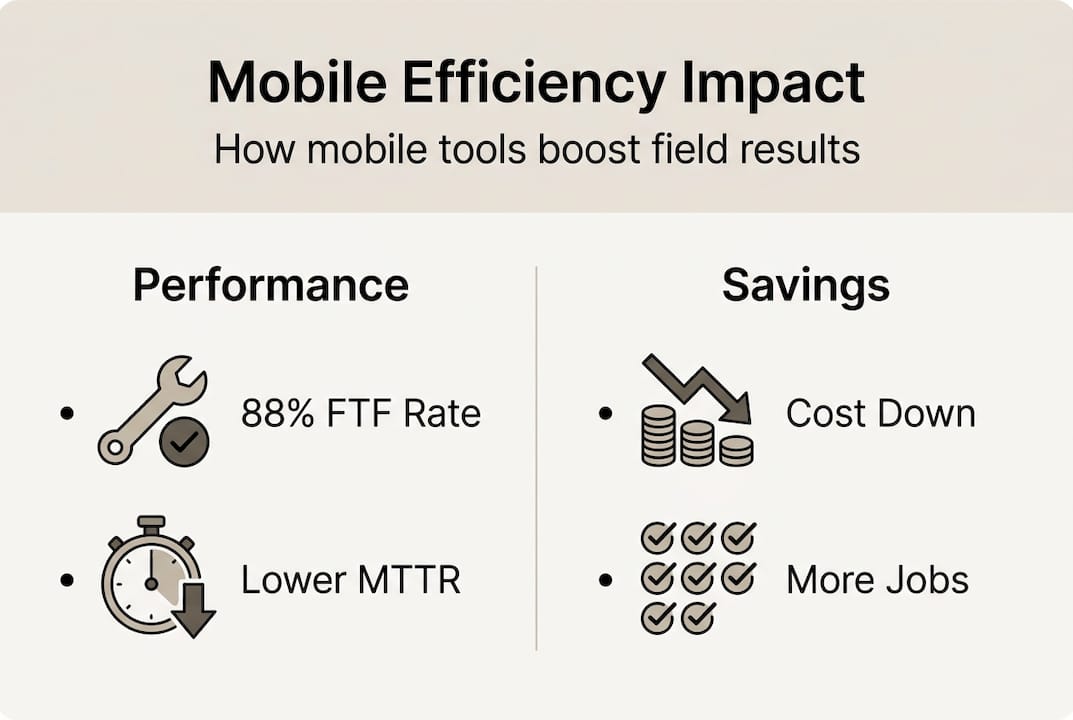
How does mobile access actually produce these results? The answer lies in the quality of information available at the point of service. When a technician arrives on site with full visibility of the asset’s service history, current fault codes, and the correct parts already loaded in their vehicle, the probability of resolving the issue in a single visit rises sharply. Errors caused by incomplete job briefs or missing documentation drop significantly.
The practical steps that drive these improvements include:
- Providing technicians with digital access to asset manuals and service histories before arrival
- Using AI scheduling to match the right engineer to each job based on skills and parts inventory
- Enabling real-time status updates so dispatchers can re-prioritise dynamically
- Capturing job data digitally to feed back into performance reporting and field service software advantages
- Integrating mobile tools with inventory systems to reduce parts shortages on-site
Pro Tip: Start tracking FTF and MTTR before you deploy a new mobile platform. Having a clear baseline makes it far easier to demonstrate ROI to stakeholders and identify which workflows are improving fastest after go-live.
For operations managers looking to optimise field service management, these KPIs provide the clearest evidence of whether a mobile solution is delivering value.
Features to prioritise in mobile-first field service management
Understanding the benefits, it’s crucial to know what to look for when choosing a mobile FSM platform. Not all solutions are equal, and selecting the wrong platform can result in low adoption, poor data quality, and wasted investment. Operations managers should evaluate platforms against a defined set of criteria before committing.
The most important features to look for include:
- AI-driven dispatch and scheduling: Automatically assigns jobs based on technician proximity, skill set, and parts availability, reducing manual coordination and improving response times
- Offline functionality: Field environments are rarely ideal for connectivity. A platform that degrades without signal will frustrate technicians and create data gaps
- Integration with asset tracking systems: Seamless data flow between mobile tools and your asset management or ERP system ensures technicians always have accurate, up-to-date information
- Customisable workflows: Industrial operations vary widely. A platform that allows you to tailor checklists, approval steps, and reporting fields to your specific processes will see far higher adoption
- KPI tracking and reporting: The platform must measure and surface FTF, MTTR, and cost per visit automatically, not require manual extraction
Operations leaders should focus on AI-driven dispatch, rugged hardware compatibility, and built-in KPI tracking to achieve optimal cost savings from mobile FSM investments.
Device durability also deserves attention. Consumer-grade tablets and smartphones are not built for industrial environments. Platforms that support rugged, certified hardware reduce the risk of device failure mid-job and lower long-term replacement costs.

Pro Tip: When evaluating platforms, ask vendors for a demonstration using your actual workflows, not a generic demo script. This reveals usability gaps that only appear with real operational data.
Refer to a mobile workforce management guide to map your current processes against these criteria before beginning vendor conversations. The clearer your requirements, the faster the selection process and the smoother the implementation.
Real-world results and implementation best practices
Let’s turn from features to implementation. What actually changes in daily field service operations when mobile solutions are properly deployed?
Industry benchmarks from 2026 show consistent patterns among organisations that achieve strong results. The common thread is not the technology itself but how it is introduced and sustained within the team.
| Implementation factor | Impact on outcomes |
|---|---|
| Structured onboarding programme | Higher technician adoption rates |
| Clear KPI targets set pre-launch | Faster demonstration of ROI |
| Integration with existing systems | Reduced data duplication and errors |
| Ongoing training and support | Sustained performance improvement |
A practical roll-out follows these steps:
- Audit current workflows to identify where delays, errors, and communication gaps occur most frequently
- Define success metrics before go-live, including target FTF rate, MTTR reduction, and cost per visit benchmarks
- Pilot with a small team to surface usability issues and gather technician feedback before full deployment
- Integrate with back-office systems including inventory, scheduling, and asset databases to ensure data consistency
- Train continuously, not just at launch. Regular refreshers and peer-led knowledge sharing sustain adoption over time
“Proper scaling of mobile knowledge can unlock major cost and performance gains in field service teams, but only when the rollout is managed with the same rigour as the technology selection.”
Common challenges include resistance from experienced technicians who are comfortable with existing methods, data integrity issues during migration, and difficulty securing management buy-in without early evidence of results. Addressing these requires clear communication about why the change is happening, what the expected outcomes are, and how individual technicians will benefit. To boost field service profitability, the human side of implementation deserves as much attention as the technical configuration.
Why effective mobile adoption is about processes, not just tech
Having explored best practices, it’s worth reflecting on what truly fuels long-term improvement. There is a common assumption in industrial operations that deploying a new platform will, by itself, fix performance problems. It will not. Technology surfaces inefficiencies and enables better decisions, but it cannot correct a broken scheduling process or substitute for a team that lacks clear accountability.
Organisations that see the strongest results from mobile FSM tools are those that treat the deployment as a process redesign project, not a software installation. They revisit how jobs are assigned, how parts are ordered, and how technician performance is reviewed. The tools make these processes faster and more visible, but the processes themselves must be sound.
Focusing on culture and communication is equally important. When technicians understand how mobile data improves their working day, such as fewer repeat visits, clearer job briefs, and faster approvals, adoption follows naturally. Operations managers who optimise field service processes alongside technology deployment consistently outperform those who treat the two as separate workstreams.
Bring mobile-driven gains to your field service team
Ready to put these insights into practice? FullyOps provides industrial operations teams with the tools to manage work orders, track asset performance, and measure the KPIs that matter most, all from a single connected platform. Whether you are starting with resource allocation for asset management or building a complete view of your asset lifecycle management, FullyOps gives your team the real-time visibility needed to act quickly and accurately. Explore our maintenance tracking tools designed specifically for industrial field service environments and see how your operation can move from reactive to proactive.
Frequently asked questions
What are mobile solutions in field service management?
Mobile solutions refer to apps and connected devices that enable engineers to access asset data, update work orders, and communicate in real time from the field. These connected systems scale knowledge across the entire workforce, reducing reliance on individual expertise.
How do mobile solutions impact first-time fix rates?
Mobile tools improve first-time fix rates by giving technicians immediate access to asset histories, parts data, and remote expert support before and during a job. Top organisations with mobile intelligence consistently reach an 88% first-time fix rate.
Which KPIs should field service managers monitor with mobile solutions?
Managers should prioritise first-time fix rate (FTF), mean time to repair (MTTR), and cost per service call to measure mobile solution impact accurately. FTF and MTTR are recognised as the critical benchmarks for mobile-enabled field service performance.
How can companies ensure successful adoption of mobile solutions?
Successful adoption depends on structured training, clear KPI targets set before go-live, and integrating mobile tools with existing workflows rather than running them in parallel. Scaling knowledge and change management are the primary drivers of realising cost savings from mobile FSM investments.
Recommended
- Harness mobile apps to enhance field service efficiency
- Field Service Management: Optimize & Boost Efficiency – FullyOps
- What is mobile workforce management: a complete guide
- 6 Key Advantages of Field Service Software for Efficiency
- Mobile sales tools: Boost B2B sales efficiency 2026