

TL;DR:
- Maintenance costs can account for up to 40% of industrial budgets and are often mismanaged.
- Proactive maintenance and digitized workflows significantly reduce overall costs and improve asset reliability.
- Managing data, culture, and leadership is essential for sustained maintenance cost reduction and operational excellence.
Maintenance spend is one of the largest controllable costs in any industrial operation, yet it is frequently mismanaged. Many facilities managers operate under the assumption that deferring repairs or running equipment until failure is the economical choice. In practice, the opposite is true. Unplanned breakdowns consume budget at an alarming rate, erode asset reliability, and create safety risks that planned maintenance would have prevented. This guide examines why maintenance costs spiral, what drives them, and how operational directors can implement proven strategies to reduce spend, extend asset life, and build a more predictable, efficient maintenance programme.
Table of Contents
- The true impact of maintenance costs on operations
- Key factors driving maintenance costs
- Why reducing maintenance costs matters: tangible benefits
- Actionable strategies for reducing maintenance costs
- Rethinking maintenance: what most managers miss about cost reduction
- Take control of your maintenance costs with the right tools
- Frequently asked questions
Key Takeaways
| Point | Details |
|---|---|
| Maintenance costs matter | Uncontrolled spend damages efficiency, safety, and business results. |
| Key drivers identified | Focus on preventive strategies and smarter cost tracking to find savings. |
| Digital solutions accelerate gains | Technology delivers fast, measurable reductions in downtime and spend. |
| A strategic approach pays off | Reducing costs is the first step towards high-performing asset management. |
The true impact of maintenance costs on operations
Maintenance expenditure is not a peripheral line item. In capital-intensive industries such as manufacturing, utilities, and logistics, maintenance costs can account for 15 to 40 percent of total operating budgets. For a mid-sized facility running on tight margins, that figure represents a significant lever for either financial improvement or financial damage.
The costs themselves fall into two broad categories. Direct costs include labour, spare parts, contractor fees, and equipment hire. Indirect costs are often harder to quantify but equally damaging: production downtime, lost throughput, customer penalties for missed delivery commitments, and accelerated asset degradation. Both categories compound one another. A single unplanned failure can trigger emergency procurement at premium prices, overtime labour charges, and a cascade of delayed production schedules.
The risks of uncontrolled maintenance spend extend well beyond the finance department:
- Asset failures that reduce productive capacity and require capital replacement earlier than planned
- Unplanned outages that disrupt production schedules and damage client relationships
- Safety incidents linked to poorly maintained equipment, with associated regulatory and legal consequences
- Reduced return on investment as assets underperform relative to their acquisition cost
Perhaps the most important statistic for any facilities manager to internalise is this: reactive maintenance costs up to five times more than planned maintenance. That multiplier alone reframes the entire cost conversation.
“The true cost of reactive maintenance is rarely visible until after the failure. By then, the budget damage is already done.”
Establishing robust cost tracking is the essential first step. Without accurate data on where money is being spent, it is impossible to identify the highest-impact areas for improvement. Facilities teams that track maintenance costs systematically are consistently better positioned to make evidence-based decisions, justify budget requests, and demonstrate ROI to senior leadership.
With this context in mind, it is crucial to move from awareness to identifying the main drivers behind maintenance costs.
Key factors driving maintenance costs
Understanding what inflates maintenance spend is the precondition for controlling it. Several factors recur across industrial environments, regardless of sector or asset type.
Equipment age is a primary driver. Older assets require more frequent intervention, consume more parts, and are increasingly difficult to source components for. As machinery ages beyond its design life, failure rates accelerate and repair complexity increases.
Lack of preventive maintenance is equally significant. Facilities that operate predominantly in a reactive mode spend more per repair, experience more frequent failures, and carry higher inventory buffers to manage unpredictable demand. Unplanned repairs cost two to five times more than scheduled preventive work, making the case for structured preventive maintenance steps compelling.
Poor data practices are a less obvious but highly consequential driver. When maintenance records are incomplete, stored in spreadsheets, or not captured at all, teams lose visibility into failure patterns, parts consumption, and technician productivity. Decision-making defaults to intuition rather than evidence.
| Cost driver | Typical impact |
|---|---|
| Emergency parts procurement | 20 to 40% premium over planned orders |
| Overtime labour for reactive repairs | 30 to 50% uplift on standard rates |
| Outdated assets beyond design life | Higher failure frequency and parts scarcity |
| Unstructured work order management | Duplicated effort and missed tasks |
| Reactive repair cycles | Cumulative budget overruns quarter on quarter |
Behaviours that signal inefficiency are worth monitoring closely. Frequent ad hoc purchase orders, a high ratio of unplanned to planned work, repeated failures on the same assets, and technicians spending significant time sourcing parts rather than performing work are all indicators that cost tracking methods and planning processes need attention.
Pro Tip: Track total cost of ownership across each asset’s lifetime, not just the cost of individual repairs. This reveals which assets are consuming disproportionate resources and informs replacement versus repair decisions with real data.
Now that we have identified which factors inflate costs, understanding the specific benefits of cost reduction becomes even clearer.
Why reducing maintenance costs matters: tangible benefits
Reducing maintenance costs is not simply about spending less. It is about spending more intelligently, so that assets perform reliably, operations run smoothly, and budgets remain predictable. The evidence for proactive approaches is substantial.

Companies adopting preventive maintenance can reduce overall maintenance costs by up to 25 percent. That figure translates directly into freed capital that can be reinvested in new equipment, workforce development, or capacity expansion.
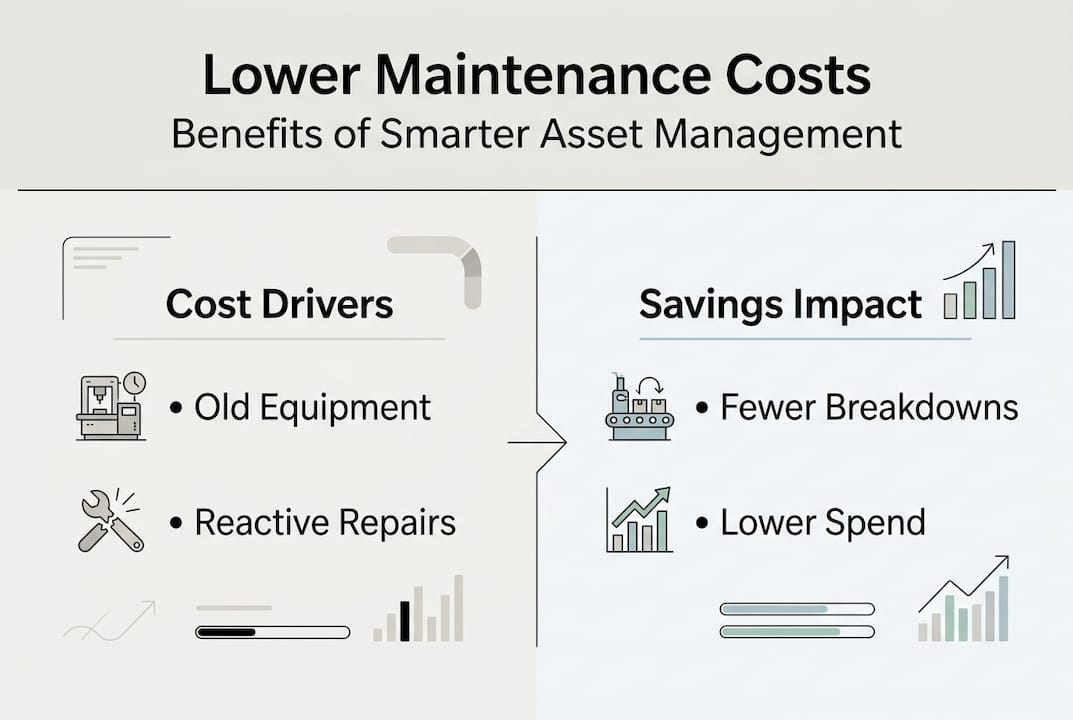
The contrast between reactive and proactive maintenance approaches is stark:
| Factor | Reactive maintenance | Proactive maintenance |
|---|---|---|
| Cost per repair | High, often unpredictable | Lower, planned and budgeted |
| Asset uptime | Frequently interrupted | Consistently higher |
| Risk of failure | Elevated | Significantly reduced |
| Compliance posture | Harder to demonstrate | Easier to document and audit |
| Budget predictability | Poor | Strong |
The benefits of active cost reduction extend across multiple dimensions:
- Higher asset reliability, meaning fewer interruptions to production and service delivery
- Reduced downtime, freeing capacity and improving throughput
- Improved regulatory compliance, as documented maintenance records satisfy audit requirements
- Predictable spend, enabling more accurate financial planning and capital allocation
- Extended asset lifespan, deferring costly capital replacement
Facilities that commit to preventive maintenance cost savings typically experience a clear progression. First, unplanned failures decrease as scheduled interventions catch developing faults early. Second, parts and labour costs stabilise as reactive procurement is replaced by planned purchasing. Third, technician productivity improves because work is organised and prioritised rather than driven by emergencies. Fourth, leadership gains confidence in maintenance forecasts, which strengthens the case for continued investment.
Improved field service management efficiency also contributes directly to business outcomes. When technicians spend less time firefighting and more time on value-adding planned work, the entire operation gains capacity. Once the benefits are understood, the next challenge is to create an actionable plan for reducing maintenance costs.
Actionable strategies for reducing maintenance costs
Knowing that costs need to come down is one thing. Knowing precisely where to start is another. The following steps provide a structured approach that facilities managers can begin implementing immediately.
-
Audit current maintenance spend. Map every cost category: labour, parts, contractors, and downtime losses. Identify the top 20 percent of assets or failure types that generate 80 percent of costs. This audit creates the baseline against which all improvements are measured.
-
Prioritise preventive maintenance tasks. Shift the balance of work from reactive to planned. Begin with high-criticality assets where failure has the greatest operational or safety impact. A structured HVAC preventive process is one practical example of how systematic scheduling reduces emergency call-outs.
-
Digitise maintenance workflows. Paper-based or spreadsheet-driven processes introduce delay, error, and invisibility. Digitising maintenance management can cut downtime by up to 50 percent by enabling real-time work order tracking, automated scheduling, and data-driven decision-making.
-
Optimise parts inventory and labour allocation. Carry strategic stock for high-frequency failure components, but avoid overstocking slow-moving parts that tie up capital. Match technician skills to task requirements to avoid costly contractor call-outs for work that in-house teams can handle.
-
Review vendor and contractor agreements. Renegotiate contracts based on performance data. Consolidate suppliers where possible to improve leverage and reduce administrative overhead.
Pro Tip: Focus initial improvement efforts on the assets and failure modes that occur most frequently. Quick wins in high-frequency areas generate measurable savings faster and build organisational momentum for broader change.
For teams new to structured planning, resources on adopting preventive maintenance provide practical guidance on overcoming the cultural and operational barriers that slow progress.
Rethinking maintenance: what most managers miss about cost reduction
The most persistent misconception in industrial maintenance is that cost reduction is a financial exercise. In reality, it is an operational and cultural one. Facilities managers who focus exclusively on cutting spend, without addressing the underlying behaviours and systems that drive it, tend to see temporary improvements followed by regression.
Viewing maintenance purely as a cost centre leads to missed opportunities. When maintenance data is used strategically, it reveals patterns that inform purchasing decisions, capital planning, and even product or service design. The organisations that achieve sustained cost reduction treat their maintenance function as a source of operational intelligence, not merely a necessary expense.
Data, culture, and leadership all matter. Teams that are empowered to flag emerging issues, document failure patterns, and contribute to planning discussions generate far more value than those operating in a purely reactive mode. Leadership that invests in digital tools and training signals that maintenance is a strategic priority, not an afterthought.
Cost reduction is the beginning, not the end, of operational excellence. The facilities managers who understand this are the ones who consistently outperform their peers on reliability, efficiency, and profitability. Exploring resources on improving field service profitability can help frame this broader strategic perspective.
Take control of your maintenance costs with the right tools
If you are ready to move from reactive firefighting to proactive asset management, the right digital platform makes the transition measurable and sustainable. FullyOps provides facilities managers and operational directors with the tools to digitise work orders, automate maintenance scheduling, track costs in real time, and generate the operational data needed for confident decision-making. Understanding the types of asset management systems available is a useful starting point for identifying the right fit for your operation. A structured resource allocation tutorial can also help you optimise how labour and parts are deployed. Explore the full capabilities of FullyOps asset management and discover how industrial teams are reducing costs while improving reliability.
Frequently asked questions
What is the most effective way to reduce maintenance costs?
Prioritising preventive maintenance, digitising planning workflows, and maintaining thorough cost tracking consistently delivers the most significant savings. Preventive maintenance can reduce overall spend by up to 25 percent when implemented systematically.
How does digitalisation help reduce maintenance spend?
Digital tools streamline planning, automate work order tracking, and surface data insights that minimise downtime and eliminate wasteful spend. Digitised maintenance planning can cut downtime by up to 50 percent compared to manual processes.
Is there a risk of over-cutting maintenance budgets?
Yes. Excessive cost-cutting without a structured preventive strategy leads to asset failures, increased downtime, and significantly higher long-term expenses. Reactive maintenance is up to five times costlier than proactive approaches, making under-investment a false economy.
What metrics are best for monitoring maintenance cost reduction?
The most reliable indicators are total cost of ownership per asset, mean time between failure (MTBF), and the ratio of planned to unplanned work orders. Tracking these consistently over time reveals whether cost reduction efforts are delivering lasting improvement.
Recommended
- How to track maintenance costs for smarter asset management
- Asset Maintenance Workflow Guide for Optimal Efficiency
- Role of Data in Asset Lifecycle: Driving Efficiency and Cost Savings
- Lock Maintenance Step by Step for Property Managers – A To Z Locksmith Inc