

TL;DR:
- Maintenance compliance involves legal, safety, environmental, and asset reliability standards.
- Strong compliance programs include risk assessments, SOPs, staff training, audits, and documentation.
- Technology automates tracking and transforms compliance into a strategic, operational advantage.
Maintenance compliance is often reduced to paperwork and periodic sign-offs, yet its true scope reaches far beyond documentation. When compliance fails, the consequences range from regulatory fines and forced shutdowns to equipment failure and serious safety incidents. For operations managers and maintenance administrators, understanding what compliance actually demands, and how to build systems that sustain it, is one of the most consequential responsibilities in the role. Maintenance compliance affects safety, efficiency, and legal adherence in ways that touch every corner of your facility. This guide breaks down the full picture, from definitions and regulatory standards to practical frameworks and digital tools.
Table of Contents
- Defining maintenance compliance in facilities management
- The core elements of maintenance compliance programmes
- Regulatory standards and common compliance challenges
- Best practices for achieving and sustaining compliance
- Why compliance is more than a checklist: An operational rethink
- Take your maintenance compliance further with FullyOps
- Frequently asked questions
Key Takeaways
| Point | Details |
|---|---|
| Beyond paperwork | Maintenance compliance protects operational reliability, safety, and reputation, not just recordkeeping. |
| Key programme elements | Effective compliance requires clear procedures, ongoing audits, and robust documentation. |
| Regulatory complexity | Managers must align with evolving standards like HSE and ISO 55000 to remain compliant. |
| Continuous improvement | Sustaining compliance means integrating regular reviews and new technology into maintenance routines. |
Defining maintenance compliance in facilities management
To understand its impact, it is essential to first define exactly what maintenance compliance encompasses. At its core, maintenance compliance addresses legal obligations, industry standards, and internal policies that govern how assets are maintained, inspected, and recorded across a facility’s operational lifecycle.
Compliance in this context is not a single standard but a layered set of obligations drawn from multiple sources. Health and safety compliance covers areas such as fire safety checks, pressure vessel inspections, and electrical testing. Environmental compliance includes emissions controls, waste disposal procedures, and energy usage monitoring. Asset reliability compliance refers to adherence to preventive maintenance schedules, manufacturer service intervals, and internal performance benchmarks.
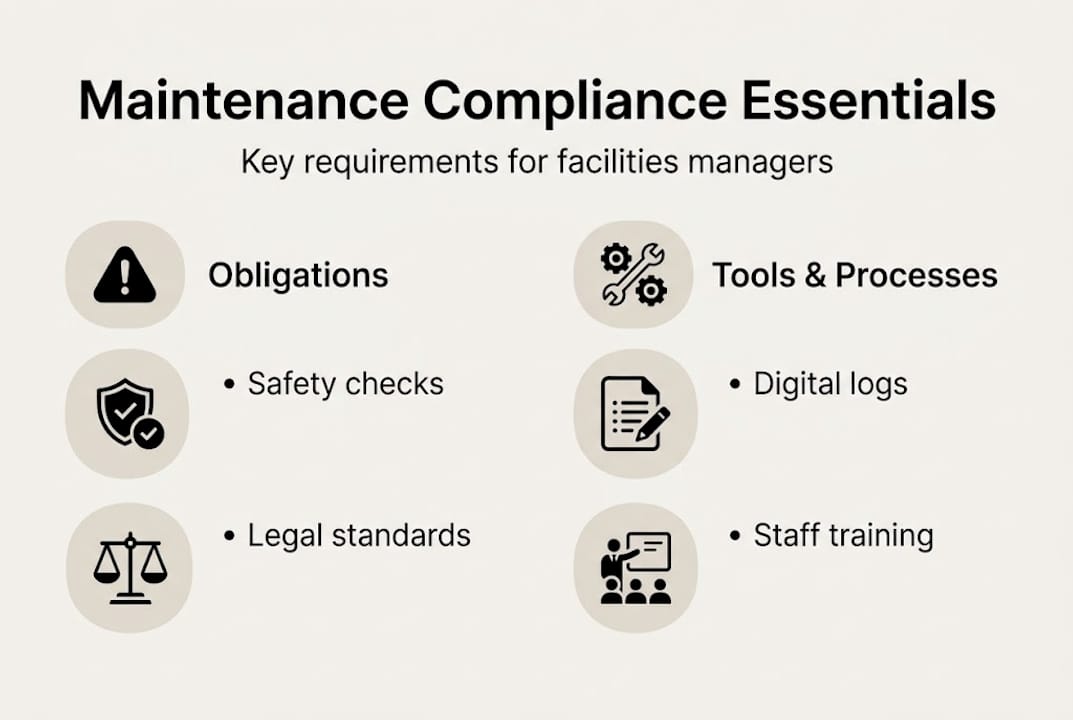
Non-compliance takes many forms. Missing a scheduled inspection, failing to document a corrective repair, using untrained staff for specialist tasks, or allowing equipment to operate beyond its certified service life all constitute compliance failures. Each carries its own risk profile, ranging from minor audit findings to catastrophic safety events.
Understanding why compliance matters helps frame the investment required to maintain it:
- Legal protection: Documented compliance shields organisations from regulatory penalties and civil liability.
- Safety assurance: Properly maintained assets reduce the risk of accidents, injuries, and fatalities.
- Cost control: Proactive compliance prevents expensive emergency repairs and unplanned downtime.
- Reputation management: Consistent compliance builds trust with clients, insurers, and regulators.
- Operational continuity: Compliant facilities experience fewer disruptions and more predictable asset performance.
“Maintenance compliance is not simply a regulatory obligation; it is a structural foundation for operational resilience and long-term asset value.”
For facilities management teams, the practical implication is clear. Compliance must be treated as an ongoing operational discipline, not a periodic administrative exercise. Exploring facilities compliance strategies in depth gives operations managers a structured starting point for building that discipline into daily workflows.
The core elements of maintenance compliance programmes
Once you know what compliance means, it is time to look closer at the pillars that make up a strong compliance programme. Successful compliance regimes require a mix of procedures, recordkeeping, training, and audits working in coordination across the entire maintenance function.
The following five elements form the backbone of any effective programme:
- Risk assessment: Identify which assets, processes, and environments carry the highest compliance risk. Prioritise inspection and maintenance schedules accordingly, ensuring high-risk assets receive more frequent attention.
- Standard operating procedures (SOPs): Document clear, step-by-step instructions for every maintenance task. SOPs reduce variability, ensure consistency across shifts and technicians, and provide a defensible record of intent.
- Staff training: Compliance is only as strong as the people executing it. Regular, role-specific training ensures technicians understand both the procedures and the reasoning behind them. Refresher sessions should align with regulatory updates.
- Regular audits: Internal and external audits verify that procedures are being followed and that records are accurate. Audits also surface gaps before they become regulatory findings. Reviewing preventive maintenance steps as part of audit preparation strengthens readiness.
- Documentation and reporting: Every inspection, repair, and corrective action must be recorded with timestamps, technician details, and outcomes. This creates the audit trail that regulators and insurers expect to see.
Staff accountability is a frequently underestimated element. When technicians understand that their work is recorded and reviewed, adherence to procedures improves measurably. Clear escalation paths for non-conformances also matter. If a technician identifies a compliance risk, the process for reporting and resolving it must be straightforward and well understood.
For facilities with complex asset portfolios, reviewing HVAC maintenance processes offers a practical example of how these elements apply to a specific asset class.

Pro Tip: Digital maintenance management platforms that centralise work orders, inspection records, and technician sign-offs dramatically reduce the administrative burden of compliance tracking. Automated reminders and real-time dashboards make it far easier to identify overdue tasks before they become audit findings.
Regulatory standards and common compliance challenges
Even well-designed programmes must address the external and internal challenges that make compliance difficult. Facility managers must navigate a range of standards, from HSE to sector-specific norms, and the landscape shifts regularly as legislation evolves.
The table below summarises key standards relevant to UK and EU facilities management:
| Standard | What it requires | Applicable sectors |
|---|---|---|
| HSE standards | Safe systems of work, risk assessments, incident reporting | All UK workplaces |
| ISO 55000 | Asset management systems, lifecycle planning, performance monitoring | Industrial, infrastructure, utilities |
| COSHH regulations | Safe handling and storage of hazardous substances | Manufacturing, facilities, laboratories |
| BS EN 13306 | Maintenance terminology and strategy frameworks | Engineering, facilities management |
| F-Gas regulations | Refrigerant handling and emissions controls | HVAC, refrigeration |
Common compliance challenges include keeping pace with regulatory changes, managing decentralised records across multiple sites, and maintaining standards during periods of high staff turnover. Each of these creates gaps that auditors and inspectors are trained to identify.
The most frequent compliance pitfalls operations managers encounter are:
- Incomplete records: Missing timestamps, unsigned inspection sheets, or undocumented corrective actions.
- Outdated procedures: SOPs that have not been revised to reflect regulatory changes or equipment upgrades.
- Inconsistent training: New staff performing tasks without verified competency records.
- Reactive maintenance bias: Prioritising urgent repairs over scheduled compliance inspections.
- Poor work order visibility: Lack of real-time oversight into task completion, covered in detail in work order management tips.
The financial stakes are significant. UK businesses face substantial fines for HSE violations, with serious breaches resulting in prosecution and operational shutdowns. Reviewing maintenance reporting best practices helps teams build the documentation rigour needed to withstand regulatory scrutiny.
Best practices for achieving and sustaining compliance
To put compliance into practice, here are expert-backed strategies and tips for daily operations. Regular preventive actions and reporting enhance sustained compliance, and the most effective programmes embed these habits into routine workflows rather than treating them as separate compliance tasks.
Daily and weekly procedures that support ongoing compliance include:
- Completing and signing off all scheduled inspections on time, with no deferrals without documented justification.
- Logging all corrective actions, including minor repairs, with technician details and timestamps.
- Reviewing open work orders daily to identify overdue compliance-critical tasks.
- Conducting brief toolbox talks to reinforce procedure awareness and flag any recent regulatory updates.
- Updating asset records immediately following any service intervention, using a step-by-step asset tracking approach to maintain accuracy.
Tracking the right key performance indicators (KPIs) is essential for measuring compliance health over time:
| KPI | Target | Measurement frequency |
|---|---|---|
| On-time inspection rate | 98% or above | Weekly |
| Audit findings per quarter | Fewer than 5 | Quarterly |
| Corrective action closure rate | 100% within agreed timeframe | Monthly |
| Training completion rate | 100% of required staff | Quarterly |
| Documentation accuracy rate | 99% or above | Monthly |
Leadership engagement is a critical and often overlooked driver of compliance culture. When senior managers visibly prioritise compliance, technicians and supervisors follow. Conversely, when compliance is treated as a back-office function, adherence deteriorates. A practical resource for field teams is the HVAC field service checklist, which demonstrates how structured checklists translate compliance requirements into actionable daily tasks.
Pro Tip: IoT-enabled sensors and automated data capture tools can log asset performance data continuously, flagging anomalies that may indicate compliance risks before they escalate. This removes reliance on manual observation and creates a real-time compliance evidence trail.
Why compliance is more than a checklist: An operational rethink
Looking beyond daily procedures, it pays to rethink the value of compliance altogether. The prevailing assumption is that compliance slows operations down, adding administrative overhead without contributing to output. This view is worth challenging directly.
Organisations that treat compliance as a performance framework rather than a regulatory burden consistently report better asset reliability, lower maintenance costs, and stronger audit outcomes. The discipline required to maintain compliance, structured procedures, accurate records, and regular reviews, is the same discipline that drives operational efficiency. These are not competing priorities.
Digital transformation has made this case more compelling. Platforms that automate compliance tracking, generate audit-ready reports, and provide real-time visibility into asset status convert compliance from a reactive chore into a proactive management tool. Reviewing automation’s role in compliance illustrates how this shift plays out in practice.
The most forward-thinking operations managers use compliance data as a strategic input. Trends in inspection findings, corrective action rates, and audit results reveal patterns that inform asset investment decisions, training priorities, and process improvements. Compliance, approached this way, becomes a source of competitive advantage rather than a cost centre.
Take your maintenance compliance further with FullyOps
For those ready to refine their processes and drive results, industry-leading tools and insights are available through FullyOps. The platform is built specifically for operations managers and maintenance administrators who need to manage compliance, asset performance, and work orders within a single, integrated system. FullyOps provides automated reporting, real-time work order visibility, and structured documentation tools that make audit preparation straightforward. Exploring resources on resource allocation for asset management, asset management systems, and preventive maintenance essentials gives your team the foundation to turn compliance into a measurable operational strength.
Frequently asked questions
What is the main objective of maintenance compliance?
The core objective is to ensure assets and operations meet regulatory, safety, and quality standards for legal and organisational protection. It also supports consistent asset performance and reduces the risk of unplanned failures.
What are the consequences of non-compliance in maintenance?
Non-compliance can result in fines, shutdowns, and safety hazards alongside significant reputational damage. In serious cases, organisations face prosecution and loss of operating licences.
Which standards commonly govern maintenance compliance?
Typical standards include HSE guidelines, ISO 55000, and local building safety codes, with additional sector-specific regulations applying in areas such as HVAC, manufacturing, and utilities.
How can technology help with maintenance compliance?
Digital solutions simplify compliance recordkeeping and audit readiness by automating tracking, reporting, and documentation, which reduces human error and ensures nothing is missed.