

Resumo:
- A manutenção preditiva deteta falhas em equipamentos antes que elas aconteçam, utilizando dados de sensores em tempo real e analítica.
- A implementação de PdM pode reduzir o tempo de inatividade em até 50% e prolongar significativamente a vida útil dos ativos.
- O sucesso depende da preparação organizacional, da adesão da equipa, da cibersegurança e da aprendizagem iterativa.
A maioria dos gestores de operações parte do princípio de que um plano de manutenção pontual mantém o equipamento em bom estado. A realidade é mais perturbadora: uma proporção significativa de avarias dispendiosas ocorre não quando a manutenção está em atraso, mas precisamente entre essas inspeções agendadas. Os padrões de vibração alteram-se, as temperaturas variam e a fadiga do metal acumula-se de forma invisível, enquanto os registos de inspeção mostram que tudo está normal. A manutenção preditiva prevê falhas antes de ocorrerem, utilizando dados de sensores em tempo real, análises impulsionadas por IA e monitorização contínua do estado para fechar essa lacuna perigosa. Este artigo aborda o que é a manutenção preditiva, como a tecnologia funciona, os benefícios mensuráveis que proporciona e um roteiro prático para começar.
Índice
- Os fundamentos da manutenção preditiva
- Como funciona a tecnologia de manutenção preditiva
- Principais benefícios: redução de custos, tempo de inatividade e falhas de ativos
- Principais desafios e dicas de peritos para a implementação
- Aplicação: passos para implementar a manutenção preditiva
- Além do entusiasmo: porque é que a manutenção preditiva tem sucesso ou falha
- Implemente a manutenção preditiva com ferramentas inteligentes de gestão de ativos
- Perguntas mais frequentes
Principais conclusões
| Ponto | Detalhes |
|---|---|
| Definição de PdM | A manutenção preditiva utiliza dados em tempo real e inteligência artificial para prever falhas em equipamentos antes que estas perturbem as operações. |
| Benefícios empresariais comprovados | As empresas que adotam a manutenção preditiva alcançam até 50% menos tempo de inatividade e poupanças de custos significativas em poucos meses. |
| Fusão de tecnologia e perícia | A tecnologia por si só não basta; a experiência e a melhoria contínua são essenciais para o sucesso da PdM. |
| Estratégia de implementação | Uma implementação faseada e baseada em dados, com o apoio da liderança e formação das equipas, produz resultados fiáveis. |
Os fundamentos da manutenção preditiva
A manutenção tradicional divide-se em duas grandes categorias. A manutenção reativa espera que algo avariue e depois repara-o, o que é barato de planear, mas caro na prática porque as paragens não planeadas acarretam custos de penalização, taxas de aquisição urgente e perdas de produção. A manutenção preventiva segue cronogramas fixos, independentemente da condição real do equipamento, o que constitui uma melhoria, mas continua a desperdiçar recursos em ativos que funcionam perfeitamente, falhando ocasionalmente em avarias que se desenvolvem rapidamente entre os intervalos. A leitura de um sólido guia de manutenção preventiva ajuda a esclarecer onde essa abordagem é bem-sucedida e onde deixa lacunas.
A manutenção preditiva (PdM) é uma estratégia proativa que utiliza dados em tempo real provenientes de sensores, IA e análises para prever falhas em equipamentos antes que estas ocorram, permitindo que as equipas intervenham exatamente no momento certo. Não é baseada em cronogramas nem em falhas. Em vez disso, é baseada na condição, o que significa que as ordens de trabalho são geradas quando os dados sinalizam que a intervenção é genuinamente necessária.
Os três principais fluxos de dados que alimentam um programa de PdM são:
- Análise de vibrações: Deteta desequilíbrio, desalinhamento, desgaste de rolamentos e fadiga estrutural em maquinaria rotativa, tais como motores, bombas e ventiladores.
- Monitorização térmica: Os sensores de infravermelhos e os termopares sinalizam assinaturas de calor anómalas em quadros elétricos, caixas de velocidades e equipamento de processo.
- Análise de óleos e fluidos: A amostragem química revela contaminação, quebra de viscosidade e partículas de desgaste em estágio inicial nos lubrificantes antes que os danos mecânicos se tornem visíveis.
A monitorização de emissões acústicas, a análise da assinatura de corrente e os ensaios ultrassónicos também figuram em programas de manutenção preditiva mais avançados, particularmente para ativos de elevado valor.
| Fonte de dados | O que deteta | Equipamento típico |
|---|---|---|
| Sensores de vibração | Desgaste de rolamentos, desequilíbrio, desalinhamento | Motores, compressores, turbinas |
| Câmaras térmicas | Pontos quentes, avarias elétricas | Equipamento de manobra, acionamentos de tapetes transportadores |
| Análise de óleo | Contaminação, perda de viscosidade | Caixas de velocidades, sistemas hidráulicos |
| Sensores acústicos | Fugas, formação de arcos, propagação de fendas | Recipientes sob pressão, tubagens |
| Análise atual | Falhas nos enrolamentos, anomalias de carga | Electric motors, drives |
Pro Tip: Even a basic early warning system built around vibration and temperature thresholds can reduce unplanned downtime by flagging developing faults weeks before a failure event occurs. Starting simple builds team confidence before expanding to more complex analytics.
Como funciona a tecnologia de manutenção preditiva
Sensors are only the starting point. The real capability of PdM comes from what happens to the data once it is collected, and understanding that process helps operations teams make better decisions about technology investment.
Predictive maintenance leverages real-time sensor data and analytics through a structured workflow that moves from raw measurement to actionable insight. The process runs as follows:
- Data collection: Sensors installed on critical assets continuously sample operating parameters at defined intervals, often multiple times per second for vibration signals.
- Data transmission: Readings are transmitted via wired or wireless networks, including industrial IoT protocols such as MQTT or OPC-UA, to an on-premise gateway or cloud platform.
- Pre-processing and feature extraction: Raw signals are cleaned, normalised, and broken into meaningful features such as RMS amplitude, frequency spectra, and temperature gradients.
- AI and machine learning analysis: Algorithms trained on historical failure data identify deviations from normal operating baselines and assign probability scores to specific failure modes.
- Alert generation: When a parameter crosses a predefined threshold or a model flags an anomaly, a prioritised alert is sent to the maintenance team, specifying the asset, the suspected fault, and the estimated time to failure.
- Planned intervention: Technicians schedule the repair or replacement during a planned window, minimising production disruption and allowing for parts procurement in advance.
O papel de AI in asset management has matured considerably in recent years. Early PdM systems relied on static threshold alerts, which generated high rates of false positives and quickly lost credibility with maintenance teams. Modern machine learning models, particularly those using anomaly detection and pattern recognition, are far more discriminating. They learn what “normal” looks like for each individual asset under varying load conditions, seasonal temperatures, and production rates, making their predictions considerably more reliable.
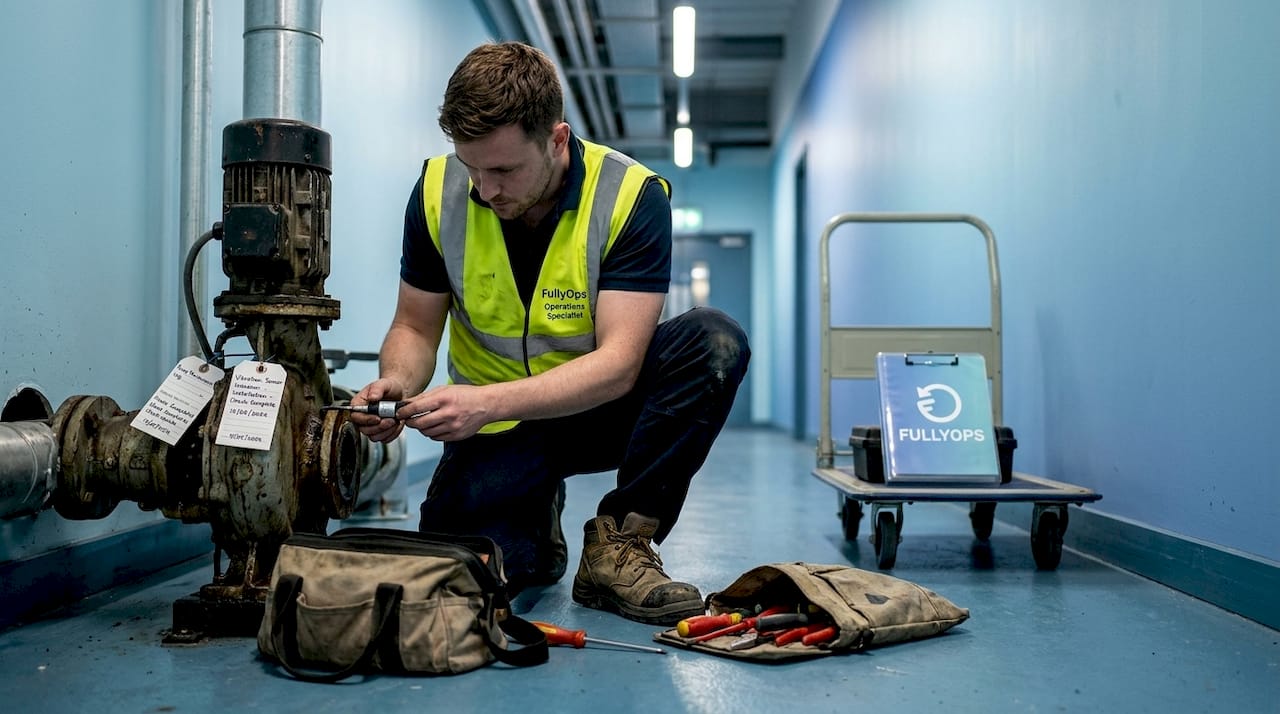
Edge computing has added another dimension by processing data locally on the asset or at a gateway device rather than transmitting everything to the cloud. This reduces latency, lowers bandwidth costs, and keeps the system operational even during network interruptions. Exploring automation for asset efficiency reveals how edge-enabled automation fits into broader maintenance programmes, particularly in HVAC and process industries.
Studies indicate that well-implemented PdM programmes can achieve up to 50% downtime reduction compared with purely reactive approaches, a figure that reflects both the elimination of catastrophic failures and the optimisation of planned maintenance windows.
Principais benefícios: redução de custos, tempo de inatividade e falhas de ativos
The business case for predictive maintenance is now well-supported by benchmark data from large-scale industrial deployments. What was once speculative is increasingly measurable.
Benchmark results show 30 to 50% less downtime, 18 to 40% reduction in maintenance costs, 20 to 40% extension of asset service life, and an ROI of 250% with a payback period of 12 to 18 months for organisations that deploy PdM effectively. These figures are not outliers; they reflect outcomes across manufacturing, utilities, and process industries where continuous operation is financially critical.
“Organisations that implement predictive maintenance strategically report payback periods of 12 to 18 months and ROI figures approaching 250%, driven by the compound effect of fewer failures, lower parts consumption, and extended asset life.”
For operations managers, the benefits translate into five concrete operational improvements:
- Menos tempo de inatividade não planeado: Faults are caught in the early degradation phase, allowing work to be scheduled rather than scrambled.
- Lower maintenance spend: Resources are directed only where and when they are actually needed, eliminating unnecessary preventive replacements.
- Extended asset life: Intervening before secondary damage occurs preserves the structural integrity of components that would otherwise be destroyed by a cascade failure.
- Improved safety: Early fault detection reduces the probability of catastrophic failures that put personnel at risk.
- Better spare parts management: Advance notice of required interventions allows procurement teams to source parts at standard prices rather than emergency rates.
Understanding the full potential of reducing maintenance costs through condition-based strategies is an important step for any maintenance administrator building a business case for investment. Similarly, tracking efficiency trends in asset management helps contextualise where PdM fits within the broader evolution of industrial operations.
The financial argument is compelling, but the operational argument is arguably more important. A single unplanned failure on a critical production line can eliminate weeks of maintenance savings in a single event. PdM fundamentally changes the risk profile of the asset base.
Principais desafios e dicas de peritos para a implementação
No technology programme is without obstacles, and PdM is no exception. Understanding the challenges before committing budget prevents costly missteps and sets realistic expectations with stakeholders.
PdM works best with domain experts, hybrid models, and edge computing, but faces persistent challenges around cybersecurity, integration with legacy systems, and the organisational discipline required to act on alerts consistently.
“Cybersecurity is an underappreciated risk in predictive maintenance programmes. Sensor networks and cloud analytics platforms extend the attack surface of industrial systems, requiring deliberate security architecture from the outset.”
The most common pitfalls in unsuccessful PdM rollouts include:
- Data silos: Sensor data that is not integrated with the CMMS (computerised maintenance management system) or ERP creates disconnected information that teams cannot act on efficiently.
- Legacy system incompatibility: Older control systems and PLCs were not designed to transmit data to modern analytics platforms, requiring middleware or protocol translation layers.
- Alert fatigue: Poorly calibrated models generate excessive false positives, causing technicians to dismiss alerts and ultimately defeating the purpose of the system.
- Insufficient domain expertise: Technology vendors may provide the platform, but understanding what the data means for a specific machine type requires engineering knowledge that must reside within the organisation.
- Lack of leadership commitment: PdM requires cultural change. Without clear ownership and executive support, programmes stall when initial implementation costs arise.
- Cybersecurity gaps: Connected sensor networks must be protected against both external intrusion and internal data integrity risks.
Exploring how optimising maintenance with cloud solutions address integration challenges gives a practical view of how modern platforms bridge legacy infrastructure with analytics capability.
Pro Tip: Invest in structured training that teaches maintenance technicians not just how to use the PdM platform but how to interpret what the data means in the context of specific machines. A technician who understands both the technology and the equipment is far more valuable than one who can only read a dashboard.
Aplicação: passos para implementar a manutenção preditiva
A phased approach to PdM implementation reduces financial risk and allows teams to build knowledge incrementally rather than committing to full-scale deployment before the organisation is ready.
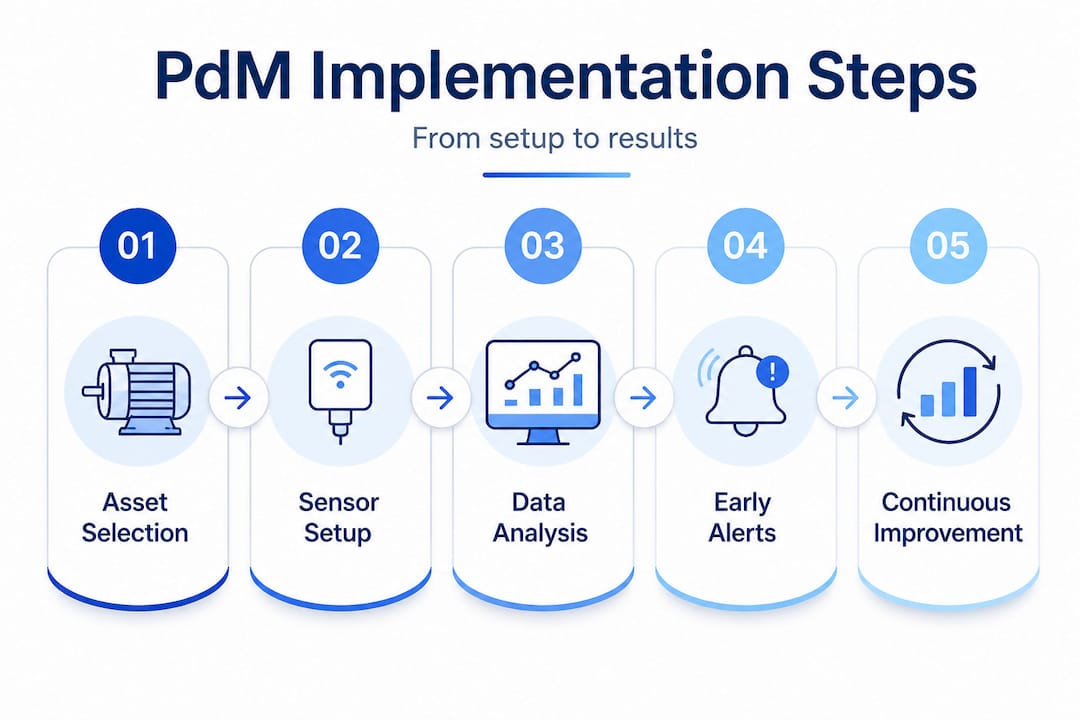
Successful PdM requires strong integration and expert interpretation at every stage of the rollout. The following steps provide a reliable framework:
- Assess asset criticality: Rank assets by failure consequence, production impact, and failure frequency to identify the highest-priority candidates for initial sensor deployment.
- Establish baseline data: Before fitting predictive sensors, gather historical maintenance records, failure modes, and current condition assessments to inform model training.
- Pilot on selected assets: Deploy sensors and analytics on a small number of high-impact machines. This generates early results, builds team familiarity, and validates the chosen technology before broader investment.
- Integrate with existing systems: Connect the PdM platform to your CMMS or work order system so that alerts automatically generate maintenance tasks without manual re-entry.
- Upskill the maintenance team: Provide structured training on data interpretation, alert response protocols, and the engineering context behind the monitored parameters.
- Review and refine models: After the pilot period, assess model accuracy, retrain algorithms with newly collected data, and adjust alert thresholds based on technician feedback.
- Phase the wider rollout: Expand sensor coverage progressively, prioritising the next tier of critical assets and applying lessons learned from the pilot.
Forte maintenance reporting reliability is essential throughout this process, because the data generated by PdM programmes is only actionable when reporting structures ensure the right people receive the right information at the right time.
Pro Tip: Start the pilot on your highest-impact, highest-failure-cost assets rather than the easiest ones to instrument. Early wins on critical equipment build executive confidence and secure continued investment for the full programme.
Além do entusiasmo: porque é que a manutenção preditiva tem sucesso ou falha
After working through the technical foundations and implementation steps, it is worth pausing to address something that most PdM guides avoid: the majority of predictive maintenance programmes that underperform do so not because the technology failed but because the organisation was not ready for it.
Technology is a necessary condition for PdM. It is not a sufficient one. The real impact on asset management comes when AI-generated insights are received, trusted, and acted upon by people who understand both the data and the machines it describes. Organisations that treat PdM as a software installation project almost always struggle. Those that treat it as a discipline, requiring iterative learning, cultural adjustment, and sustained leadership attention, consistently achieve the benchmark results cited earlier.
The single most overlooked factor is staff buy-in at the technician level. Experienced engineers who have managed equipment for years can be sceptical of algorithmic alerts, particularly early in a programme when false positives are still being filtered out. Dismissing that scepticism is a mistake. Engaging technicians in the interpretation of results, and genuinely incorporating their feedback into model refinement, converts sceptics into advocates and significantly accelerates the programme’s maturity.
The organisations that sustain PdM success beyond the initial pilot phase share a common characteristic: they treat every alert, whether it leads to a confirmed fault or a false positive, as a learning event. They document what the data showed, what the technician found, and how the model should be adjusted. That iterative loop is what separates a PdM programme that plateaus from one that continuously improves.
As one industry practitioner put it plainly: “The biggest risk is treating PdM as plug-and-play; it is a discipline, not a product.” That framing should inform every budget conversation, vendor selection, and training plan associated with predictive maintenance adoption.
Implemente a manutenção preditiva com ferramentas inteligentes de gestão de ativos
If this article has clarified what predictive maintenance is and why it matters, the practical next step is ensuring your asset management infrastructure can support it. FullyOps provides tools that connect work order management, operational analytics, and maintenance reporting within a single platform, making it considerably easier to act on the alerts that a PdM programme generates. Explore resources on alocação eficiente de recursos to see how structured asset workflows reduce the friction between data and action. Review the full landscape of Tipos de sistemas de gestão de ativos to understand where PdM integration fits within your existing infrastructure. For a forward-looking view of where the industry is heading, the 2026 asset efficiency trends analysis provides useful strategic context for operations teams planning their next investment cycle.
Perguntas mais frequentes
Que tipos de equipamento beneficiam mais da manutenção preditiva?
Ativos com elevados custos de falha ou requisitos de funcionamento contínuo, tais como bombas, turbinas, compressores e sistemas de AVAC, obtêm os maiores ganhos porque os dados de sensores destes ativos evitam diretamente paragens não planeadas dispendiosas.
Quanto tempo demora a obter o retorno do investimento (ROI) da manutenção preditiva?
A poupança e os benefícios mensuráveis surgem tipicamente entre 12 e 18 meses após a implementação, com o retorno a ocorrer habitualmente dentro deste período, impulsionado por reduções nos custos de reparações de emergência e na paragem não programada.
Qual é o maior desafio na adoção da manutenção preditiva?
A integração com sistemas de controlo legados e a manutenção da cibersegurança em redes de sensores expandidas são os dois principais obstáculos, uma vez que tanto os desafios de integração como os de cibersegurança exigem um planeamento deliberado antes de a implementação dos sensores ter início.
Precisa de conhecimentos de IA para implementar a manutenção preditiva?
A experiência dedicada em IA nem sempre é necessária internamente, mas colaborar tanto com engenheiros de domínio quanto com especialistas em análise garante resultados de modelos fiáveis, uma vez que o sucesso da PdM depende da experiência no domínio a par da capacidade de análise avançada.
Como é que a manutenção preditiva difere da manutenção preventiva?
A manutenção preditiva aciona intervenções com base em dados de condição de ativos em tempo real, enquanto a manutenção preventiva segue intervalos fixos de tempo ou utilização, independentemente da saúde real do equipamento, uma distinção claramente delineada em abordagens de PdM proativas e baseadas em dados em comparação com o agendamento periódico.
Recomendado
- Passos essenciais de manutenção preventiva: maximize a fiabilidade
- Dicas essenciais de manutenção preventiva para operações fiáveis