

Compliance in facilities management is frequently reduced to a checklist exercise, yet ISO 41001:2018 makes clear that genuine compliance shapes safety outcomes, operational reliability, and long-term organisational performance. For facility managers and compliance officers, the stakes extend well beyond avoiding regulatory penalties. Poor compliance directly increases the risk of equipment failure, workplace incidents, and costly audits. This article clarifies what compliance truly means in a facilities context, examines the frameworks and technology that support it, identifies the barriers most organisations face, and offers practical strategies for building a compliance-first culture that delivers measurable efficiency gains.
Índice
- Defining compliance in facilities management
- Core components and frameworks for compliance
- The role of technology in compliance management
- Barriers to compliance and effective solutions
- Best practices for building a compliance-first facilities culture
- What most compliance strategies overlook: the human factor
- Streamline your facilities compliance with smart solutions
- Perguntas mais frequentes
Principais conclusões
| Ponto | Detalhes |
|---|---|
| Compliance drives efficiency | Effective compliance reduces risk and improves day-to-day operations. |
| Technology enables automation | Digital tools streamline compliance tasks and help ensure audit-readiness. |
| Culture is essential | Lasting compliance success comes from engaged teams and strong leadership. |
Defining compliance in facilities management
Building on the importance of compliance, we first need to clarify the term itself. In a facilities management context, compliance is not a single activity but a layered set of obligations spanning legal, regulatory, operational, and ethical dimensions. Understanding each layer is essential before any meaningful programme can be designed.
At its most fundamental level, compliance means meeting statutory and regulatory obligations. These include:
- Health and safety legislation, such as workplace safety regulations and risk assessment requirements
- Environmental standards, covering waste management, emissions controls, and energy consumption limits
- Building codes and fire safety regulations, which govern structural integrity, emergency systems, and occupancy standards
- Occupational health requirements, including exposure limits for hazardous substances and ergonomic standards
Beyond legal obligations, compliance also encompasses adherence to international management standards. The ISO 41001:2018 standard standardises facility management systems, aligning with organisational needs and promoting continuous improvement. Similarly, ISO 14001 addresses environmental management and ISO 9001 governs quality management systems, each providing a structured approach to meeting obligations consistently.
Operational compliance is a third dimension that is often overlooked. This includes safe working practices, planned preventative maintenance (PPM) schedules, and documented procedures for routine tasks. A facility can be legally compliant on paper yet operationally non-compliant if technicians bypass procedures or maintenance records are incomplete.
Compliance as a processo means having systems, procedures, and controls in place. Compliance as an outcome means those systems are actually working as intended, evidenced by audits, records, and performance data.
The distinction between process and outcome matters enormously. Many organisations invest in compliance frameworks but fail to verify whether those frameworks are functioning in practice. Bridging this gap requires both rigorous documentation and a culture of accountability at every level of the facility team.
Core components and frameworks for compliance
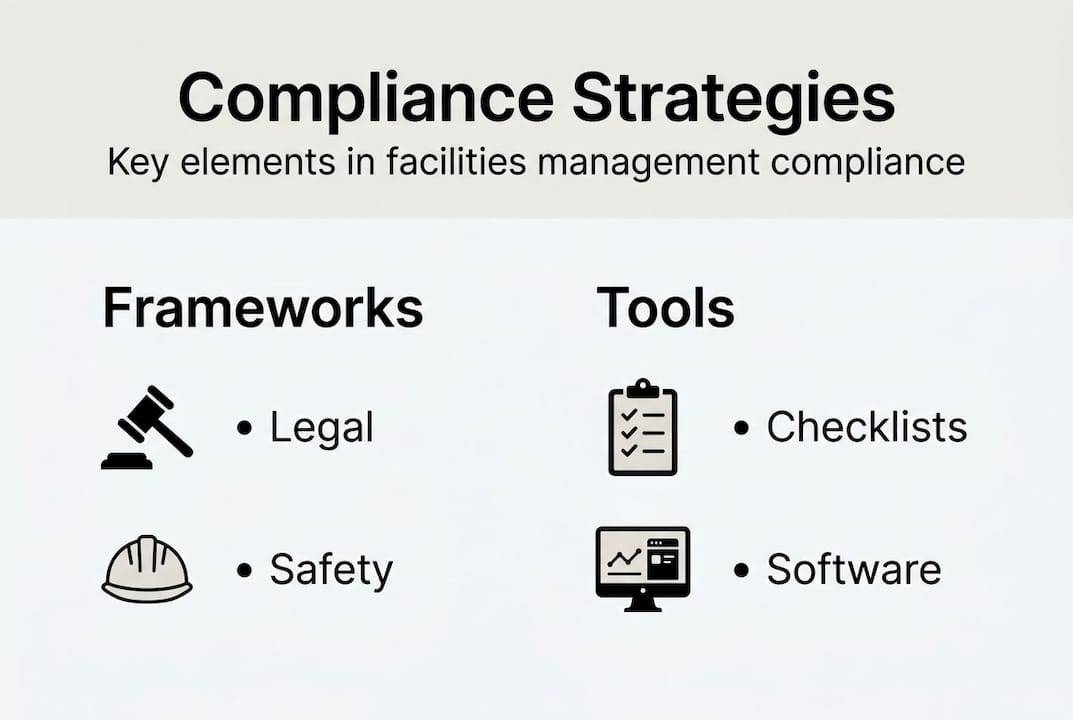
With a clearer sense of what compliance means, let us look at the frameworks and standards that bring structure to the process. Effective compliance management in facilities relies on integrating multiple frameworks rather than treating each obligation in isolation.
The four primary compliance pillars for facility managers are:
| Framework area | Key standard | Core focus |
|---|---|---|
| Legal and regulatory | National legislation | Health, safety, fire, building codes |
| Environmental | ISO 14001 | Waste, emissions, energy management |
| Quality management | ISO 9001 | Process consistency and customer satisfaction |
| Facility management | ISO 41001 | Integrated FM systems and continuous improvement |
ISO 41001:2018 aligns facility management systems with other standards like ISO 9001 and ISO 14001, ensuring a holistic approach to compliance. This integration reduces duplication of effort and creates a single, coherent management system rather than several disconnected ones.
A practical step-by-step framework for managing compliance as an ongoing system looks like this:
- Identify all applicable obligations across legal, environmental, quality, and operational domains
- Conduct a gap assessment to establish where current practices fall short of requirements
- Assign clear ownership for each compliance area to named individuals or teams
- Implement controls and procedures supported by documented work instructions
- Monitor and measure performance using audits, inspections, and data analysis
- Review and improve on a scheduled cycle, incorporating lessons from incidents and near-misses
Using a structured lista de controlo da gestão das instalações supports each of these steps by ensuring nothing is overlooked during routine operations. The value of an integrated management approach is significant: it reduces administrative duplication, improves cross-team visibility, and makes audit preparation far less burdensome. Organisations that manage their compliance obligations through a single integrated system consistently report better audit outcomes and fewer compliance incidents than those using fragmented approaches.
The role of technology in compliance management
Once the framework is in place, technology becomes the key enabler for ongoing, efficient compliance management. Digital tools have fundamentally changed how facility teams record, monitor, and report on compliance activities.

Technology like CMMS and IWMS reduces admin by 70% and improves audit-readiness, but cost is a barrier for 33% of organisations. A Computerised Maintenance Management System (CMMS) automates work order generation, tracks asset maintenance histories, and produces audit-ready reports without manual intervention. An Integrated Workplace Management System (IWMS) extends this further, connecting space management, lease administration, and compliance tracking in a single platform.
| Technology benefit | Impact | Barrier |
|---|---|---|
| Automated record-keeping | Reduces human error | Initial setup cost |
| Real-time compliance dashboards | Instant visibility | Staff training requirements |
| Predictive maintenance via IoT | Prevents non-compliance events | Complexidade da integração |
| Cloud-based audit trails | Always accessible, version-controlled | Data migration effort |
IoT sensors now enable predictive compliance by monitoring equipment conditions in real time. When a sensor detects that an HVAC unit is operating outside its prescribed parameters, the system can automatically raise a work order before a compliance breach occurs. Reviewing asset management trends shows how IoT-driven maintenance is becoming standard practice in high-compliance environments.
Key technology capabilities that directly support compliance include:
- Automated scheduling of planned preventative maintenance
- Digital checklists with mandatory sign-off fields
- Instant escalation alerts for overdue compliance tasks
- Integration with regulatory reporting portals
Pro Tip: Adopt cloud-based maintenance tools to maintain a continuously updated audit trail. Cloud platforms ensure that records are timestamped, version-controlled, and accessible to auditors without manual preparation.
Understanding how field service management transformation intersects with compliance helps teams appreciate that technology is not simply an administrative aid but a core operational control.
Barriers to compliance and effective solutions
Using technology is not always straightforward; many organisations encounter common roadblocks on the path to effective compliance management. Recognising these barriers early allows facility managers to plan realistic implementation strategies.
The most frequently reported barriers include:
- Budget constraints: Cost is a leading barrier to implementing effective digital compliance solutions, impacting over a third of organisations
- Siloed data systems: Compliance data spread across spreadsheets, paper records, and disconnected software makes consolidated reporting nearly impossible
- Formação insuficiente: Teams that do not understand compliance requirements cannot apply them consistently
- Resistência à mudança: Long-established working habits are difficult to shift, particularly when teams do not see immediate personal benefit
Practical solutions to each of these barriers exist and have been proven in industrial and maintenance settings. For budget constraints, a phased digital adoption approach allows organisations to prioritise the highest-risk compliance areas first, generating quick wins that justify further investment. Reviewing a facility compliance checklist helps identify where gaps are most critical and where limited resources will have the greatest impact.
For siloed data, the answer is consolidation. Migrating compliance records to a single platform, even incrementally, dramatically improves visibility. A structured maintenance reporting guide provides a practical starting point for standardising how data is captured and shared across teams.
Addressing resistance to change requires leadership commitment and clear communication. When teams understand that compliance protects them personally, not just the organisation, engagement improves markedly. Regular maintenance practices reinforce this message by demonstrating how proactive compliance prevents the costly failures that disrupt daily work.
Pro Tip: Start with your highest-risk compliance areas. Quick wins in critical zones build team confidence, demonstrate value to leadership, and create momentum for broader adoption.
Best practices for building a compliance-first facilities culture
Overcoming barriers is easier when compliance is part of the organisational DNA. Embedding compliance as a core value requires deliberate effort from leadership and consistent reinforcement at every level of the facility team.
A step-by-step approach to building a compliance-first culture:
- Secure visible leadership commitment: Senior managers must actively champion compliance, not merely endorse it in policy documents
- Define clear roles and responsibilities: Every compliance obligation should have a named owner with documented accountability
- Deliver targeted training: Training must be role-specific, practical, and regularly refreshed to reflect regulatory changes
- Establish a feedback loop: Technicians and frontline staff should have a clear channel to report compliance concerns without fear of blame
- Measure and celebrate milestones: Recognising compliance achievements reinforces positive behaviour and sustains momentum
- Conduct scheduled internal audits: Regular self-assessment identifies drift before external auditors do
Following a structured guia do fluxo de trabalho de manutenção de activos ensures that compliance steps are embedded directly into daily maintenance activities rather than treated as separate administrative tasks. Similarly, exploring automation in facilities compliance reveals how automated workflows can enforce compliance steps without relying solely on individual memory or discipline.
Continuous improvement and risk management are central to long-term compliance success, as ISO 41001:2018 establishes. Organisations that treat compliance as a living system rather than a fixed target consistently outperform those that treat it as a periodic exercise.
For practical operational areas such as drainage and water systems, following sector-specific guidance on commercial drain maintenance ensures that often-overlooked compliance obligations are addressed systematically.
What most compliance strategies overlook: the human factor
Stepping back from frameworks and technology, there is a less-discussed but critical element that determines whether compliance actually works in practice: the people involved. Standard processes and sophisticated digital tools mean very little without genuine buy-in from the teams responsible for executing them.
The toughest compliance challenges are rarely technical. They are about communication, trust, and incentives. When facility technicians see compliance as something imposed on them rather than something that protects them, adherence becomes inconsistent. The most resilient compliance programmes are those where frontline staff understand why each requirement exists and see the direct benefit to their own safety and working conditions.
The best systems adapt to team feedback, not just external audits. A field service management approach that incorporates technician input into compliance process design produces far more durable results than one designed entirely from the top down. Real compliance improvement happens when the people closest to the work feel ownership of the standards they are expected to uphold.
Streamline your facilities compliance with smart solutions
For those seeking practical tools to begin or improve their compliance journey, purpose-built digital solutions make a measurable difference. FullyOps supports facility managers and compliance officers with a platform designed to simplify work order management, automate maintenance scheduling, and maintain complete audit trails across all asset types. The platform’s real-time visibility and integrated reporting tools directly address the compliance challenges outlined in this article, from closing data silos to enforcing planned preventative maintenance. Explore the tutorial de atribuição de recursos to see how smarter resource planning supports compliance goals, and review gestão do ciclo de vida dos activos capabilities to understand how FullyOps helps organisations maintain compliance across the full asset lifespan.
Perguntas mais frequentes
What are the key regulations in facilities management compliance?
Key regulations include health and safety laws, environmental standards, building codes, and international standards such as ISO 41001, which provides the international benchmark for facility management systems.
How does technology help with facilities compliance?
Digital tools automate checks, record-keeping, and reporting, with CMMS and IWMS platforms reducing administrative workload by up to 70% and significantly improving audit-readiness.
What is the first step facility managers should take for compliance?
Begin with a compliance gap assessment to identify where current practices fall short, then prioritise high-risk areas for immediate corrective action to generate the most impactful early improvements.
Why do many organisations struggle with compliance?
The top barriers are high implementation costs, siloed data systems, insufficient staff training, and cultural resistance to changing established working practices.
Recomendado
- Facility management checklist: boost efficiency and asset control
- Relatórios de manutenção: Melhorar a fiabilidade dos activos de AVAC
- Tendências de gestão de activos 2026: Transformar as operações de AVAC
- Why maintain commercial drainage for property management