

Resumo:
- Field service inefficiencies cause significant financial losses and productivity setbacks across industries.
- Proper planning, digital tools, and cultural change are essential for sustainable operational improvements.
- Continuous measurement and leadership support are key to maintaining long-term field service efficiency gains.
Field service operations in industrial environments carry real financial weight. When equipment fails unexpectedly or technicians arrive without the right parts or information, production stops and costs spiral. Field service software has cut downtime by up to 42% and maintenance costs by 28% in industrial settings, yet many operations managers still rely on spreadsheets, radio calls, and reactive maintenance cycles. This guide walks through the core challenges holding teams back, the tools and preparation required to address them, a step-by-step process for operational improvement, and a practical framework for measuring and sustaining the gains you achieve.
Índice
- Understanding the challenges of field service efficiency
- Essential tools and prerequisites for improvement
- Step-by-step process: optimising your field service operations
- measuring and sustaining improvements
- Why improving field service efficiency is more than going digital
- Next steps: make your efficiency gains real with fullyops
- frequently asked questions
Principais conclusões
| Ponto | Detalhes |
|---|---|
| Major efficiency gains possible | Applying proven strategies can reduce downtime by over 40% and cut costs dramatically. |
| Right tools enable success | Modern software and data-driven approaches are foundational for sustainable field service improvements. |
| Measurement is essential | Track metrics such as MTTR and OEE to ensure continuous improvement and sustain long-term results. |
| People matter most | Culture, leadership, and continual learning are critical for the success of any efficiency initiative. |
Understanding the challenges of field service efficiency
Before any improvement strategy can take hold, it helps to understand exactly where field service operations tend to break down. The problems are rarely isolated. Poor coordination between the back office and technicians in the field leads to duplicated effort, missed appointments, and wasted travel time. Without real-time visibility into asset status, managers make decisions based on outdated information. And when maintenance is predominantly reactive rather than preventive, breakdowns dictate the schedule rather than planned work.
The financial consequences are significant. Field service inefficiencies in the mining sector alone have caused up to $3.2 million in annual losses per operation. These are not outliers. The pattern repeats across manufacturing, utilities, logistics, and facilities management wherever reactive maintenance dominates.
The most common operational pain points include:
- Poor scheduling and dispatch: technicians are sent to jobs without adequate preparation, leading to multiple return visits
- No single source of truth: maintenance history, parts availability, and asset data sit in disconnected systems
- Limited technician visibility: managers cannot see where teams are or what stage a job is at without chasing phone calls
- Manual reporting: paper-based or spreadsheet records delay decision-making and introduce errors
- No predictive capability: without sensor data or analytics, failures are only discovered when assets stop working
“The gap between a team that reacts to breakdowns and a team that anticipates them is not just operational. It represents a measurable revenue difference across every quarter.”
Technician underutilisation is another underappreciated cost. When job allocation is inefficient, skilled engineers spend time travelling unnecessarily or waiting for parts that should have been staged in advance. Every hour of underutilised capacity is a direct cost with no productive output. The cumulative effect across a year can be staggering, particularly in operations with large mobile workforces.
Recognising these patterns is the first step. The second is building the infrastructure to address them systematically.
Essential tools and prerequisites for improvement
With the main challenges identified, the focus shifts to laying the necessary groundwork. You cannot digitise what you have not yet mapped, and you cannot measure what you have not yet defined. Before deploying any software platform or process change, a structured inventory of your current capabilities is essential.
Technology adoption has reduced mean time to repair by over 30% in process-heavy industries. However, the tool is only as effective as the environment it operates in. Consider this preparation checklist before beginning any implementation:
- Define your current workflows: document every step from fault detection to job closure, including who is responsible at each stage
- Map your asset inventory: identify all equipment that requires maintenance, its service history, and current condition
- Set baseline KPIs: establish current downtime rates, cost per maintenance event, and average response times before making changes
- Review technician skills: identify gaps in digital literacy or process knowledge that training needs to address
- Check integration readiness: confirm whether your existing ERP, finance, or inventory systems can connect to a new platform
| Tool or resource | Objetivo | Priority level for most teams |
|---|---|---|
| Field service management platform | Work order management, scheduling, job tracking | Elevado |
| Mobile app for technicians | On-site reporting, checklists, time logging | Elevado |
| Dashboard and analytics layer | KPI monitoring, performance trends | Medium |
| Parts and inventory module | Stock visibility, parts forecasting | Medium |
| Training programme | Skills alignment, adoption readiness | Elevado |
Pro tip: Before rolling out any new software, run a pilot with a small team on a subset of assets. This reveals integration gaps and process misalignments early, before they affect the whole operation.
O vantagens de software de serviço de campo are well established, but the organisations that see the fastest return are those who invest equally in preparing their people and processes. A thorough scheduling guide for technicians can also help you structure deployment in a way that fits your team’s existing workload patterns.
Step-by-step process: optimising your field service operations
With your foundation in place, the practical actions that deliver efficiency gains become much more straightforward. Follow these steps in sequence to avoid common implementation pitfalls.
- audit existing workflows: map every job type from notification to completion, recording where delays, errors, or handoffs break down
- digitise work orders and records: replace paper forms with structured digital work orders, ensuring all historical maintenance data is captured and searchable
- automate scheduling and dispatch: use rules-based or AI-assisted scheduling to assign technicians based on skill, location, and parts availability rather than manual allocation
- introduce predictive analytics: connect sensor data and historical records to identify failure patterns before they become breakdowns
- monitor KPIs continuously: set up live dashboards that track downtime, job completion rates, and cost per intervention against your established baselines
Digital work orders and predictive maintenance can raise mean time between failures by 25%, which directly translates to fewer emergency callouts and lower unplanned maintenance costs.
| Process area | Abordagem tradicional | optimised approach |
|---|---|---|
| Job scheduling | Manual allocation by phone or whiteboard | Rules-based automated dispatch |
| Gestão de ordens de serviço | Paper forms or email chains | Digital work orders with real-time updates |
| Parts management | Ad hoc ordering when parts run out | Stock alerts and pre-staged parts per job |
| Performance tracking | Monthly spreadsheet reviews | Live dashboards with daily KPI monitoring |
| Asset maintenance | Run-to-failure reactive model | Schedule-based preventive and predictive maintenance |
Pro tip: When deploying mobile solutions for field service, ensure technicians can complete job reports and access asset history offline. Poor connectivity in industrial sites is common and cannot be allowed to block your workflow.
The most overlooked step is the audit. Many teams rush to deploy technology without documenting what actually happens in the field, which means the new system reflects the old problems. Field service optimisation strategies consistently show that a thorough audit phase shortens the overall implementation timeline. You can also apply focused approaches to increase profitability in field services by aligning pricing and resource use more precisely once visibility improves.

measuring and sustaining improvements
After implementing improvements, the next priority is verifying that those changes produce durable results. Many organisations see an initial uplift after going digital, then plateau or regress when the measurement discipline fades.
The core KPIs every operations manager should track include:
- Mean time to repair (mttr): how long it takes from fault detection to asset restoration
- Mean time between failures (mtbf): average operating time between unplanned breakdowns
- Overall equipment effectiveness (oee): a composite measure of availability, performance, and quality
- Cost per maintenance event: total spend divided by number of interventions
- Taxa de fixação da primeira vez: percentage of jobs resolved without a return visit
OEE improvements of 6.1% were recorded in fertiliser sector case studies after digital adoption. While that figure may sound modest, in high-throughput industrial environments it translates to significant additional output value across a year.
“What gets measured gets managed. But what gets reviewed in regular structured sessions with accountable owners is what actually improves.”
A practical review cadence matters as much as the metrics themselves. Weekly operational reviews should assess job completion rates and any repeat failures. Monthly reviews should evaluate trend data on downtime and cost. A quarterly review should benchmark your KPIs against industry norms and feed findings back into your maintenance planning cycle. Use the field service management checklist to structure each review so nothing is overlooked.
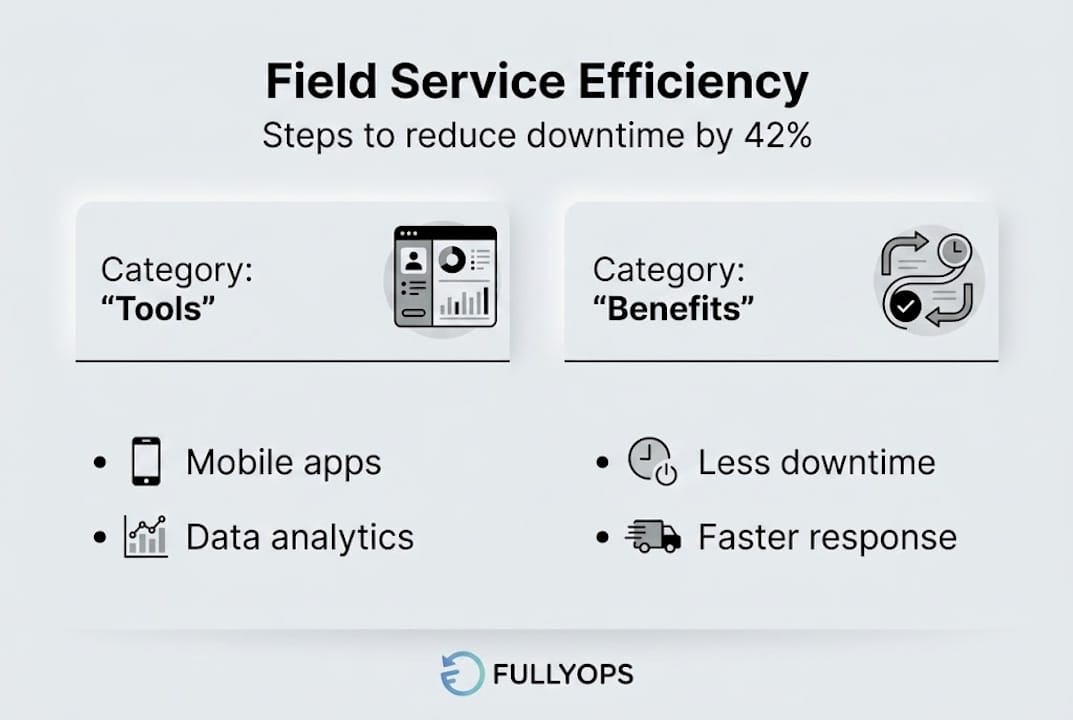
Continuous improvement is not a one-time project. It requires ongoing feedback loops between technicians, supervisors, and management. The teams that sustain gains longest treat their measurement frameworks as living documents, updated as assets age, teams change, and operational demands shift.
Why improving field service efficiency is more than going digital
Here is an observation that the data consistently supports but that software vendors rarely lead with: the technology is rarely the reason digital initiatives fail. Most failures trace back to people and process, not platforms.
Organisations that invest in a field service platform but neglect the cultural shift required to use it consistently will see limited returns. The role of mobile solutions in field service is genuinely transformative, but only when leadership actively champions adoption, technicians receive meaningful training, and process owners hold teams accountable to the new workflows.
Process discipline is a force multiplier that technology cannot substitute. Real-time feedback between the field and back office, leadership willingness to act on data rather than gut instinct, and a culture of continuous learning are the variables that separate high-performing operations from those that bought software and saw nothing change. The uncomfortable truth is that buying better tools is the easiest part. Building the habits and culture that make those tools effective is the harder and more important work.
Next steps: make your efficiency gains real with fullyops
![cta_image]
With the big picture in mind, here are actionable resources to accelerate your field service improvements. If you are ready to move from identifying inefficiencies to systematically eliminating them, the following guides offer practical starting points. Begin with a structured tutorial de atribuição de recursos to align your asset management approach with operational demand. From there, the passos essenciais de manutenção preventiva guide will help you build a maintenance schedule that reduces reactive callouts. For a broader overview of platform options that can support your strategy, review our roundup of the Melhor software de gestão de manutenção. Every operational improvement starts with a clear plan and the right tools to execute it.
frequently asked questions
What are the most important metrics for field service efficiency?
Key metrics include downtime frequency, mean time to repair, mean time between failures, cost per maintenance event, and overall equipment effectiveness. OEE and mttr are widely used benchmarks that show measurable returns following technology adoption.
How quickly can you see results from field service software?
Significant improvements typically appear within the first year of deployment. Industrial users observed up to 42% less downtime and 28% lower maintenance costs after implementing modern software solutions.
Can small teams achieve the same efficiency gains as large organisations?
Yes, smaller operations benefit from digital tools when processes and management practices are properly aligned. Mining, trucking, and fertiliser sectors all demonstrated efficiency gains across different scales of operation.
What is the main barrier to field service efficiency improvement?
Resistance to change and the absence of leadership buy-in are consistently more challenging than the technology itself. Many initiatives stall due to poor process adoption rather than any deficiency in the tools deployed.
Recomendado
- Gestão de serviços no terreno: Otimizar e aumentar a eficiência - FullyOps
- Dicas de otimização de serviços de campo: 5 estratégias para eficiência
- 4 dicas para aumentar a rentabilidade dos serviços no terreno - FullyOps