

Resumo:
- Cloud computing enables industry to improve operational efficiency and real-time decision-making with on-demand resources. Implementations like smart factory platforms reduce machine downtime by up to 50% and speed up supply chain disruption resolution by 50%. Successful cloud adoption depends on governance, workforce skills, and continual architecture reviews to maximize value and control costs.
Cloud computing is defined as the delivery of on-demand computing resources, including storage, processing, and software, over the internet at variable scale. The role of cloud solutions in industry has shifted from a cost-reduction tactic to a core business strategy, enabling manufacturers, logistics operators, and public sector organisations to run faster, leaner, and with far greater visibility. Global cloud infrastructure spending in manufacturing alone is anticipated to reach $107 billion by the end of 2026. Platforms like Microsoft Azure, enterprise resource planning systems, and Industrial Internet of Things (IIoT) integrations now form the operational backbone of modern industrial enterprises. The decisions you make about cloud adoption today will define your competitive position for the next decade.
How do cloud solutions improve operational efficiency in industry?
Manufacturers using cloud technology report 30–40% operational efficiency boosts compared to those running purely on-premises infrastructure. That figure is not a projection. It reflects documented outcomes from smart factory programmes where cloud platforms connect machines, people, and data in real time.

The clearest gains appear in asset uptime and workforce productivity. Smart factory cloud implementations cut machine downtime by 30–50% and raise labour productivity by 15–30%. Quality-related costs fall by 10–30% through cloud-enabled advanced analytics. For a mid-sized manufacturer running three shifts, those numbers translate directly into fewer emergency repairs, lower scrap rates, and more predictable output.
Supply chain visibility is another area where cloud technology delivers measurable results. When disruptions occur, cloud-based supply chain platforms help organisations resolve issues 30–50% faster than those relying on disconnected legacy tools. Real-time data sharing across suppliers, logistics partners, and production floors means decisions get made on current information rather than yesterday’s spreadsheet.
Cloud-based ERP and sistemas de gestão de ativos add a further layer of resource control. They centralise work orders, maintenance schedules, and inventory data into a single accessible platform. Operations managers gain a live picture of resource allocation without waiting for end-of-shift reports.
Dica profissional: Connect your cloud analytics platform directly to your maintenance scheduling system. Predictive alerts generated from machine sensor data reduce unplanned stoppages far more effectively than fixed-interval maintenance calendars.
Cloud-native vs legacy infrastructure: what is the real difference?
Traditional on-premises ERP systems carry a structural disadvantage that compounds over time. Legacy ERPs face 18–36 month upgrade delays with accumulating technical debt, meaning each deferred update makes the next one harder and more expensive. The IT team spends its time maintaining existing systems rather than building new capabilities.
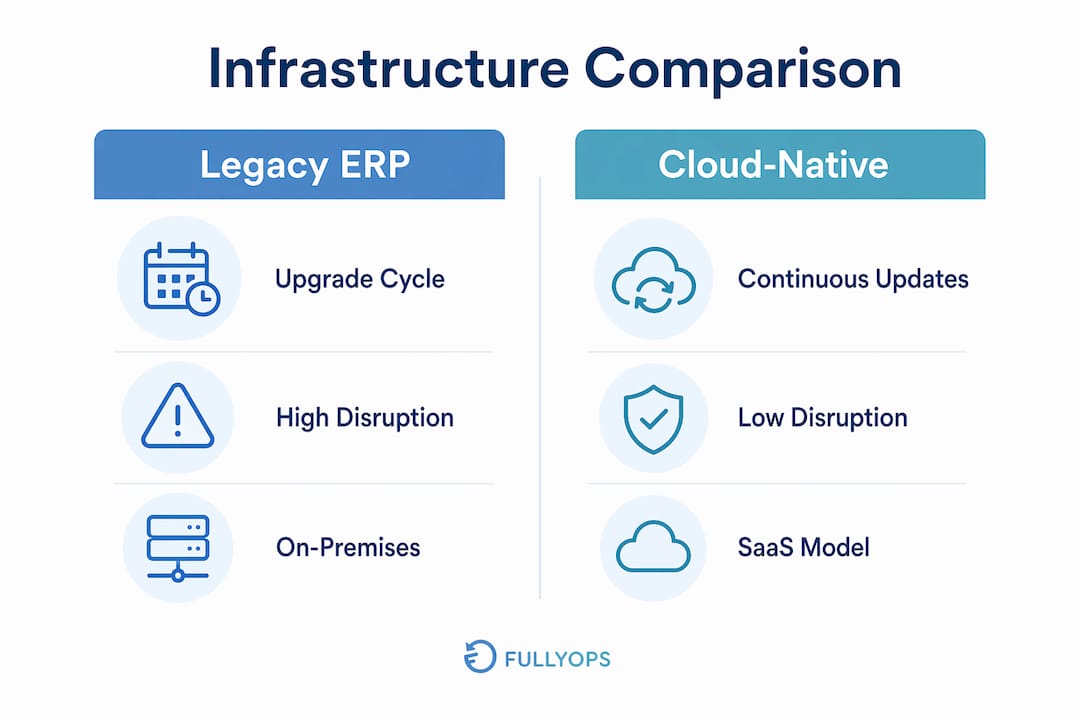
Cloud-native platforms operate on a fundamentally different model. Vendors release new features continuously, and organisations receive updates without managing the underlying infrastructure. The IT burden shifts from maintenance to configuration and governance.
| Fator | Legacy on-premises ERP | Cloud-native platform |
|---|---|---|
| Upgrade cycle | 18–36 months, high disruption | Continuous, low disruption |
| IT overhead | High: patching, hardware, licences | Lower: vendor-managed infrastructure |
| Escalabilidade | Limited by physical capacity | Scales on demand |
| Innovation pace | Slow, constrained by upgrade windows | Rapid, feature releases ongoing |
| Upfront cost | High capital expenditure | Subscription-based operating expenditure |
| Integration flexibility | Complex, often bespoke | API-first, broader ecosystem support |
The comparison above does not mean cloud migration is without risk. Egress costs when moving large data volumes out of cloud providers can offset savings if architecture planning is poor. Uncontrolled SaaS subscription sprawl can double costs every 18 months without strict governance in place. The financial case for cloud is strong, but only when the transition is managed with discipline.
Dica profissional: Before signing any cloud contract, map your data flows and calculate estimated egress costs for your most data-intensive processes. A single overlooked data pipeline can erode months of projected savings.
What governance strategies ensure successful cloud adoption?
Cloud computing is no longer just an IT upgrade. It is a fundamental business strategy, and organisations that treat it as purely a technology decision consistently underperform those that align it with business KPIs from the outset.
The Flexera 2026 State of the Cloud Report confirms this shift. 64% of organisations now prioritise value delivered to business units as their primary cloud success metric, moving away from cost savings as the headline measure. That is a significant change in how boards and operations leaders assess cloud return on investment.
Governance structures are the mechanism that turns strategy into results. Key elements include:
- Cloud Centres of Excellence (CCOEs): Cross-functional teams that set standards, manage vendor relationships, and prevent fragmented procurement decisions.
- FinOps teams: Specialists who track cloud spend in real time, identify waste, and align expenditure with business outcomes. Over 70% of organisations have now adopted CCOEs or FinOps structures to manage complexity and cost.
- Identity management: Compromised cloud admin accounts remain the top access breach vector. Robust multi-factor authentication (MFA) and role-based access controls are non-negotiable security requirements.
- Workforce upskilling: Successful cloud initiatives demand workforce competence in managing digital workflows. Without it, even well-architected platforms underperform.
Legacy system integration is the most common operational bottleneck. Older manufacturing execution systems and SCADA platforms were not built for API connectivity. Bridging them to cloud environments requires careful middleware selection and phased migration planning.
Dica profissional: Treat AI workloads as a separate cost category within your FinOps framework. Wasted cloud spend has risen to 29%, driven largely by AI workload growth, according to Flexera’s 2026 report. Unmonitored AI model training and inference costs accumulate quickly.
How are businesses implementing cloud solutions in practice?
Real-world cloud adoption in 2026 spans manufacturing, logistics, and the public sector, with each context producing distinct but measurable outcomes. The common thread is that hybrid cloud architectures and AI-enabled services are emerging as the dominant implementation pattern rather than full public cloud migration.
In manufacturing, cloud platforms support predictive maintenance by aggregating sensor data from production equipment and running anomaly detection models against historical baselines. A plant running 200 CNC machines can monitor vibration, temperature, and cycle time data centrally, receiving alerts before failures occur rather than after. The result is a direct reduction in unplanned downtime and a more efficient use of maintenance labour.
In supply chain management, cloud visibility tools connect tier-one and tier-two suppliers into a shared data environment. When a component shortage emerges, procurement teams see the impact on production schedules within hours rather than days. Cloud-enabled platforms improve visibility, collaboration, and analytic response capabilities in ways that disconnected systems cannot replicate.
| Industrial application | Primary cloud benefit | Measurable outcome |
|---|---|---|
| Manutenção preventiva | Real-time sensor analytics | 30–50% reduction in machine downtime |
| Supply chain management | End-to-end visibility | 30–50% faster disruption resolution |
| Gestão de ordens de serviço | Centralised scheduling | Reduced labour idle time |
| Quality control | Advanced analytics | 10–30% reduction in quality costs |
| Government services | Agility and scalability | Faster citizen service delivery |
Edge computing is extending cloud capabilities to environments where network latency matters. In remote industrial sites or production lines where millisecond response times are required, edge nodes process data locally while synchronising with central cloud platforms for reporting and analytics. This architecture gives operations teams the benefits of cloud data aggregation without sacrificing real-time control.
Para field service efficiency, cloud platforms enable mobile-first work order management, allowing technicians to receive, update, and close jobs from the field. That single capability reduces administrative overhead and improves first-time fix rates across maintenance teams.
Principais conclusões
Cloud solutions deliver their greatest industrial value when governance, workforce readiness, and business alignment are treated as equal priorities alongside the technology itself.
| Ponto | Detalhes |
|---|---|
| Efficiency gains are quantified | Cloud adoption in manufacturing produces 30–40% operational efficiency improvements and cuts machine downtime by 30–50%. |
| Legacy systems carry compounding risk | On-premises ERP upgrade delays of 18–36 months accumulate technical debt that slows every subsequent improvement. |
| Governance determines ROI | CCOEs and FinOps teams, now used by over 70% of organisations, are the primary mechanism for controlling cloud costs and complexity. |
| Value metrics have replaced cost metrics | 64% of organisations now measure cloud success by value delivered to business units, not by IT cost reduction alone. |
| Security starts with identity | Robust MFA and role-based access controls for cloud admin accounts are the first line of defence against breaches. |
Cloud strategy in 2026: what the numbers do not tell you
The efficiency statistics are compelling. A 30–40% operational improvement is the kind of number that justifies a board presentation and a capital allocation request. But after working closely with industrial operations teams, I have seen the same pattern repeat: organisations that focus exclusively on the technology achieve far less than those that invest equally in governance and people.
The Flexera data on wasted cloud spend is instructive here. When 29% of cloud expenditure produces no measurable business value, the problem is rarely the platform. It is the absence of clear ownership, unclear accountability for costs, and AI workloads that were approved without a consumption model. The technology works. The organisational wrapper around it often does not.
The shift from cost-saving to value-driven metrics is the most important strategic signal in the 2026 data. It means cloud adoption has matured past the point where simply moving workloads off-premises counts as success. Leaders now need to connect every cloud investment to a specific operational outcome, whether that is faster maintenance response, better inventory accuracy, or reduced quality failures.
My practical observation is this: treat cloud adoption as a continuous programme, not a one-time migration project. The organisations that perform best review their cloud architecture quarterly, retire unused services, and actively upskill their teams as new capabilities become available. The ones that struggle are those that completed a migration two years ago and have not revisited their setup since.
— Pedro
How Fullyops supports cloud-driven asset and resource management
Fullyops is a field service and asset management platform built for industrial operations teams that need real-time visibility across work orders, maintenance schedules, and resource allocation. For operations managers looking to connect cloud technology directly to maintenance outcomes, the Fullyops tutorial de atribuição de recursos provides a practical framework for aligning cloud-based asset data with day-to-day operational decisions. The platform integrates with existing ERP systems, supports ERP and field service management integration, and gives maintenance teams the tools to manage work orders, track interventions, and generate automated reports without manual data entry. For industrial companies evaluating cloud-enabled maintenance software, Fullyops offers tiered plans suited to teams of varying size and complexity.
FAQ
What is the role of cloud solutions in industry?
Cloud solutions provide industrial organisations with scalable, on-demand platforms for managing operations, assets, and data. Their primary role is to improve operational efficiency, enable real-time decision-making, and reduce the cost and complexity of maintaining on-premises infrastructure.
How much can cloud adoption improve manufacturing efficiency?
Manufacturers using cloud technology report 30–40% operational efficiency improvements, with smart factory implementations cutting machine downtime by 30–50% and raising labour productivity by 15–30%.
What is the biggest risk in cloud migration for industrial companies?
Uncontrolled egress costs and SaaS subscription sprawl are the two most common financial risks. Without centralised governance, subscription costs can double every 18 months and data transfer fees can erode projected savings.
What is a Cloud Centre of Excellence (CCOE)?
A CCOE is a cross-functional team that sets cloud standards, manages vendor relationships, and governs cloud spending across an organisation. Over 70% of organisations have adopted CCOEs or FinOps structures to manage cloud complexity effectively.
How does cloud technology support predictive maintenance?
Cloud platforms aggregate real-time sensor data from industrial equipment and run analytics models to detect anomalies before failures occur. This approach reduces unplanned downtime and allows maintenance teams to schedule interventions based on actual equipment condition rather than fixed time intervals.
Recomendado
- Otimização da manutenção com a nuvem: eficiência, poupança, estratégia
- Maintenance trends in 2026: what you need to know
- Vantagens do seguimento de activos para a eficiência industrial em 2026
- Principais tendências de gestão de instalações 2026: o seu guia estratégico