

Resumo:
- Compliance reporting involves collecting and validating evidence to demonstrate regulatory adherence and manage risks effectively. High-quality reports support audits, reduce penalties, and help senior managers fulfill their fiduciary duties.
- Operational and compliance reports serve different purposes, requiring separate templates, governance, and traceability standards for audit readiness.
Compliance reporting is defined as the structured process of collecting, validating, and presenting evidence to demonstrate that an organisation adheres to relevant laws, regulations, and internal policies. The role of reporting in compliance extends well beyond filing documents on deadline. It underpins risk management, protects senior officers from personal liability, and gives regulators verifiable proof that controls are working. Non-compliance costs reached record levels in 2024, with SEC penalties alone totalling $8.2 billion. For compliance officers in regulated industries, understanding how reporting functions is not optional. It is the foundation of every audit, every regulatory inspection, and every board-level accountability conversation.
What is the role of reporting in compliance?
Compliance reporting serves as the primary mechanism through which organisations demonstrate regulatory adherence. Without it, there is no verifiable record that controls exist, that policies are followed, or that violations have been addressed. Regulators, auditors, and boards all rely on these reports to assess whether an organisation is managing its obligations.

The function of compliance reporting falls into three categories: regulatory adherence, risk identification, and organisational accountability. Regulatory adherence means producing reports that satisfy external bodies such as the SEC, HIPAA enforcement authorities, or financial regulators. Risk identification means using report data to spot gaps before they become violations. Accountability means giving senior management and boards the evidence they need to make informed decisions and accept responsibility for outcomes.
The financial stakes are significant. Global data breach costs average $4.4 million, rising to $7.42 million in healthcare under HIPAA. That figure reflects not just fines but operational disruption, legal costs, and reputational damage. Compliance reporting, when done well, reduces exposure across all three.
What are the main types of compliance reporting?
Compliance reporting requirements vary considerably by industry, regulator, and organisation size. The four most common categories are regulatory reporting, financial compliance reporting, internal audit reporting, and cybersecurity framework reporting.
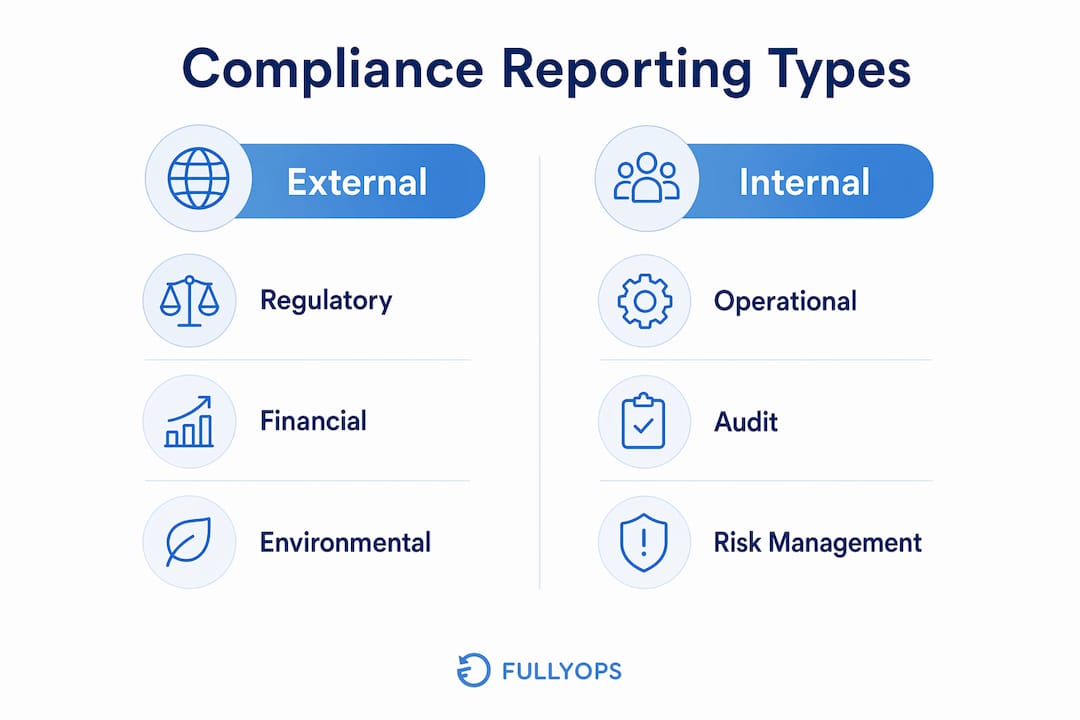
Regulatory reporting covers submissions required by government bodies or industry regulators. A clear example is the SEC’s requirement that institutional investment managers holding over $100 million in Section 13(f) securities must file quarterly Form 13F reports within 45 days of quarter end. As of february 2026, new monthly Form SHO reports are also required under Rule 13f-2. That cadence illustrates how regulatory obligations can multiply rapidly.
Financial compliance reporting covers internal controls, audit trails, and disclosures required under frameworks such as the Sarbanes-Oxley Act (SOX). Internal audit reporting documents the results of control testing and risk assessments for boards and audit committees. Cybersecurity framework reporting covers evidence of adherence to standards such as ISO 27001 or NIST, increasingly required by clients and regulators alike.
| Report type | Primary stakeholder | Key standard or framework | Typical frequency |
|---|---|---|---|
| Regulatory filing | External regulator | SEC, HIPAA, FCA | Quarterly or monthly |
| Financial compliance | Board, audit committee | SOX, IFRS | Annual or quarterly |
| Internal audit | Senior management | ISO 19011, IIA standards | Ongoing or annual |
| Cybersecurity | IT governance, regulators | ISO 27001, NIST CSF | Annual or event-driven |
The distinction between external and internal reports matters. External reports must satisfy specific regulatory formats and deadlines. Internal reports can be tailored to management needs, but they must still meet evidence standards if they are used to support external submissions.
How does reporting support compliance risk management?
Compliance reporting acts as an early warning system by identifying non-compliance patterns before they escalate into regulatory violations. A well-structured report reveals control gaps, missed deadlines, and policy breaches at a point when corrective action is still possible. That is its most underappreciated function.
The risk management value of compliance reporting operates across three levels:
- Detection: Reports surface anomalies in control performance, flagging areas where policies are not being followed consistently.
- Correction: Documented findings create a formal record that corrective actions were taken, which regulators expect to see during inspections.
- Prevention: Trend analysis across reporting periods identifies systemic weaknesses before they produce a reportable incident.
The financial consequences of inadequate reporting are severe. HIPAA penalties start at $71,162 per violation, with annual caps exceeding $2.1 million for wilful neglect left uncorrected within 30 days. Those figures apply per violation category, meaning a single audit failure can generate multiple simultaneous penalty streams.
Personal liability is equally significant. Senior management faces personal liability for failure to establish adequate internal controls and compliance reporting, with penalties that the corporation cannot indemnify. That shifts the stakes from organisational to individual.
Compliance reporting is not just a regulatory obligation. It is the mechanism through which senior officers demonstrate they have fulfilled their fiduciary duty. A report that cannot be defended in an audit is not a report. It is a liability.
What is the difference between operational and compliance reporting?
Operational reporting and compliance reporting serve fundamentally different purposes, and conflating them is one of the most common causes of audit failure. Operational reporting is speed-optimised for daily business decisions. Compliance reporting requires traceability, consistency, and strong governance to pass audits.
The practical differences are significant:
| Característica | Operational reporting | Compliance reporting |
|---|---|---|
| Primary purpose | Support day-to-day decisions | Provide audit-ready evidence |
| Data governance | Flexible, often ad hoc | Governed, version-controlled |
| Consistency requirement | Useful but not mandatory | Mandatory for regulatory validity |
| Traceability | Minimal | Full lineage required |
| Access controls | Broad team access | Role-based access control (RBAC) |
| Audience | Gestores de operações | Regulators, auditors, boards |
Mixing these two report types creates specific risks. An operational dashboard built for speed may pull from unvalidated data sources. If that same output is submitted as compliance evidence, it fails the traceability test. Regulators expect to see a clear chain from raw data to final report, with documented controls at every step.
Dica profissional: Maintain separate report templates for operational and compliance purposes. Label each clearly with its intended audience and governance standard. Never repurpose an operational report as compliance evidence without a formal validation step.
O compliance in service management context makes this distinction especially relevant for organisations managing field assets. Operational data from technicians feeds compliance records, but the two outputs must be governed separately.
What are best practices for effective compliance reporting?
Building a reliable compliance reporting system requires discipline across four areas: data governance, process standardisation, automation, and access control. Each addresses a specific failure mode that compliance officers encounter in practice.
-
Govern your data sources. Every compliance report must trace back to a validated, version-controlled data source. Ad hoc extracts from live systems introduce inconsistency. Designate authoritative data sources for each report type and document them formally.
-
Standardise report templates. Standardised templates and scheduled deliveries enable consistent, audit-ready output. Templates remove the risk of format variation between reporting periods, which auditors flag as a governance weakness.
-
Automate scheduling and version control. Automating compliance reporting with governed data sources, versioning, and role-based access control reduces errors, accelerates audits, and increases traceability. Automation also creates an audit log of every report run, which regulators increasingly expect.
-
Implement role-based access control (RBAC). Not every team member needs access to every compliance report. RBAC limits exposure, reduces the risk of unauthorised changes, and creates a clear record of who accessed what and when.
-
Maintain documentation lineage. Every report should carry metadata showing its data source, the date it was generated, the version of the template used, and the name of the person who approved it. That lineage is what makes a report defensible.
Dica profissional: Treat your compliance report run history as evidence in its own right. Regulators and auditors increasingly ask to see not just the report but the process that produced it. A complete run history demonstrates control maturity.
For organisations managing physical assets, automating service reports is a practical starting point for building the automation discipline that compliance reporting requires.
How does compliance reporting inform strategic decisions?
Compliance reporting data reveals far more than whether an organisation has met its regulatory obligations. It exposes risk concentration, resource gaps, and operational weaknesses that directly inform strategic planning. Organisations that treat compliance reports as strategic inputs make better investment decisions than those that treat them as administrative outputs.
The strategic value of compliance data shows up in several ways:
- Risk exposure mapping: Repeated findings in the same control area signal a systemic weakness. That pattern should inform budget allocation and process redesign, not just corrective action plans.
- Market expansion decisions: Entering a new jurisdiction requires understanding its compliance reporting requirements in advance. Organisations with mature reporting systems can assess that burden accurately. Those without them underestimate it consistently.
- Stakeholder trust: Transparent, well-governed compliance reporting builds confidence with investors, clients, and regulators. During due diligence processes, the quality of compliance documentation is a direct proxy for management quality.
- Ethical culture: Integrating compliance reporting into daily operations improves productivity, risk visibility, and organisational resilience. It also signals to employees that accountability is a genuine organisational value, not a periodic exercise.
O role of reporting in asset management follows the same logic. Data collected during routine operations becomes the evidence base for both compliance submissions and strategic asset decisions.
Principais conclusões
Compliance reporting is the foundation of regulatory adherence, risk management, and organisational accountability, and its quality directly determines an organisation’s legal and financial exposure.
| Ponto | Detalhes |
|---|---|
| Reporting is evidence, not administration | Every compliance report must be traceable, governed, and defensible under audit scrutiny. |
| Personal liability is real | Senior officers face individual penalties for inadequate compliance reporting that corporations cannot indemnify. |
| Operational and compliance reports are distinct | Mixing these two report types leads to audit failures; maintain separate templates and governance standards. |
| Automation reduces risk | Governed data sources, versioning, and RBAC are the minimum requirements for audit-ready compliance reporting. |
| Reporting data has strategic value | Compliance findings reveal systemic weaknesses and risk concentration that should directly inform business decisions. |
Why compliance reporting deserves more than a quarterly deadline
Most compliance failures I have observed do not start with bad intentions. They start with good people treating compliance reporting as a periodic task rather than an ongoing discipline. The report gets assembled under pressure, data is pulled from wherever is convenient, and the result passes a surface-level review but would not survive a serious audit.
The organisations that handle regulatory scrutiny well share one characteristic: they treat compliance reporting as a continuous process embedded in daily operations. Their reports are not assembled. They are generated, because the underlying data governance and controls are already in place. That distinction matters enormously when a regulator asks for evidence at short notice.
Compliance reporting embedded in daily activities improves decision-making and risk management well beyond the audit cycle. The compliance officer who can pull a defensible report at any point in the quarter is not just better prepared for regulators. They are better informed about their organisation’s actual risk position.
Leadership has a specific role here. When senior management treats compliance reporting as a genuine accountability mechanism rather than a box-ticking exercise, the entire organisation follows. When they treat it as a burden, the quality of reporting reflects that attitude. The lista de verificação de conformidade de manutenção approach, applied to compliance reporting itself, is a practical way to build that discipline systematically.
The compliance officers who build the most resilient reporting systems are those who stop asking “what do we need to file?” and start asking “what does our reporting tell us about how we are actually operating?” That shift in framing changes everything.
— Pedro
How Fullyops supports compliance reporting in regulated operations
Fullyops is built for organisations that cannot afford gaps between operational data and compliance evidence. The platform centralises work order management, maintenance records, and operational reporting in a single governed environment, so the data that feeds compliance submissions is always traceable and version-controlled. Automated report scheduling, role-based access control, and full audit logs mean your compliance reports are generated consistently, not assembled manually under deadline pressure. For compliance officers managing field assets or industrial maintenance operations, Fullyops reduces the distance between daily operations and audit-ready documentation. The tutorial de atribuição de recursos is a practical starting point for understanding how Fullyops structures operational data to support compliance workflows.
FAQ
What is compliance reporting?
Compliance reporting is the process of collecting, validating, and presenting evidence that an organisation adheres to applicable laws, regulations, and internal policies. It produces audit-ready documentation for regulators, boards, and auditors.
Why does compliance reporting matter for risk management?
Compliance reporting identifies non-compliance patterns early, enabling corrective action before violations occur. Without it, organisations face regulatory fines, operational disruption, and reputational damage.
What is the difference between compliance and operational reporting?
Operational reporting supports day-to-day decisions and prioritises speed. Compliance reporting requires full data traceability, version control, and governance to satisfy regulatory and audit standards.
Can senior managers be personally liable for compliance reporting failures?
Personal liability arises when senior officers fail to establish adequate internal controls and compliance reporting. These penalties are not indemnifiable by the corporation.
How often should compliance reports be produced?
Frequency depends on the regulatory framework. SEC Form 13F requires quarterly filing within 45 days of quarter end, while some frameworks require monthly or event-driven submissions. Internal compliance reporting should be continuous rather than periodic.
Recomendado
- O papel dos relatórios no sucesso da gestão de activos
- Compliance in service management: the operational value
- Optimise your compliance management workflow