

En resumen:
- Condition-based maintenance uses real-time asset condition data to trigger targeted interventions, reducing costs and failures. Successful CBM implementation relies on appropriate sensor selection, dynamic thresholds, and CMMS integration, avoiding common pitfalls like parameter misselection and alert fatigue. Many organizations achieve measurable benefits within months by prioritizing critical assets and employing iterative, disciplined deployment strategies.
Scheduled maintenance intervals feel reassuringly logical: service every asset at fixed intervals and failures should stay under control. The reality is more complicated. Intervening too early wastes labour and parts; intervening too late causes unplanned downtime. Condition-based maintenance (CBM) breaks this cycle by using real-time asset condition data to trigger interventions only when evidence of degradation actually exists. This article walks through what CBM is, how it compares to other strategies, how to implement it effectively, and how to avoid the pitfalls that cause nearly half of all CBM projects to underperform.
Índice
- Understanding condition-based maintenance
- Benefits of adopting condition-based maintenance
- How does CBM differ from other strategies?
- Implementing an effective condition-based maintenance programme
- Pitfalls and best practices for condition-based maintenance
- A smarter path: what most maintenance managers miss about CBM
- Supporting your condition-based maintenance journey
- Preguntas más frecuentes
Principales conclusiones
| Punto | Detalles |
|---|---|
| CBM uses real-time data | Condition-based maintenance relies on real-time asset monitoring to trigger maintenance only when required. |
| Proven cost savings | Implementing CBM can lower maintenance costs by 25-40% and reduce unplanned failures by up to 50%. |
| Integration is critical | Success requires well-integrated systems and correctly set thresholds to avoid common pitfalls. |
| Start simple, scale up | Most of the benefits can be achieved using straightforward CBM methods before scaling to more complex solutions. |
Understanding condition-based maintenance
Condition-based maintenance is a maintenance strategy in which work orders are triggered by the actual monitored state of an asset rather than a fixed calendar or hour-based schedule. Instead of servicing a pump every 90 days regardless of its health, a CBM programme monitors parameters such as vibration amplitude, bearing temperature, oil particle count, or electrical current draw. When a measured value crosses a defined threshold, an alert is generated and a targeted intervention is planned.
The core process follows four stages: continuous or periodic data collection via sensors; real-time monitoring against established baselines; threshold or statistical alarm evaluation; and automated or manual dispatch of a work order. Each stage depends on reliable data flowing through an integrated system, from the sensor on the asset to the computerised maintenance management system (CMMS) that assigns the task to a technician.
A CBM system typically includes the following primary components:
- Sensors and transducers for measuring vibration, temperature, pressure, current, or oil quality
- Data acquisition hardware that converts analogue signals to digital readings
- Monitoring software with configurable alarm logic and trend visualisation
- Baseline libraries that define normal operating envelopes for each asset class
- CMMS or work order integration to convert alerts into scheduled interventions
- Reporting dashboards that track condition trends over time
A common misconception is that CBM and predictive maintenance (PdM) are interchangeable terms. They are related but distinct. As GE Vernova explains, CBM acts on current condition data on an as-needed basis, whereas PdM uses machine learning models to forecast future failures before threshold crossings occur. CBM is, in practice, the operational foundation on which PdM is built.
CBM vs. PdM in brief: CBM responds to what is happening now; PdM anticipates what is likely to happen next. For most industrial sites, CBM is the practical entry point, and PdM is the logical evolution once sufficient historical data has been accumulated.
For teams already managing a structured proceso de mantenimiento preventivo, adopting CBM does not mean abandoning all scheduled work. It means supplementing time-based tasks with condition-triggered ones, reserving calendar-based interventions for assets where condition monitoring is impractical or cost-prohibitive.
Benefits of adopting condition-based maintenance
The business case for CBM is well supported by industry benchmarks. Leading implementations report 25 to 40 per cent reductions in maintenance costs, 35 to 50 per cent fewer unplanned failures, and 20 to 30 per cent longer component life. US Department of Energy benchmarks further indicate that CBM runs 8 to 12 per cent cheaper than preventive maintenance and 30 to 40 per cent cheaper than purely reactive approaches.
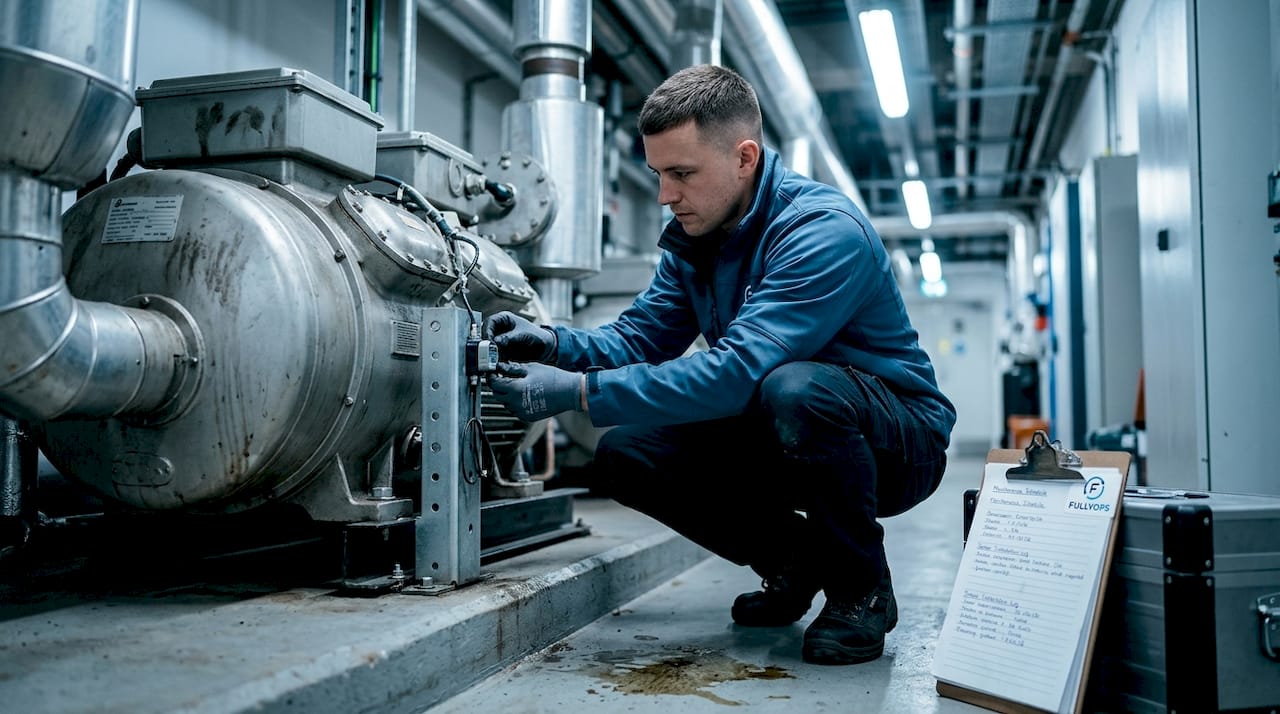
These figures translate directly into operational impact. Consider a manufacturing facility running 40 rotating assets on a fixed quarterly service schedule. Switching those assets to CBM typically results in roughly a third of interventions being deferred because the assets remain within healthy operating parameters. The remaining two-thirds are addressed earlier and more precisely than a calendar would have caught them. The net effect is fewer emergency callouts, lower parts consumption, and longer intervals between major overhauls.
| Maintenance strategy | Cost relative to reactive | Unplanned failure rate | Average component life extension |
|---|---|---|---|
| Reactive (run to failure) | Baseline (100%) | Alta | None |
| Preventive (time-based) | 60 to 70% of reactive | Moderate | Low to moderate |
| Condition-based (CBM) | 30 to 40% of reactive | Bajo | Moderate to high |
| Predictive (PdM) | 25 to 35% of reactive | Very low | Alta |
The figures above illustrate why industrial operations managers are actively looking to reduce maintenance costs by transitioning away from purely reactive or calendar-driven programmes.
A real-world example clarifies the impact. A food processing plant monitoring a critical compressor with vibration sensors detected an early-stage bearing defect through a gradual rise in high-frequency vibration. The bearing was replaced during a planned window three weeks later at a cost of approximately £800. Had the defect gone undetected, a catastrophic bearing failure would have caused shaft damage, a full compressor overhaul, and an estimated 18 hours of unplanned line downtime, costing closer to £14,000 in parts and lost production. One detection event covered months of monitoring costs.
Implementing software de mantenimiento basado en la nube significantly accelerates the realisation of these benefits by providing centralised data storage, real-time alert routing, and cross-site condition visibility without requiring on-premises server infrastructure.
Pro Tip: When measuring CBM performance, track the ratio of planned to unplanned work orders and the number of failures actively avoided rather than the volume of alerts generated. High alert volume with low work order quality signals poorly calibrated thresholds, not a healthy system.
How does CBM differ from other strategies?
Understanding the distinctions between maintenance strategies helps you decide where CBM fits and where it does not. The table below compares the three principal approaches across several decision-relevant dimensions.
| Dimension | Preventive (time-based) | Condition-based (CBM) | Predictive (PdM) |
|---|---|---|---|
| Desencadenar | Fixed schedule | Threshold crossing | Model-based forecast |
| Data requirement | Bajo | Moderate | Alta |
| Lead time for action | Planned in advance | Triggered by condition | Forecast window |
| Technology investment | Bajo | Moderate | Alta |
| Risk of over-maintenance | Alta | Bajo | Bajo |
| Más adecuado para | Low-cost, simple assets | Critical steady-state assets | Variable-load complex systems |
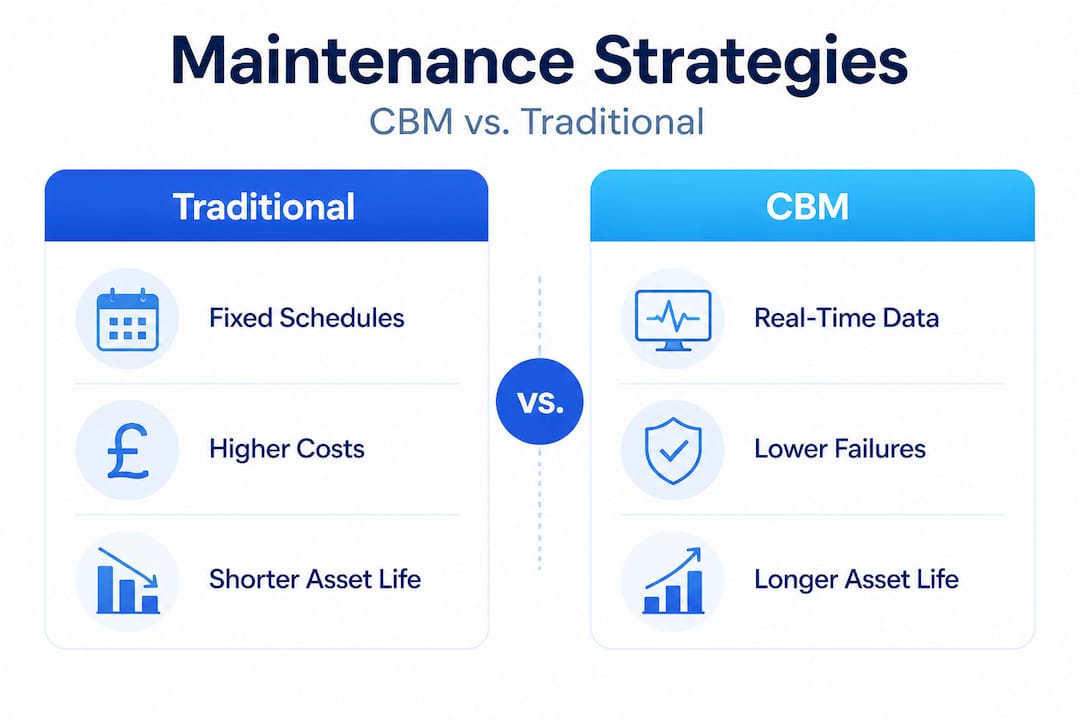
As noted in CBM literature, CBM acts on current condition data rather than projections, making it both more accessible than PdM and more responsive than fixed schedules.
Each strategy has genuine limitations worth understanding before committing resources:
- Mantenimiento preventivo risks unnecessary part replacements, accumulated technician time on healthy assets, and calendar-driven downtime that interrupts production for no measurable gain.
- Condition-based maintenance requires upfront sensor installation and threshold configuration, and delivers limited value on assets with non-continuous or highly variable operating cycles.
- Mantenimiento predictivo demands substantial historical failure data, data science expertise, and ongoing model maintenance, which makes it impractical for many mid-sized industrial operations.
For teams reviewing their pasos de mantenimiento preventivo and looking to evolve their approach, CBM typically represents the most accessible next level, particularly for rotating machinery, HVAC systems, electrical switchgear, and hydraulic circuits. Those building or refining their maintenance schedule creation process will find that a hybrid model, retaining fixed intervals for low-cost consumables while applying CBM to critical assets, often delivers the best balance of cost and reliability.
Implementing an effective condition-based maintenance programme
A methodical implementation avoids the configuration errors and integration gaps that cause most CBM projects to fail. The following steps reflect current best practice for industrial deployments.
- Conduct a criticality analysis. Rank assets by failure consequence, replacement cost, and production impact. Prioritise the top tier for CBM instrumentation first. Not every asset justifies sensor investment.
- Select appropriate monitoring parameters. Match the sensing technology to the dominant failure mode. Vibration analysis suits rotating equipment; thermography detects electrical faults; oil analysis identifies internal wear in gearboxes and hydraulics.
- Establish operational baselines. Collect 30 to 90 days of clean operating data before setting any thresholds. As best practice guidance confirms, dynamic, load-normalised thresholds at two to three standard deviations above the baseline mean outperform fixed alarm values because they account for normal operating variability.
- Configure alerts and integrate with your CMMS. Use API connections to route threshold crossings directly into your work order system as draft or auto-generated work orders. This eliminates manual transcription errors and shortens response times.
- Run parallel with your existing schedule initially. During the first two to three months, continue performing scheduled maintenance as planned while also responding to CBM alerts. This parallel-run phase validates your thresholds and builds team confidence before you begin deferring calendar-based interventions.
- Review and refine. Assess false alarm rates, missed detections, and planned-to-unplanned ratios monthly during the first six months. Adjust thresholds based on actual failure data rather than generic benchmarks.
Good work order management best practices are essential at this stage because the quality of CBM depends heavily on how reliably triggered work orders are actioned, tracked, and closed out with accurate feedback data.
Pro Tip: Use multi-technique confirmation before dispatching high-cost interventions. If a vibration alarm fires but temperature and oil analysis remain normal, schedule a manual inspection rather than an immediate replacement. Multi-technique agreement dramatically reduces false positives and builds technician trust in the system.
Common pitfalls to avoid during implementation:
- Monitoring the wrong parameters for the actual failure mode of the asset
- Using static alarm thresholds that do not account for load or speed variation
- Neglecting sensor calibration schedules, leading to gradual sensor drift that corrupts baseline data
- Failing to close the loop between alerts, work orders, and outcome records in the CMMS
- Alert fatigue caused by overly sensitive thresholds that generate more notifications than technicians can meaningfully respond to
Pitfalls and best practices for condition-based maintenance
Even well-intentioned CBM programmes fail at a surprisingly high rate. Research indicates that 47 per cent of CBM projects underperform due to wrong parameter selection, ineffective threshold setting, and poor integration with CMMS platforms. Edge cases include sensor drift in harsh environments, non-stationary noise in variable-speed equipment, alert fatigue from miscalibrated alarms, and statistically unreliable conclusions drawn from limited failure datasets.
The last point deserves particular attention. When an asset has experienced zero failures in a monitoring period, it is tempting to conclude that the CBM programme is working perfectly. In fact, limited failure data makes it statistically risky to draw firm conclusions. A zero-failure observation could reflect genuine asset health, insufficient monitoring sensitivity, or simply too short a monitoring window.
“Success in CBM is not measured by the number of alerts your system generates. It is measured by the failures you avoided, the ratio of planned to unplanned work, and the accuracy of your threshold calibration over time.” Informed by CBM migration best practices.
Avoidable mistakes and corrective best practices:
- Wrong parameters: Conduct a formal failure mode and effects analysis (FMEA) before selecting sensors to ensure each monitored parameter directly reflects a relevant failure mechanism.
- Fixed thresholds: Replace static alarms with statistical alarms based on rolling baseline distributions, adjusted for load and ambient conditions.
- Poor CMMS integration: Ensure every alert automatically creates a traceable work order with priority, asset ID, and the triggering parameter value captured in the record.
- Sensor drift: Schedule quarterly sensor verification checks, particularly for vibration transducers and temperature sensors in high-temperature or high-vibration environments.
- Multi-component coupling: In systems where components degrade interdependently, such as a motor driving a pump through a coupling, consider coupled degradation modelling rather than treating each component in isolation.
A smarter path: what most maintenance managers miss about CBM
There is a persistent tendency in industrial maintenance to equate technological sophistication with operational effectiveness. CBM and PdM are often discussed as if complexity is inherently desirable, but the evidence does not fully support that view.
Research comparing threshold-based CBM with ML-based PdM confirms that simpler threshold CBM can deliver approximately 80 per cent of the available performance improvement at around 20 per cent of the complexity cost for steady-state assets with limited failure history. ML-driven PdM is genuinely more powerful for assets operating under variable loads with rich historical data, but that profile describes a minority of industrial assets in most facilities.
The practical implication is significant. Many operations managers delay CBM implementation because they feel the organisation is not yet ready for full predictive capability. This is a costly mistake. Basic statistical alarms, well-calibrated baselines, and disciplined CMMS integration deliver substantial, measurable results without requiring a data science team or enterprise AI infrastructure.
The smarter path is iterative deployment: instrument your highest-criticality assets first, build good baseline data, refine your thresholds over six to twelve months, and only then evaluate whether ML-based forecasting would add meaningful value on specific asset classes. This approach aligns with the preventive maintenance essentials principle of building rigour incrementally rather than attempting a full-system transformation in one step.
Measuring the right outcomes reinforces this mindset. Track failures avoided, the planned-to-unplanned work ratio, and maintenance cost per operating hour. These metrics reveal real-world impact and guide threshold refinement far more reliably than the sophistication of your monitoring dashboard.
Supporting your condition-based maintenance journey
Translating CBM principles into day-to-day operational practice requires the right tools and processes working in concert. FullyOps provides industrial maintenance teams with an integrated platform for work order management, asset tracking, condition-based alert routing, and operational reporting. Whether you are at the baseline-setting stage or refining an established programme, the platform connects sensor alerts directly to actionable work orders and performance dashboards. Explore our tutorial de asignación de recursos for practical guidance on CBM asset prioritisation, review the full range of sistemas de gestión de activos suited to industrial maintenance, or see how best maintenance software supports reliable, cost-efficient operations at scale.
Preguntas más frecuentes
What are the key components of a condition-based maintenance system?
A functioning CBM system requires sensors for parameter measurement, real-time monitoring software with configurable alarms, dynamic threshold libraries, and automated work order creation. As GE Vernova defines it, CBM triggers interventions only when monitored data provides evidence of actual asset degradation.
How quickly can organisations see results from condition-based maintenance?
Many organisations report measurable cost and failure reductions within the first year, with some improvements visible within the first few months after thresholds are properly calibrated. Industry benchmarks point to 25 to 40 per cent maintenance cost reductions and 35 to 50 per cent fewer unplanned failures in leading implementations.
Is CBM suitable for all types of assets and industries?
CBM delivers the greatest return on critical, high-value assets where early detection avoids costly failures, but simpler or low-cost assets with straightforward failure modes may not justify the sensor investment. Research confirms that threshold-based CBM suits steady-state assets with limited data, while ML-driven PdM is better reserved for complex, variable-load systems with rich failure histories.
What are the most common mistakes in CBM projects?
The two most prevalent causes of underperformance are selecting parameters that do not align with actual failure modes and failing to integrate CBM alerts with a CMMS to produce traceable work orders. Data shows that 47 per cent of CBM projects fail for these exact reasons, making threshold design and system integration the most critical success factors.
Recomendado
- Pasos esenciales de mantenimiento preventivo: maximizar la fiabilidad
- Dominar la creación de programas de mantenimiento para activos fiables
- Consejos esenciales de mantenimiento preventivo para operaciones confiables
- Manufacturing productivity checklist for efficiency in 2026