

En resumen:
- Maintenance audits identify gaps in procedures, safety, and documentation before failures occur.
- Regular, structured audits improve operational efficiency, reduce downtime, and extend asset life.
- Successful auditing requires team engagement, accurate data, and a culture of continuous learning.
Many maintenance managers operate under the assumption that doing more maintenance automatically means better performance. In practice, the opposite can be true. Poorly targeted maintenance wastes labour, inflates costs, and still leaves critical failures undetected. Structured maintenance auditing changes this equation entirely. Preventive maintenance reduces downtime by 50% and extends asset life by 20 to 40%, but only when the underlying processes are sound. This guide clarifies what maintenance auditing actually involves, how it is structured, which areas it targets, and how you can apply it to drive measurable efficiency and compliance gains across your operations.
Índice
- Defining maintenance auditing: purpose and process
- Key areas examined during maintenance audits
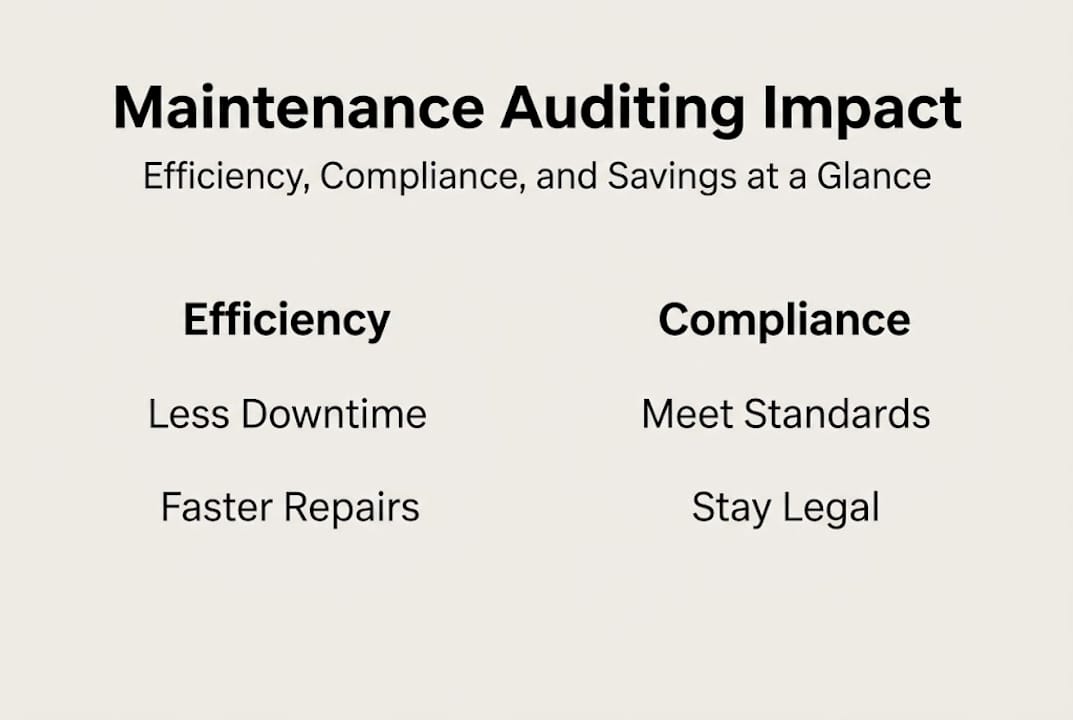
- How maintenance auditing drives efficiency and compliance
- Common pitfalls and best practices for maintenance audits
- Our perspective: what most teams miss in maintenance auditing
- Take maintenance auditing to the next level with FullyOps
- Preguntas más frecuentes
Principales conclusiones
| Punto | Detalles |
|---|---|
| Auditing drives efficiency | Regular maintenance audits dramatically reduce downtime and extend equipment life. |
| Comprehensive checklists win | Effective audits closely review policies, work orders, asset inventories, and KPIs for improvement. |
| Digital tools maximise impact | Using CMMS and digital work orders elevates audit accuracy and operational gains. |
| Continuous improvement is key | Audits should inform ongoing training and process upgrades, not just compliance. |
Defining maintenance auditing: purpose and process
A maintenance audit is a systematic assessment of how well an organisation manages its physical assets, maintenance documentation, and process compliance. It is not a casual inspection. It is a structured evaluation designed to reveal gaps in preventive maintenance, safety practices, and performance tracking before those gaps become costly incidents or regulatory failures.
The primary objectives of a maintenance audit are to verify that assets are being maintained according to defined standards, that documentation is accurate and complete, and that the organisation is meeting both internal performance targets and external compliance requirements. Audits also serve as a diagnostic tool, helping teams understand whether their maintenance strategy is aligned with operational goals.
A maintenance audit is not about finding fault. It is about building a clear, evidence-based picture of where your operations stand and where they need to go.
A typical audit is structured around several key components. Key components include verifying asset existence and condition, assessing maintenance practices and schedules, reviewing documentation, work orders, inventory, safety and compliance, and KPIs. This makes the audit a broad but focused exercise that touches every layer of your maintenance operation.
In practice, a maintenance audit will typically include the following activities:
- Asset verification: Confirming that assets on record actually exist, are in the expected condition, and are correctly classified.
- Procedure assessment: Evaluating whether maintenance procedures are documented, up to date, and being followed in the field.
- Documentation review: Examining work order records, maintenance logs, and service histories for completeness and accuracy. A solid work order management checklist is often the starting point for this review.
- Compliance evaluation: Checking adherence to safety regulations, environmental standards, and industry-specific requirements.
- KPI analysis: Measuring actual performance against targets, including metrics such as mean time between failures, planned maintenance compliance, and overall equipment effectiveness.
Most organisations schedule maintenance audits annually or biannually. High-criticality environments may require more frequent reviews. Audits can be led by internal teams with sufficient expertise or by external auditors who bring an independent perspective. Both approaches have merit, and many organisations use a combination of the two to balance objectivity with contextual knowledge.
Key areas examined during maintenance audits
With a clear definition in hand, let us explore precisely what areas a maintenance audit targets and why they are crucial. Checklist areas include policies and procedures, planning and PM strategy, work orders, assets, CMMS usage, training, and KPIs. Each of these domains provides a different lens through which auditors assess operational health.
The following areas are typically scrutinised during a thorough maintenance audit:
- Maintenance policies and procedures: Are they documented, current, and consistently applied across all sites and shifts?
- Work order records: Are work orders being raised, completed, and closed in a timely manner? The work order process is a reliable indicator of operational discipline.
- Planning and scheduling: Is preventive maintenance planned proactively, or does the team spend most of its time reacting to breakdowns?
- Asset inventory: Is the asset register accurate, and does it reflect current asset condition and lifecycle stage?
- CMMS effectiveness: Is the Computerised Maintenance Management System (CMMS) being used to its full potential, or is data entry inconsistent and reporting unreliable?
- Staff training and competency: Do technicians have the skills and knowledge required to carry out maintenance tasks safely and correctly?
- Safety logs: Are near-misses, incidents, and safety inspections being recorded and acted upon?
- KPIs: Are performance indicators tracked regularly and used to drive decisions?
A useful way to understand the audit’s scope is to compare preventive and reactive maintenance practices side by side:
| Audit area | Mantenimiento preventivo | Mantenimiento reactivo |
|---|---|---|
| Planning | Scheduled in advance | Unplanned, demand-driven |
| Documentación | Consistent and complete | Often incomplete |
| Asset condition | Monitored regularly | Assessed after failure |
| Previsibilidad de costos | Alta | Bajo |
| Compliance risk | Managed proactively | Elevated |
A robust audit does not simply check whether documentation exists. It verifies that practice in the field matches what is written on paper. Reviewing a guía de flujo de trabajo de mantenimiento alongside field observations is a reliable method for identifying this kind of discrepancy. External resources such as a property maintenance guide can also offer useful benchmarks for comparing documentation standards.
Pro Tip: Do not rely solely on written records during an audit. Walk the floor, speak to technicians, and observe maintenance tasks being carried out. This often reveals gaps that paperwork alone will never show.
How maintenance auditing drives efficiency and compliance
Knowing what auditors look for, it becomes clear why regular audits are such a powerful lever for operational success. The connection between structured auditing and measurable performance improvement is well supported by data.

Unplanned downtime costs manufacturers $50 billion per year, and top-quartile steel operations maintain costs below $12 per tonne through disciplined maintenance practices. These figures illustrate the financial stakes involved. Auditing is the mechanism that keeps those practices on track.
Here is how maintenance auditing creates a sequential chain of operational improvement:
- Issue detection: Audits surface hidden inefficiencies, unsafe practices, and documentation gaps before they escalate into failures or regulatory breaches.
- Targeted intervention: With clear audit findings, maintenance managers can direct resources precisely where they are needed, rather than spreading effort uniformly across all assets.
- Process refinement: Audit outcomes feed directly into updated procedures, revised schedules, and improved training programmes, strengthening the maintenance system over time.
- Continuous improvement: Each audit cycle builds on the last, creating a compounding effect where small gains accumulate into significant long-term performance uplift.
The data behind these outcomes is compelling:
| Métrica | Benchmark impact |
|---|---|
| Downtime reduction | Up to 50% with preventive maintenance |
| Asset life extension | 20 to 40% longer service life |
| Reactive maintenance reduction | 10 to 25% decrease |
| Annual unplanned downtime cost | $50 billion across manufacturing |
Beyond cost and reliability, auditing also supports legal and environmental compliance. Regulatory frameworks in most industrial sectors require documented evidence of maintenance activity, safety inspections, and corrective actions. Audits provide the structured review process that ensures this evidence exists and is accurate. Reviewing pasos de mantenimiento preventivo as part of the audit cycle ensures that compliance is built into daily operations rather than addressed reactively. Structured informes de mantenimiento also makes it significantly easier to demonstrate compliance to regulators and insurers.
Common pitfalls and best practices for maintenance audits
The benefits are significant. However, securing them depends on avoiding common missteps and applying industry-proven strategies.
Many organisations invest in auditing but fail to extract full value from the process. The most frequent pitfalls include:
- Siloed data: When maintenance records are spread across spreadsheets, paper logs, and disconnected systems, auditors cannot form an accurate picture of performance.
- Lack of documentation: Missing or incomplete work order records make it impossible to assess compliance or identify trends.
- Staff resistance: Technicians who view audits as a threat rather than a tool for improvement are less likely to provide accurate information or engage constructively.
- Inconsistent scheduling: Audits conducted irregularly lose their value as a continuous improvement mechanism.
- Compliance-only focus: Treating audits as a box-ticking exercise misses the broader opportunity for operational learning and process refinement.
In contrast, high-performing teams apply the following best practices. PM compliance reached 89% in one retail chain case study, breakdowns were cut by 38% in a fleet operation, and reactive maintenance fell by 10 to 25% through disciplined auditing and follow-through.
- Involve cross-functional teams, including operations, safety, and finance, so that audit findings are understood and acted upon across the business.
- Use a CMMS to maintain real-time records that auditors can access quickly and reliably. Órdenes de trabajo digitales eliminate the documentation gaps that undermine audit quality.
- Verify findings through spot checks and field observations, not just document reviews.
- Link audit outcomes directly to KPIs so that improvement targets are measurable and accountable.
- Use a structured asset tracking guide to ensure your asset register is accurate before the audit begins. Resources such as a facility cleanout guide can also help prepare physical environments for inspection.
Pro Tip: Communicate audit findings transparently to your maintenance team and involve them in developing corrective actions. Teams that understand the purpose of an audit and see their input reflected in outcomes are far more likely to engage positively in future cycles.
Our perspective: what most teams miss in maintenance auditing
With practical strategies covered, it is worth pausing to consider the deeper lessons from teams that have genuinely excelled at auditing. Most organisations focus heavily on the technical and procedural dimensions: checklists, KPIs, CMMS data, and compliance records. These matter. But they are rarely what separates good auditing from great auditing.
The teams that see compounding returns from their audit programmes share one characteristic: they treat audits as a learning event, not an inspection. This means investing in feedback loops, not just findings. It means leadership visibly engaging with audit outcomes and acting on them quickly. It means technicians understanding that the audit exists to make their work safer and more effective, not to catch them out.
Technology accelerates this process, but it cannot replace the cultural foundation. Optimising asset workflows is far more effective when the team using those workflows understands why they exist and how they contribute to broader operational goals. The organisations that treat auditing as a continuous conversation rather than a periodic event are the ones that build genuine operational resilience over time.
Take maintenance auditing to the next level with FullyOps
Armed with a clearer understanding of maintenance auditing, the logical next step is to ensure your digital infrastructure supports the process. FullyOps is built specifically for maintenance managers and operational leaders who need integrated tools for workflow automation, asset tracking, and compliance management. The platform brings together gestión del ciclo de vida de los activos, real-time work order tracking, and performance reporting in a single environment, making audit preparation and follow-through significantly more efficient. Explore Herramientas de seguimiento de mantenimiento designed for industrial teams, and review how sistemas de gestión de activos can support your auditing programme from day one.
Preguntas más frecuentes
What is the main objective of a maintenance audit?
A maintenance audit aims to assess the effectiveness and compliance of maintenance processes, identifying gaps that hinder operational performance. It covers asset condition, work orders, and KPIs to give managers a complete operational picture.
How often should maintenance audits be conducted?
Best practice is to conduct maintenance audits annually or biannually, with higher-frequency reviews for assets that are safety-critical or subject to strict regulatory requirements.
What data is most important during a maintenance audit?
Key data includes maintenance schedules, work order completion rates, asset condition records, compliance documentation, and KPIs tied to reliability and cost performance.
Can maintenance audits reduce operational costs?
Yes. By strengthening preventive maintenance, audits can cut downtime by 50% and extend asset life by 20 to 40%, producing direct and measurable cost savings.
What is the biggest mistake in maintenance auditing?
The most common mistake is treating audits purely as a compliance exercise rather than using them as a structured opportunity for continuous improvement and team engagement.
Recomendado
- Pasos esenciales de mantenimiento preventivo: maximizar la fiabilidad
- Guía de flujos de trabajo de mantenimiento de activos para una eficiencia óptima
- Optimización del mantenimiento en 2026: reducir el tiempo de inactividad en 30%
- Property maintenance: Cape Coral rental success guide