

Industrial operations often treat resource allocation as a back-office task, yet poor allocation directly causes maintenance backlogs, asset underutilisation, and spiralling costs. Optimising how you deploy labour, equipment, and materials transforms operational efficiency and financial performance. This guide explains why improving resource allocation matters and reveals proven methods to reduce downtime, control budgets, and boost productivity across your industrial facilities.
Índice
- Principales conclusiones
- The importance of resource allocation in industrial operations
- Key benefits of improving resource allocation in operations
- Strategies and tools to improve resource allocation
- Measuring and sustaining improvements in resource allocation
- Explore FullyOps solutions for optimised resource allocation
- Frequently asked questions about improving resource allocation
Principales conclusiones
| Punto | Detalles |
|---|---|
| Operational efficiency gains | Improved resource allocation lowers maintenance costs and reduces downtime, boosting overall efficiency. |
| Cost and downtime reduction | Precise deployment of technicians and materials lowers emergency repairs and aids budget predictability. |
| Strategic decision making | Structured allocation enables faster evidence based decisions and improved risk management. |
| Digital tools enable allocation | Digital and data driven platforms provide real time visibility into resource use and forecast needs. |
The importance of resource allocation in industrial operations
Resource allocation in industrial settings refers to the strategic deployment of assets, labour, materials, and budget across maintenance tasks, production schedules, and service delivery. When allocation decisions lack structure, operations suffer from duplicated efforts, idle equipment, and maintenance backlogs that compound over time. Inefficient resource allocation increases operational costs significantly, often by 20 to 35 percent in facilities with reactive maintenance cultures.
Poor allocation creates bottlenecks that ripple through workflows. A maintenance team dispatched to low-priority tasks while critical assets await repair exemplifies misalignment. Similarly, overstaffing certain shifts while leaving others understaffed disrupts continuity and inflates labour costs. Underutilised assets tie up capital without generating value, and deferred maintenance on high-use equipment leads to unexpected failures that halt production.
Balanced allocation smooths workflow continuity by matching resource availability to actual demand. When you assign technicians based on skill requirements and equipment criticality, you reduce idle time and improve first-time fix rates. Proper allocation also shortens response times, preventing minor issues from escalating into costly breakdowns.
Key obstacles in industrial resource allocation include:
- Limited visibility into real-time asset status and technician availability
- Siloed data across maintenance, operations, and procurement systems
- Reactive scheduling that prioritises urgency over strategic importance
- Inadequate tools for forecasting resource needs based on historical patterns
- Resistance to adopting digital platforms that centralise allocation decisions
Addressing these obstacles requires both cultural shifts and technological investment. Operations managers who treat allocation as a strategic priority rather than an administrative function unlock substantial efficiency gains.
Key benefits of improving resource allocation in operations
Optimising resource allocation delivers tangible operational and financial advantages. Effective resource allocation can lower maintenance costs by up to 25 percent and reduce downtime by 30 percent, transforming budget predictability and service reliability.
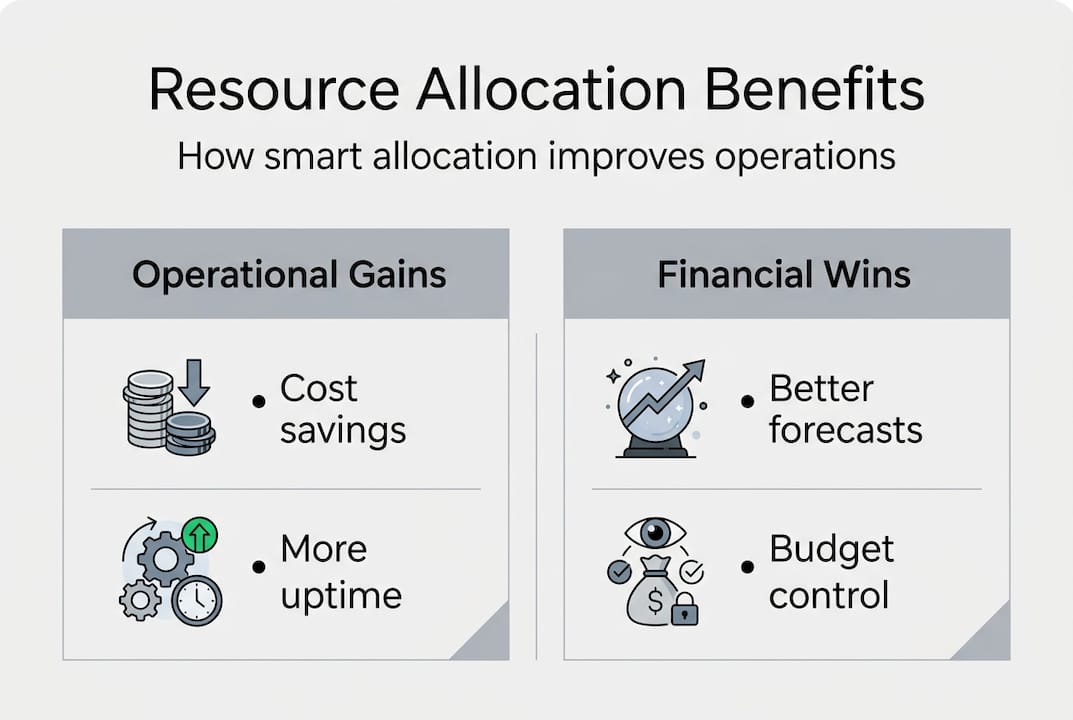
Reduced operational costs emerge from precise resource deployment. When you allocate technicians to preventive maintenance based on equipment criticality and condition data, you avoid emergency repairs that cost three to five times more than planned interventions. Materials procurement becomes more efficient when allocation systems forecast spare parts needs accurately, reducing expedited shipping fees and excess inventory holding costs.
Improved uptime and productivity follow naturally. Equipment failures drop when maintenance resources align with asset health indicators rather than arbitrary schedules. Production lines maintain consistent output, and service teams meet delivery commitments without last-minute scrambles. This reliability strengthens customer satisfaction and protects revenue streams.
Enhanced financial forecasting and budget control stem from allocation transparency. Digital platforms provide real-time visibility into resource consumption, enabling managers to compare actual spending against budgets and adjust allocations proactively. You can identify cost drivers, such as overtime labour or repeat failures on specific assets, and redirect resources to address root causes.
Better service schedule adherence results from matching resource capacity to workload. When allocation tools account for technician skills, travel time, and task complexity, you complete more work orders within target timeframes. This precision reduces customer complaints and improves regulatory compliance in industries with strict service level agreements.
| Beneficio | Measurement | Typical improvement |
|---|---|---|
| Reducción de costes | Maintenance spend per asset | 15-25% decrease |
| Uptime increase | Equipment availability | 20-30% improvement |
| Cumplimiento del horario | On-time completion rate | 25-40% improvement |
| Budget accuracy | Variance from forecast | 30-50% reduction |
Pro Tip: Continuously monitor allocation effectiveness using dashboards that track utilisation rates, cost per work order, and mean time to repair. Monthly reviews reveal patterns that inform smarter allocation decisions and prevent resource drift.
Strategies and tools to improve resource allocation
Achieving allocation improvements requires structured methods and modern technology. Start by assessing your current state through a resource audit that maps asset inventories, technician skills, materials stocks, and budget allocations against actual demand patterns. Identify gaps where resources sit idle or where critical needs go unmet due to misallocation.

Prioritisation matrices help rank tasks and assets by criticality and urgency. Assign resources first to high-criticality, high-urgency items, then to high-criticality preventive work that avoids future emergencies. This framework prevents the common trap of reacting to every urgent request while neglecting strategic maintenance that sustains long-term reliability.
Predictive maintenance transforms allocation from reactive to proactive. Condition monitoring sensors and analytics forecast equipment failures before they occur, allowing you to schedule maintenance when resources are available and minimise disruption. Data-driven tools and SaaS solutions transform allocation efficiency in industrial operations by integrating real-time data from assets, work orders, and inventory systems.
Dynamic scheduling adapts resource allocation to changing conditions. Advanced software recalculates optimal technician assignments when emergencies arise, balancing immediate needs against planned work without manual intervention. This agility reduces downtime and maintains productivity during unexpected events.
Cross-functional communication strengthens allocation decisions. Regular coordination between maintenance, operations, procurement, and finance teams ensures resource plans reflect actual business priorities. Collaborative platforms that share allocation data across departments prevent conflicting demands and resource hoarding.
- Conduct a comprehensive resource audit to establish baseline utilisation and identify allocation gaps
- Implement prioritisation frameworks that rank tasks by criticality, urgency, and business impact
- Deploy gestión de recursos software that centralises asset data, work orders, and technician schedules
- Integrate predictive analytics to forecast maintenance needs and allocate resources proactively
- Establish cross-functional review meetings to align resource allocation with strategic objectives
- Train teams on allocation tools and methodologies to ensure consistent application
- Monitor performance metrics continuously and adjust allocation rules based on results
Pro Tip: Integrate data from multiple sources such as ERP systems, field service management platforms, and IoT sensors into a unified tutorial de asignación de recursos gestión de activos system for holistic allocation decisions. Siloed data leads to fragmented allocation that misses optimisation opportunities.
Measuring and sustaining improvements in resource allocation
Establishing clear metrics ensures allocation improvements deliver lasting value. Define key performance indicators that reflect both efficiency and effectiveness. Utilisation rates measure the percentage of available resource hours applied to productive work, revealing whether assets and labour are fully deployed. Downtime frequency and duration track how well allocation decisions prevent equipment failures. Cost savings quantify financial gains from reduced maintenance spend, lower inventory costs, and fewer emergency repairs.
Service level agreement compliance indicates whether allocation strategies enable reliable service delivery. Compare planned versus actual completion times for work orders to identify allocation bottlenecks. Regular performance measurement is essential for sustaining resource allocation benefits and preventing backsliding into reactive patterns.
Qualitative monitoring complements quantitative KPIs. Technician feedback reveals whether allocation decisions account for skill levels and workload balance. Customer satisfaction surveys indicate whether improved allocation translates to better service quality. Qualitative insights often surface issues that metrics alone miss, such as morale problems from inequitable work distribution.
Continuous improvement cycles embed allocation optimisation into operational culture. Monthly reviews compare current performance against targets and historical trends. Root cause analysis identifies why certain allocations underperform, whether due to inaccurate demand forecasts, inadequate tools, or insufficient training. Implement corrective actions, measure their impact, and refine allocation rules iteratively.
Dashboards and analytics provide real-time visibility into allocation performance. Visual displays of utilisation rates, cost trends, and schedule adherence enable managers to spot problems quickly and adjust resources before small issues escalate. Automated alerts notify teams when metrics deviate from acceptable ranges, prompting immediate intervention.
| Monitoring approach | Puntos fuertes | Limitaciones |
|---|---|---|
| Quantitative KPIs | Objective, measurable, trend analysis | May miss context and human factors |
| Qualitative feedback | Captures nuance, morale, and satisfaction | Subjective, harder to aggregate |
| Automated dashboards | Real-time, proactive alerts | Requires data integration and setup |
| Periodic audits | Comprehensive, strategic perspective | Infrequent, reactive |
Common pitfalls to avoid when sustaining allocation improvements:
- Neglecting to update allocation rules as business conditions change
- Relying solely on historical data without incorporating predictive insights
- Failing to train new team members on allocation tools and processes
- Allowing allocation decisions to revert to informal, ad hoc methods
- Ignoring feedback from frontline technicians who execute allocation plans
- Underinvesting in technology maintenance and upgrades that support allocation systems
Sustaining gains requires leadership commitment to treat resource allocation as a strategic capability, not a one-time project. Embed allocation reviews into regular management routines, celebrate wins publicly, and hold teams accountable for maintaining discipline in resource deployment.
Explore FullyOps solutions for optimised resource allocation
FullyOps offers integrated tools designed to help operations managers and maintenance directors achieve superior resource allocation and operational efficiency. Our platform combines gestión del ciclo de vida de los activos with intelligent scheduling, real-time analytics, and cross-system integration to eliminate allocation guesswork. Explore our resource allocation tutorial asset management to learn step-by-step methods for optimising labour, assets, and materials across your facilities. Discover how the role of SaaS in operations transforms maintenance from reactive to proactive through data-driven allocation decisions. FullyOps empowers you to reduce costs, improve uptime, and sustain continuous improvement in resource management.
Frequently asked questions about improving resource allocation
What are the first steps in improving resource allocation?
Begin with a comprehensive resource audit that maps current asset inventories, technician skills, and workload patterns against actual demand. Identify gaps where resources remain underutilised or where critical needs go unmet. Implement prioritisation frameworks that rank tasks by criticality and urgency to guide initial allocation improvements.
How can technology specifically help in resource allocation?
Technology centralises data from assets, work orders, and inventory systems into unified platforms that automate scheduling and optimise resource deployment. Predictive analytics forecast maintenance needs before failures occur, enabling proactive allocation. Real-time dashboards provide visibility into utilisation rates and cost trends, supporting agile decision making.
What KPIs are most important to monitor?
Track utilisation rates to measure productive use of assets and labour, downtime frequency to assess maintenance effectiveness, and cost per work order to quantify financial efficiency. Monitor schedule adherence rates to ensure timely service delivery. Combine these quantitative metrics with qualitative feedback from technicians and customers for a complete performance picture.
How often should resource allocation strategies be reviewed?
Conduct monthly reviews to compare current performance against targets and identify emerging trends. Quarterly strategic reviews assess whether allocation strategies align with evolving business priorities and market conditions. Immediate reviews are necessary when major operational changes occur, such as new equipment installations or significant shifts in demand.
Can small operations benefit from resource allocation improvements?
Absolutely. Small operations often experience proportionally larger gains from allocation improvements because inefficiencies have outsized impacts on limited resources. Even basic prioritisation frameworks and simple scheduling tools deliver measurable cost reductions and uptime improvements. Scalable SaaS platforms make sophisticated allocation capabilities accessible regardless of operation size.
Recomendado
- Guía de asignación de recursos para el mantenimiento industrial
- Tutorial de asignación de recursos para una gestión eficiente de los activos
- 7 estrategias probadas de gestión de recursos para la eficiencia de los activos