

Resumo:
- Effective inventory tracking provides real-time visibility crucial for maintenance and cost control.
- Automated, integrated systems reduce downtime, emergency procurement, and improve asset utilization.
- Successful implementation depends on data hygiene, staff training, and organizational discipline, not just technology.
Many operations managers treat inventory tracking as an administrative task, a periodic count of parts sitting on shelves. In asset-heavy industries, this assumption carries real operational risk. Inventory tracking is, in fact, one of the most direct levers you have over maintenance performance, asset uptime, and cost control. Get it wrong and technicians spend hours chasing missing parts, emergency orders inflate procurement budgets, and scheduled maintenance slips. Get it right and you gain real-time visibility into every critical component, enabling faster repairs, smarter resource allocation, and measurably lower downtime. This guide defines inventory tracking in industrial terms, explains its measurable impact, and outlines the methods and strategies that deliver lasting operational gains.
Índice
- Defining inventory tracking in industrial settings
- The impact of effective inventory tracking on maintenance and operations
- Modern methods and technologies for inventory tracking
- Strategies for implementing efficient inventory tracking
- Our perspective: what most industrial teams get wrong about inventory tracking
- Take the next step towards efficient inventory and asset management
- Perguntas mais frequentes
Principais conclusões
| Ponto | Detalhes |
|---|---|
| Beyond basic stock control | Effective inventory tracking is foundational to asset management and maintenance reliability. |
| Directly reduces downtime | Accurate tracking ensures parts and resources are on hand when needed, lowering repair delays and costs. |
| Modern tools boost results | AI, cloud, and mobile systems enhance accuracy, forecasting, and team collaboration in industrial contexts. |
| Strategic implementation matters | Success relies on blending the right tech, best practices, and organisational buy-in—not just new tools. |
Defining inventory tracking in industrial settings
Inventory tracking, in an industrial maintenance context, is the real-time, systematic monitoring of every part, material, consumable, and asset required to keep operations running. It goes well beyond counting what is on the shelf. It means knowing precisely where each item is located, how quickly it is being consumed, and when replenishment is needed, before a shortfall causes a problem.
This distinction matters enormously. A periodic stock-take, typically done monthly or quarterly, gives you a snapshot. By the time you act on that snapshot, critical parts may already be depleted. Controlo do inventário done continuously closes this gap entirely, ensuring that maintenance teams always have accurate, current data to work from. Think of the difference between reading yesterday’s weather report and checking a live forecast. One informs you; the other guides your decisions.
For operations managers running facilities with complex machinery, the components of a robust tracking system typically include:
- SKU (stock-keeping unit) identification for every part, down to individual fasteners and filters
- Location data across multiple storage areas, vehicles, and site locations
- Quantity and reorder thresholds configured per part criticality
- Usage rates tracked over time to identify demand patterns
- Condition and expiry status for perishable or regulated items
Proper automating asset tracking removes the manual effort from these tasks and reduces the risk of human error that plagues spreadsheet-based approaches. Without automation, records become outdated quickly, especially across multi-site or multi-team environments.
The most common challenges teams face include misplaced items that never make it back into the system, outdated records caused by informal workarounds, and fragmented storage across multiple locations with no single source of truth. These are not minor inconveniences. They translate directly into delayed work orders, duplicated purchases, and wasted technician time. A monitorização passo a passo de ativos approach helps organisations move from reactive firefighting to structured, predictable inventory control.
In short, effective inventory tracking is the operational foundation upon which reliable maintenance management is built. Without it, even the most capable maintenance team is operating with one hand tied behind its back.
The impact of effective inventory tracking on maintenance and operations
The operational consequences of poor inventory tracking are not abstract. When a technician arrives at a job and the required part is missing or its location is unknown, that scheduled task becomes an emergency. Emergency procurement is consistently more expensive, slower, and more disruptive than planned purchasing. The knock-on effects ripple through your entire maintenance schedule.
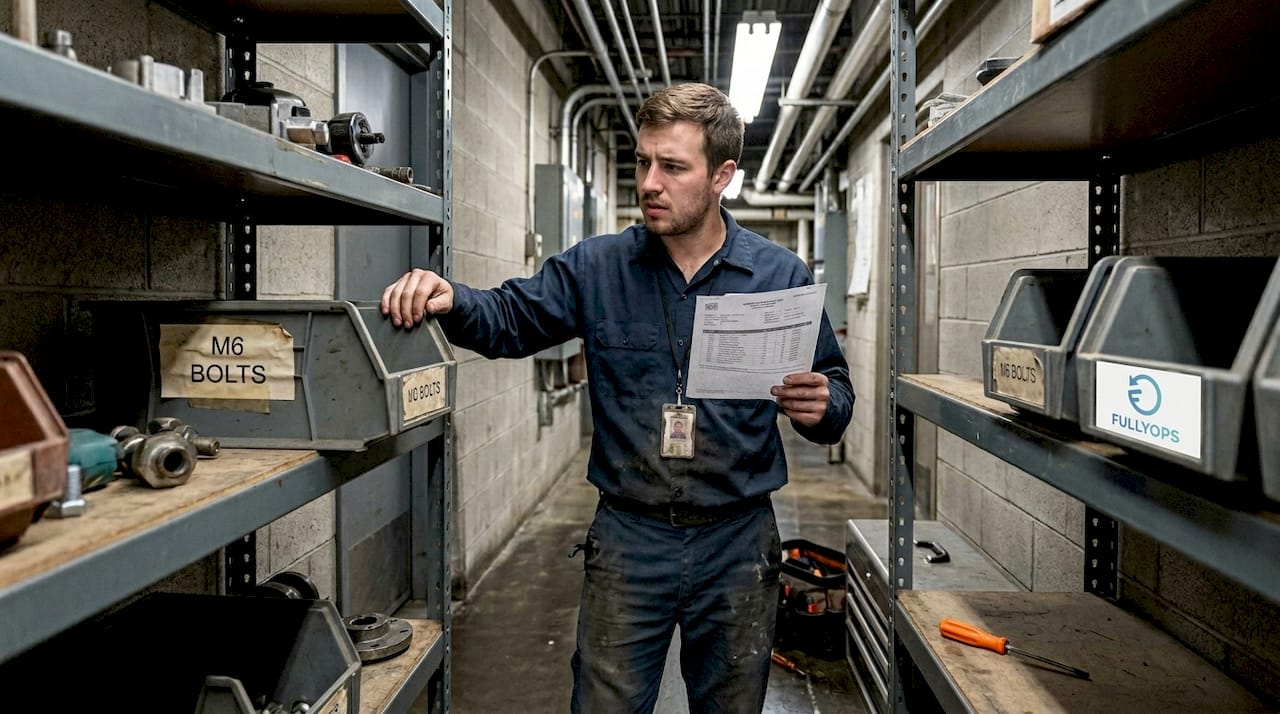
Centralised control and the right tracking strategies can reduce inventory needs by 15 to 30%, a significant figure for any industrial operation carrying thousands of SKUs. The savings come not just from fewer purchases, but from eliminating holding costs for redundant stock and reducing write-offs on expired or obsolete items.
The table below illustrates how operations compare with and without robust inventory tracking in place:
| Métrica | Without robust tracking | With robust tracking |
|---|---|---|
| Unplanned downtime | High, driven by missing parts | Significativamente reduzido |
| Emergency procurement | Frequent and costly | Rare and controlled |
| Asset utilisation | Sub-optimal | Maximised through timely maintenance |
| Compliance risk | Elevated for regulated parts | Managed with real-time alerts |
| Technician productivity | Reduced by search time | Focused on skilled tasks |
Para field service efficiency to improve, inventory accuracy must come first. Technicians cannot complete jobs on time if the parts catalogue does not reflect reality. Accurate tracking also supports preventive maintenance scheduling, since work orders can only be planned reliably when you know the required parts are available and accounted for.
“The most overlooked source of maintenance downtime is not equipment failure. It is inventory failure — the absence of the right part at the right moment.”
Compliance is another critical dimension. Regulated environments require specific parts to be sourced, stored, and applied according to strict standards. Without accurate tracking, organisations risk using expired or substituted components, which can invalidate warranties, breach regulatory requirements, and create safety liabilities.
Pro Tip: Link your inventory system directly to your gestão de ordens de trabalho process. When a work order is raised, the system should automatically check part availability, flag shortfalls, and trigger reorder requests before the scheduled task date.
Modern methods and technologies for inventory tracking
The range of tracking technologies available to industrial operations has expanded significantly, and choosing the right combination depends on your team size, facility complexity, and integration requirements. Here is a structured overview of current options and their practical fit.
Barcodes and QR codes remain the most cost-effective entry point. Each part or asset receives a unique label, and scanning provides instant location and quantity updates. They are reliable, low-cost, and easy to implement across small to mid-sized operations.
RFID (radio-frequency identification) tags allow scanning without line-of-sight contact, making them better suited to high-volume or fast-moving environments. They support bulk scanning of entire shelves or containers, reducing manual effort substantially.
Cloud-based inventory platforms provide real-time, multi-site visibility accessible from any device. Updates made in one location are immediately visible to all users, eliminating the synchronisation lag that undermines spreadsheet systems.
Using mobile apps for tracking extends this capability into the field. Technicians can confirm part usage, log returns, and raise stock requests directly from their devices, keeping records accurate in real time without additional administrative steps.
AI-powered forecasting is an emerging best practice. Combining JIT, safety buffers, and AI forecasting allows systems to predict demand before it materialises, triggering automated reorders based on usage trends, seasonal patterns, and scheduled maintenance plans.
| Method | Prós | Contras | Best fit |
|---|---|---|---|
| Barcodes/QR codes | Low cost, simple | Manual scanning required | Small to mid-sized teams |
| RFID | Fast, bulk scanning | Higher setup cost | High-volume environments |
| Cloud platforms | Real-time, multi-site | Requires reliable connectivity | Multi-site operations |
| AI forecasting | Predictive, automated | Needs data maturity | Larger, data-rich facilities |
When selecting a solution, consider these steps:
- Audit your current inventory volume and location complexity
- Identify which parts are most critical to maintenance continuity
- Evaluate integration capability with your existing maintenance or ERP platform
- Pilot the solution on one site or one category before full rollout
- Measure performance against baseline KPIs after 90 days
Pro Tip: The benefits of field service software extend well beyond scheduling. Platforms that unify inventory, maintenance, and workforce data in a single environment reduce administrative duplication and give managers a genuinely consolidated view of operational performance.
Strategies for implementing efficient inventory tracking
Technology alone will not solve your inventory challenges. Implementation strategy determines whether a tracking system actually changes how your organisation operates or simply adds a new layer of complexity on top of old habits.
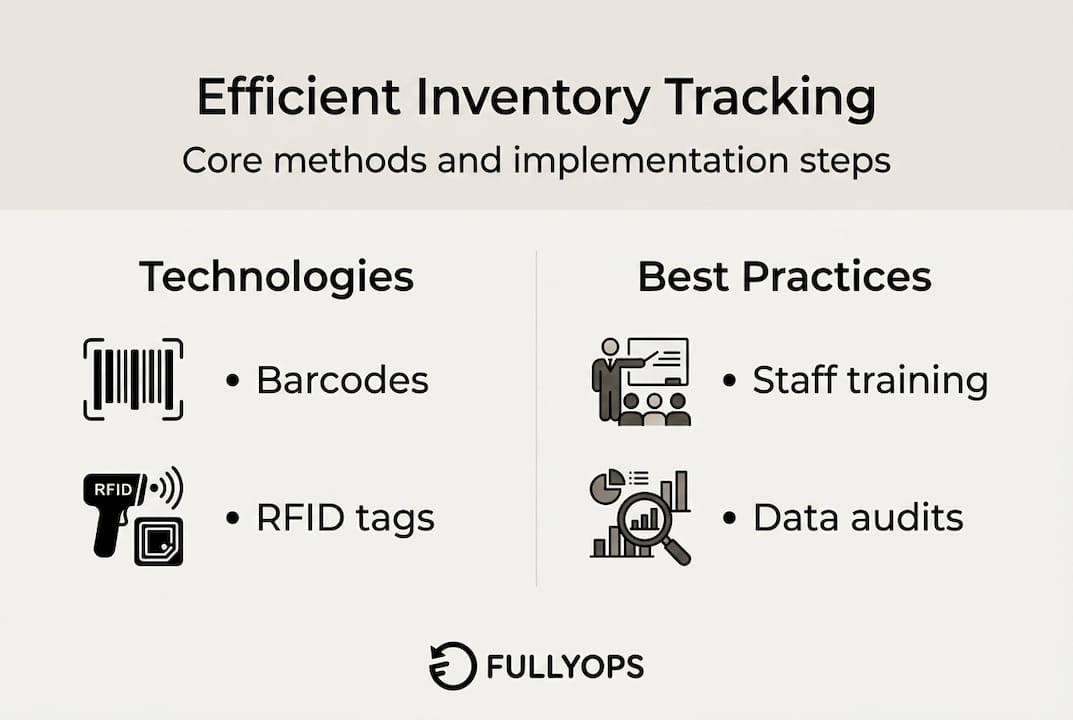
Blending safety stock, JIT, and centralisation yields the greatest inventory reductions, but this balance requires deliberate configuration and ongoing management. Here is a practical framework for rolling out or upgrading your tracking system.
Top features every industrial tracking system must have:
- Real-time stock visibility across all locations
- Automated reorder alerts based on configurable thresholds
- Integration with work order and maintenance management systems
- Mobile accessibility for field and warehouse teams
- Audit trail and reporting for compliance purposes
- Multi-unit and multi-site support
Steps for a smooth technology transition:
- Conduct a full inventory audit to establish accurate baseline data
- Classify items by criticality, frequency of use, and lead time
- Select and configure your tracking platform with role-based access
- Train all staff who interact with inventory, including technicians, not just administrators
- Run a parallel period where both old and new systems operate simultaneously to validate data accuracy
- Decommission legacy processes once confidence in the new system is established
- Monitor KPIs monthly and adjust reorder points as usage patterns evolve
Common pitfalls to avoid include poor data hygiene at the point of entry, lack of staff buy-in caused by insufficient training, and failing to integrate the tracking system with your maintenance platform. Siloed data is nearly as damaging as no data at all.
For guidance on managing assets over time, gestão do ciclo de vida dos activos principles provide a useful framework for determining which parts warrant the highest tracking priority and how usage data should inform procurement decisions across the full asset lifespan.
Our perspective: what most industrial teams get wrong about inventory tracking
The most persistent mistake we see is treating a new tracking platform as the solution itself. Teams invest in software, complete a rollout, and then wait for results that never fully materialise. The reason is almost always process and culture, not technology.
Inventory tracking is an organisational discipline. The platform is only as accurate as the behaviours surrounding it. If technicians bypass the system when they are under pressure, if stock movements are not logged consistently, if nobody owns data quality, the system degrades within months.
Equally, many organisations focus exclusively on cost reduction when evaluating tracking improvements. Cost matters, but reliability, compliance, and knowledge transfer are what sustain long-term gains. When a senior technician leaves, their informal knowledge of where items are stored and how fast they are consumed walks out with them. A well-maintained tracking system preserves that knowledge institutionally.
The teams that achieve lasting improvements treat field service optimisation and inventory management as interconnected disciplines, not separate functions. Integration between inventory, maintenance scheduling, and operational analytics is where the real value accumulates, not in any single tool viewed in isolation.
Take the next step towards efficient inventory and asset management
Improving inventory tracking is not a one-time project. It is an ongoing operational commitment that pays dividends in uptime, cost control, and team effectiveness. If you are ready to move beyond spreadsheets and disconnected systems, FullyOps provides purpose-built tools for industrial operations teams. Explore our tutorial de atribuição de recursos to understand how better allocation drives maintenance outcomes, or review our overview of Tipos de sistemas de gestão de ativos to identify the right architecture for your organisation. The right system, implemented correctly, transforms inventory from a recurring problem into a reliable operational advantage.
Perguntas mais frequentes
What are the main challenges in inventory tracking for industrial maintenance?
Tracking errors and lack of centralisation drive inefficiency for maintenance teams, compounded by dispersed asset locations, manual processes, and misalignment with maintenance schedules.
How does inventory tracking reduce maintenance downtime?
Proper inventory tracking ensures parts and tools are available just in time for scheduled repairs, eliminating the delays and inflated costs that come with emergency procurement.
What technologies are currently revolutionising inventory tracking?
Barcode and RFID systems, cloud-based platforms, AI-powered forecasting, and mobile integration now support real-time updates and automated reordering across complex industrial environments.
Should industrial teams blend just-in-time and safety stock strategies?
Yes. Blending JIT and safety stock with centralised control provides the best balance between procurement cost, operational risk, and parts availability across maintenance cycles.