

Untracked maintenance costs are one of the most persistent budget problems in industrial operations. A single missed work order, an unrecorded downtime event, or a poorly categorised spare part purchase can quietly compound into significant financial losses over months. Indirect maintenance costs often exceed direct costs by 60–75%, meaning the visible spend on labour and parts is rarely the full picture. This guide walks you through the practical steps to identify, record, and reduce your true maintenance costs, so you can make data-driven decisions that protect both your assets and your operational budget.
Índice
- Understanding the real costs of maintenance
- Preparing your tracking system: what you need
- Executing effective cost tracking: essential steps
- Common tracking mistakes and troubleshooting tips
- Verifying and optimising your maintenance data
- Our perspective: tracking costs is about boosting value, not just cutting budgets
- How FullyOps can support your maintenance cost tracking
- Perguntas mais frequentes
Principais conclusões
| Ponto | Detalhes |
|---|---|
| Include indirect costs | Capturing hidden downtime and quality losses is crucial for accurate maintenance budgeting. |
| Prioritise preventive strategies | Switching from reactive to preventive maintenance consistently lowers costs and boosts efficiency. |
| Automate tracking with digital tools | Modern software enables complete, real-time tracking and delivers actionable savings insights. |
| Review and act on KPIs | Regularly analyse your tracked data to uncover trends and drive continuous optimisation. |
Understanding the real costs of maintenance
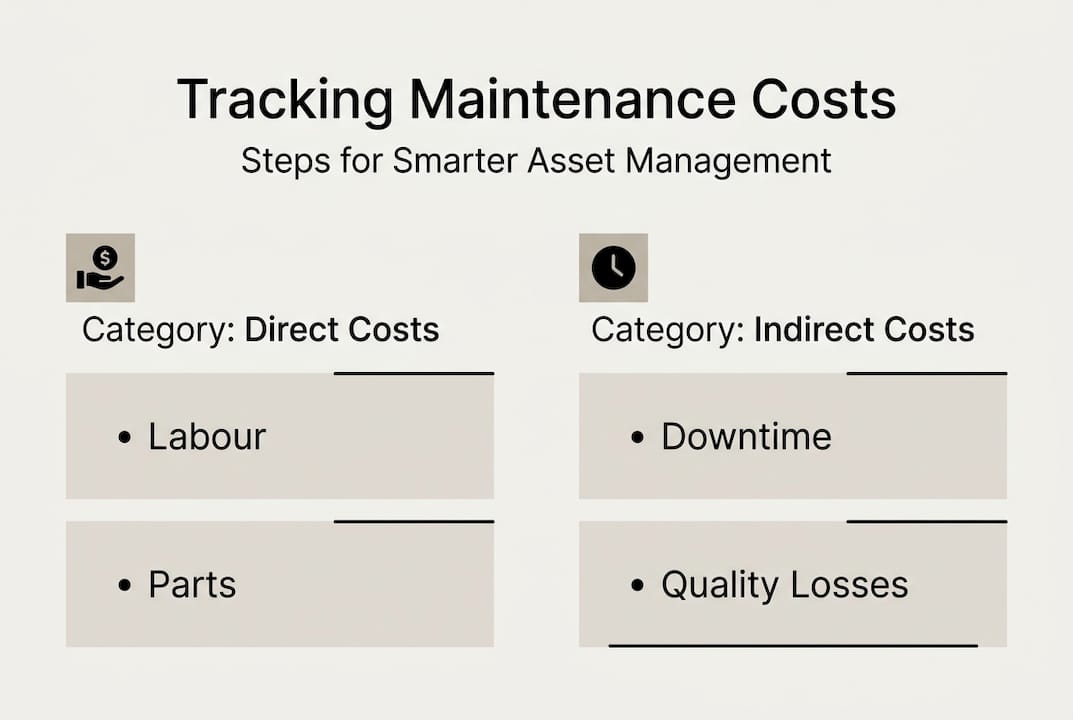
Most operations managers are comfortable tracking direct maintenance costs: labour wages, spare parts, contractor fees, and consumables. These are the figures that appear on purchase orders and invoices. However, the indirect costs are where budgets genuinely suffer, and they are far harder to see without a structured system.
Consider a realistic scenario. A facility with £450,000 in direct annual maintenance spend may be carrying an additional £915,000 in indirect losses, bringing the true cost to £1.365 million. Direct maintenance costs often hide far greater indirect losses, which can total over 60–75% more than the visible figures.
The most common indirect cost drivers include:
- Production downtime caused by unplanned equipment failures
- Energy wastage from degraded or poorly maintained machinery
- Quality control failures resulting in rework, scrap, or customer complaints
- Regulatory non-compliance penalties linked to missed maintenance schedules
- Overtime labour required to recover lost production time
“The true cost of maintenance is rarely what appears on the invoice. Organisations that only track direct spend are managing half the problem.”
Understanding both cost types is essential for accurate asset management. When you track maintenance hours alongside parts and downtime, you build a complete financial picture that supports better planning, budgeting, and asset lifecycle decisions.
| Cost type | Examples | Visibility |
|---|---|---|
| Direct | Labour, parts, contractors | Elevado |
| Indirect | Downtime, energy waste, quality losses | Baixa |
Without capturing both categories, any cost reduction effort is working from incomplete data.
Preparing your tracking system: what you need
With a clear idea of what to track, here is how to set up a system that really works. The right tools and frameworks determine whether your data is reliable or riddled with gaps.
The three main tracking approaches each carry distinct trade-offs:
| Approach | Exatidão | Setup effort | Escalabilidade |
|---|---|---|---|
| Manual (spreadsheets) | Low to medium | Baixa | Poor |
| Automated (CMMS) | Elevado | Medium | Good |
| Integrated (CMMS + ERP) | Very high | Elevado | Excellent |
For most industrial facilities, a Computerised Maintenance Management System (CMMS) is the practical starting point. Digital work order systems capture labour hours, parts usage, and failure causes in real time, removing the reliance on memory or paper records.
Inventory data is equally important. ABC analysis and min/max levels can reduce carrying costs by 30–40%, making inventory optimisation one of the highest-return actions available. ABC analysis classifies parts by value and usage frequency, so you focus tighter controls on high-value, high-impact items.
To get started, follow these steps:
- List all assets and assign unique identifiers
- Define cost categories: labour, parts, contractors, downtime, energy
- Choose your tracking platform, whether spreadsheet, CMMS, or cloud-based maintenance software
- Set minimum and maximum inventory levels for critical spare parts
- Establish a data entry protocol so all team members record costs consistently
Pro Tip: Start with your existing asset list and add cost detail gradually. Trying to capture everything at once leads to incomplete records and low team adoption. Build the habit first, then expand the scope.
Explorar maintenance optimisation strategies early in your setup process helps you align your tracking framework with your broader efficiency goals from the outset.
Executing effective cost tracking: essential steps
After your tools are in place, these are the exact actions that drive results. Knowing what to track is one thing; building a consistent execution process is what separates reliable data from noise.
Follow these steps to establish a robust tracking routine:
- Map every asset to a cost centre so expenditure is always attributed correctly
- Link each work order to labour hours, parts consumed, and the failure cause
- Record downtime events immediately, noting duration, affected output, and root cause
- Categorise maintenance type as reactive, preventive, or predictive for each job
- Review costs weekly at the asset level to catch anomalies before they accumulate
Reactive maintenance costs 3–5 times as much as preventive or predictive approaches. This is a critical figure for any operations manager building a cost reduction case internally.
Shifting your maintenance mix matters financially. Each 10% shift from reactive to preventive maintenance saves approximately 2–3% of your overall maintenance budget annually. Over a £1 million budget, that is £20,000 to £30,000 per year from a single strategic change.
Building a structured workflow for preventive maintenance ensures that scheduled tasks are completed on time and that costs are captured at every stage. Pairing this with reliable maintenance tracking tools gives your team the visibility to act before failures occur.
Pro Tip: Record downtime events and labour hours as they happen, not at the end of a shift. Delayed recording introduces errors and underestimates true costs by as much as 20%.
Common tracking mistakes and troubleshooting tips
To maintain high-quality tracking, watch for these errors and know how to address them quickly. Even well-intentioned systems fail when common pitfalls go unaddressed.
The most frequent mistakes operations managers encounter include:
- Missing indirect costs entirely: Teams record parts and labour but ignore downtime losses and energy waste, producing a misleadingly low cost figure
- Inconsistent data entry: Different technicians categorise the same job type differently, making trend analysis unreliable
- Skipping asset mapping: Costs recorded without asset attribution cannot be used for lifecycle analysis or replacement planning
- Ignoring inventory discrepancies: Unrecorded parts usage creates phantom stock levels and unexpected shortages
- Failing to track failure causes: Without root cause data, the same failures recur and costs repeat indefinitely
For each of these, the fix is straightforward. Standardise your cost categories, train your team on data entry protocols, and audit records monthly. A preventive maintenance workflow with built-in cost fields removes ambiguity at the point of recording.
Budget-cutting without ROI and cost avoidance measurement rarely succeeds, while correct tracking delivers 2–3x better outcomes.
This is a critical warning for any manager facing pressure to reduce spend quickly. Cutting budgets without data typically increases failure rates and long-term costs. Investing in maintenance tracking software that captures ROI and cost avoidance gives you the evidence to make smarter decisions rather than reactive ones.
Verifying and optimising your maintenance data
Once you are recording data confidently, here is how to turn insights into ongoing savings. Verification is not a one-time audit; it is a regular discipline that keeps your cost picture accurate and actionable.
Structure your data reviews as follows:
- Weekly: Check for missing work order costs, unrecorded downtime, and inventory discrepancies
- Monthly: Analyse cost per asset, identify outliers, and compare actual spend against budget
- Quarterly: Review KPI trends, assess the reactive-to-preventive maintenance ratio, and update asset replacement forecasts
The KPIs that matter most for maintenance cost optimisation are:
| KPI | What it measures | Review frequency |
|---|---|---|
| Cost per asset | Total spend attributed to each asset | Monthly |
| Downtime cost | Revenue or output lost per failure event | Weekly |
| Cost avoidance | Savings from prevented failures | Quarterly |
| Maintenance ROI | Return on maintenance investment | Quarterly |
| Spare inventory value | Capital tied up in stock | Monthly |
ROI-focused cost tracking and visibility delivers 2–3x the results of simple budget cuts. This reinforces why verification is not administrative overhead; it is where the financial value of your tracking system is realised.
Use your findings to take concrete action. Replace assets with consistently high repair costs. Adjust preventive maintenance frequencies based on actual failure data. Renegotiate contractor rates using documented performance records. Refer to a maintenance optimisation guide to align your verified data with a structured improvement plan.
Our perspective: tracking costs is about boosting value, not just cutting budgets
The instinct to cut maintenance budgets under financial pressure is understandable, but it is often counterproductive. In our experience working with industrial operations teams, the facilities that achieve the best long-term cost outcomes are those that treat tracking as a value-generation activity rather than a reporting obligation.
When you have accurate, complete cost data, you stop making decisions based on assumptions. You can see which assets are approaching end-of-life, which failure modes are consuming disproportionate resources, and where a modest increase in preventive activity would prevent a costly breakdown. That is a fundamentally different position from simply reducing headcount or deferring scheduled maintenance.
ROI and cost avoidance tracking repeatedly outperform simple cost-cutting, delivering up to three times the impact. The data supports a proactive approach to maintenance performance improvement that protects asset reliability while reducing waste.
Blind budget cuts increase failure rates, erode asset value, and create the very cost spikes they were meant to prevent. Tracking costs properly gives you the authority to push back on uninformed cuts and propose evidence-based alternatives instead.
How FullyOps can support your maintenance cost tracking
Ready to make cost tracking seamless? FullyOps gives operations managers a single platform to automate work order management, record labour hours, track parts usage, and generate real-time cost reports across all assets. The platform’s maintenance tracking tools eliminate manual data entry errors and surface the indirect costs that spreadsheets routinely miss. With built-in support for resource allocation and asset management, you can align maintenance spend with asset priorities from day one. Explore FullyOps’s gestão do ciclo de vida dos activos features to see how integrated tracking translates directly into smarter budgeting and measurable cost reduction.
Perguntas mais frequentes
What are the most overlooked indirect maintenance costs?
Downtime losses, energy waste, and product quality issues are frequently missed and can account for over 60% of true maintenance costs, far exceeding the visible direct spend on parts and labour.
How quickly can switching to preventive or predictive maintenance impact cost savings?
A 10% shift to preventive from reactive maintenance typically saves 2–3% of your overall maintenance budget within a single year, making it one of the fastest-return changes available.
Is automating maintenance cost tracking worth the investment?
Automated tracking systems reduce data entry errors and reveal hidden cost patterns, with ROI tracking delivering 2–3x the results compared to manual or ad hoc approaches.
What KPIs should operations managers track for maintenance cost optimisation?
The most important KPIs include cost per asset, cost avoidance, maintenance ROI, uptime percentage, and spare inventory value, reviewed on a weekly to quarterly basis depending on the metric.
Recomendado
- Why track maintenance hours: reduce costs and boost efficiency
- Guia de fluxo de trabalho de manutenção de activos para uma eficiência óptima
- Monitorização de activos passo a passo para uma gestão eficiente do AVAC
- 7 Essential Rental Property Maintenance Checklist Tips – Rental Income Insurance