

TL;DR:
- IoT-enabled asset management provides real-time visibility, shifting maintenance from reactive to predictive.
- Effective implementation relies on solid architecture, seamless integration, and strong security measures.
- Success depends on focusing on workflow integration and support, not just sensor and technology choices.
Most operations managers still treat asset management as a scheduling problem. You set a maintenance interval, dispatch a technician, and hope nothing fails in between. IoT-enabled asset management challenges that assumption entirely. Instead of working from calendars and guesswork, you gain continuous, real-time visibility into the actual condition of every asset on your floor. This article covers what IoT asset management really means in practice, how it shifts maintenance from reactive to predictive, what architecture you need to support it, and how to avoid the implementation pitfalls that derail most projects before they deliver value.
Table of Contents
- What is IoT-enabled asset management?
- Core benefits: From reactive to predictive maintenance
- Architecture: Building a robust IoT asset management system
- Implementation challenges and success factors
- Our perspective: What most IoT asset management strategies miss
- Take the next step with IoT-powered asset management
- Frequently asked questions
Key Takeaways
| Point | Details |
|---|---|
| IoT enables real-time insight | Connected sensors and smart analytics transform asset tracking and condition monitoring. |
| Predictive maintenance cuts downtime | Leveraging IoT and machine learning lets teams act before failures occur and save costs. |
| Architecture and integration matter | The right hardware, networks, and software integration are key to successfully scaling IoT-powered systems. |
| Vendor support outperforms features | Prioritise robust integration and responsive support instead of being swayed by feature lists. |
What is IoT-enabled asset management?
IoT stands for Internet of Things, a network of physical devices embedded with sensors, software, and connectivity that allows them to collect and exchange data automatically. When applied to asset management, this means your equipment, vehicles, pipelines, and infrastructure are no longer silent. They report their own condition, location, and performance in real time.
Traditional asset management relies on scheduled inspections, manual logs, and reactive repairs. IoT-enabled asset management replaces that cycle with continuous data streams. Real-time monitoring, predictive maintenance, and asset tracking become possible because sensors collect data on vibration, temperature, and usage, which is then processed via edge computing and cloud analytics for condition-based actions.
The types of assets commonly monitored include:
- Rotating machinery: motors, pumps, compressors, and conveyors monitored for vibration and thermal anomalies
- Fleet and mobile equipment: vehicles and forklifts tracked for location, fuel consumption, and usage patterns
- Fixed infrastructure: pipelines, electrical panels, and HVAC systems monitored for pressure, temperature, and flow
- Electronic and production equipment: CNC machines and assembly lines tracked for cycle times and error rates
Sensor types vary by application. Vibration sensors detect early-stage bearing wear. Temperature sensors flag overheating before it causes failure. Acoustic sensors pick up ultrasonic frequencies that indicate leaks or friction. Each sensor type contributes a different layer of intelligence.
Connectivity links these sensors to a central platform. Data travels via Wi-Fi, cellular, or low-power wide-area networks (LPWAN) to edge devices that pre-process it locally, then pass relevant signals to cloud analytics systems. This layered approach, explored in depth across IoT asset management technologies, enables organisations to act on insights within seconds rather than days.
For a practical walkthrough of how this applies in field operations, the asset tracking step by step guide covers the process from sensor installation through to actionable reporting.
“The shift from scheduled to condition-based maintenance is not a technology upgrade. It is a fundamental change in how organisations relate to their physical assets.”
The result is an asset management approach that is proactive rather than reactive, evidence-based rather than assumption-driven, and scalable across sites and asset classes.

Core benefits: From reactive to predictive maintenance
With a working definition in place, it is essential to see the practical benefits IoT brings to the maintenance landscape. The most significant shift is from reactive repairs, where you fix what breaks, to predictive maintenance, where you intervene before failure occurs.
Predictive maintenance using machine learning on IoT data allows systems to identify failure patterns before they manifest as downtime. Asset Health Index (AHI) models and sensor fusion techniques combine multiple data streams into a single health score for each asset, giving maintenance teams a clear, prioritised view of where to focus attention.
The practical steps to move from reactive to predictive maintenance are:
- Baseline your assets: install sensors and collect at least 30 to 90 days of operational data to establish normal behaviour patterns
- Define failure thresholds: work with engineers to set alert conditions based on historical failure data and manufacturer specifications
- Integrate with your CMMS: connect sensor alerts directly to your computerised maintenance management system so work orders are generated automatically
- Train your team: ensure technicians understand how to interpret health scores and act on alerts rather than waiting for scheduled inspections
- Review and refine: use failure event data to continuously improve your predictive models and reduce false positives
The ROI is measurable. IoT shifts asset management from reactive to predictive, optimising efficiency via real-time insights, though this requires robust architecture to overcome connectivity and security hurdles.
Statistic: Organisations that adopt predictive maintenance report up to 30% reduction in maintenance costs and a significant decrease in unplanned downtime compared to those using scheduled maintenance alone.
Pro Tip: Before investing in advanced ML models, focus first on getting clean, consistent sensor data. Poor data quality is the single most common reason predictive maintenance programmes underperform. You can learn how to track maintenance costs effectively to measure your baseline before and after IoT adoption.
For operations managers looking to build confidence before a full rollout, reviewing asset tracking tips for industrial environments provides a grounded starting point. The industrial asset IoT use case for conveyor systems illustrates how these benefits translate in a real production environment.
Architecture: Building a robust IoT asset management system
Understanding the benefits is crucial, but implementing successful IoT asset management starts with the right system architecture. The technology stack has several distinct layers, and weaknesses in any one of them will limit the performance of the entire system.
| Layer | Components | Key considerations |
|---|---|---|
| Perception | Sensors, actuators, RFID tags | Sensor type, accuracy, durability |
| Connectivity | Wi-Fi, LTE-M, LPWAN, Bluetooth | Range, power consumption, reliability |
| Edge processing | Edge devices, gateways | Latency, local storage, ruggedness |
| Cloud analytics | Data platforms, ML engines | Scalability, integration, security |
| Application | CMMS, dashboards, ERP | Usability, workflow alignment |
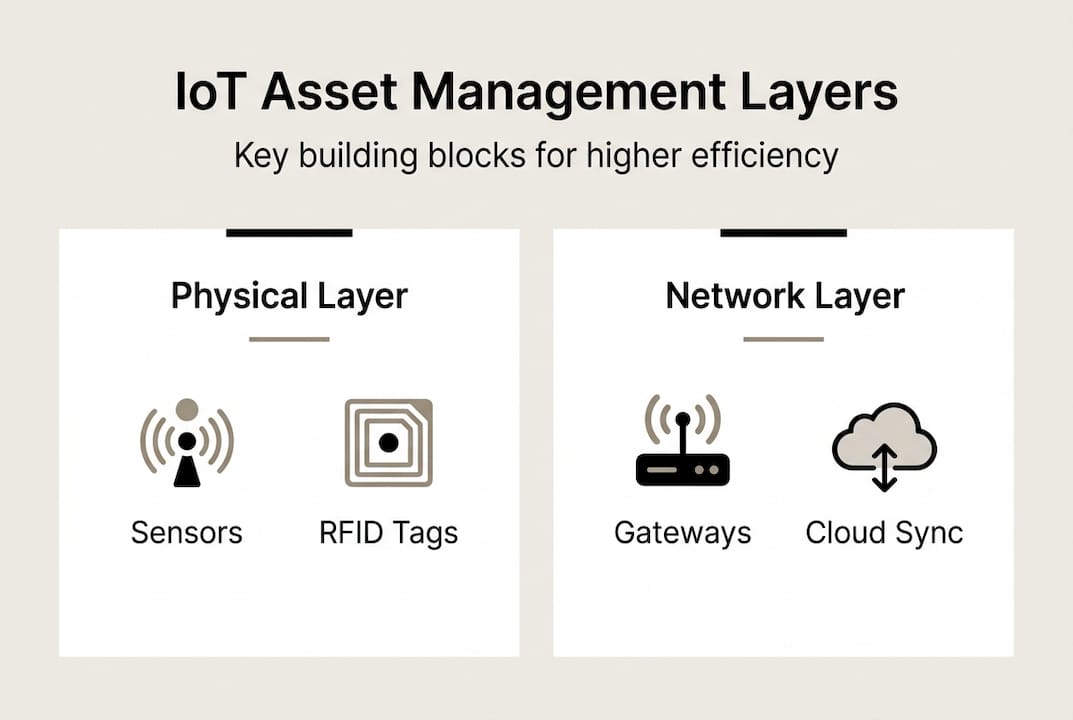
Hardware selection is particularly important in industrial environments. Harsh environments require rugged edge devices, and battery life or power availability for remote assets must be factored into the design. Indoor and remote areas with poor connectivity need LPWAN or hybrid network solutions to maintain reliable data transmission.
Key architecture decisions to get right from the start:
- Edge versus cloud processing: time-sensitive alerts, such as vibration spikes, should trigger locally at the edge to minimise latency; aggregated trend analysis can happen in the cloud
- Security by design: encrypt data in transit and at rest, use device authentication, and segment IoT networks from core IT infrastructure
- Scalability planning: choose platforms that support adding new asset types and sites without requiring a full rebuild
- CMMS integration: ensure your IoT platform has documented APIs that connect cleanly to your maintenance management system
Pro Tip: Do not underestimate the complexity of connectivity in large facilities. Conduct a site survey before specifying hardware. Dead zones and signal interference are far cheaper to address at the design stage than after installation.
For a broader view of how architecture decisions affect long-term outcomes, the asset tracking advantages guide covers the operational efficiency gains available when the technical foundation is solid. If you are considering automating your tracking processes, automate asset tracking explains the practical steps and expected outcomes.
Implementation challenges and success factors
Having understood the technical layers, it is vital to prepare for the practicalities and challenges unique to IoT rollouts. Most projects that fail do not fail because the technology does not work. They fail because of integration gaps, underestimated security requirements, and in-house systems that cannot support the new data flows.
| Factor | Vendor solution | In-house solution |
|---|---|---|
| Initial cost | Higher upfront licence | Lower initial spend |
| Integration support | Included, tested | Requires custom development |
| Security updates | Managed by vendor | Internal responsibility |
| Scalability | Built-in | Depends on internal capacity |
| Ongoing support | Dedicated team | Internal resource dependent |
While most adopters report high ROI, challenges like poor integration lead to underperformance. Vendor solutions consistently outperform in-house builds when support and security are prioritised over feature lists.
The steps most likely to ensure a successful implementation are:
- Define clear objectives: agree on specific KPIs before selecting technology, such as reducing unplanned downtime by 20% within 12 months
- Audit existing systems: understand what your current CMMS, ERP, and data infrastructure can support before adding IoT layers
- Start with a pilot: select a single asset class or production line to prove the concept and build internal confidence
- Prioritise integration from day one: treat connectivity between IoT platforms and existing systems as a primary requirement, not an afterthought
- Plan for security governance: assign clear ownership for IoT network security and include it in your broader cybersecurity policy
“The organisations that extract the most value from IoT are those that treat it as an operational transformation, not a technology installation.”
For a structured approach to selecting the right methods, top asset tracking methods for field operations provides a practical comparison. Before you begin, working through an asset tracking checklist helps ensure nothing critical is overlooked during planning.
Our perspective: What most IoT asset management strategies miss
Most IoT asset management conversations focus on sensor specifications, connectivity protocols, and machine learning models. These are important, but they are rarely where projects succeed or fail. In our experience working with industrial operations teams, the critical gap is almost always between data collection and actionable workflow integration.
Organisations invest heavily in sensor networks and dashboards, then discover that alerts are not connected to work orders, technicians are not trained to act on health scores, and the data sits unused in a platform nobody checks. The technology works. The process does not.
The uncomfortable truth is that seamless analytics, security, and vendor support consistently outperform in-house flexibility. Choosing a solution because it offers more configuration options is tempting, but configuration without support creates technical debt that compounds over time.
Focus on what keeps your team productive. That means prioritising tracking maintenance hours accurately, ensuring alerts trigger real actions, and selecting vendors who treat integration as a core deliverable rather than a paid add-on. The best IoT strategy is the one your team actually uses.
Take the next step with IoT-powered asset management
The insights in this article point toward a clear direction: IoT asset management delivers measurable value when it is built on solid architecture, integrated with existing workflows, and supported by the right platform. FullyOps is designed precisely for this. From asset lifecycle management to operational reporting and work order automation, the platform connects IoT data to the maintenance actions that matter. Explore the resource allocation tutorial to see how resource planning fits into a connected asset strategy, and review the asset management system types guide to identify the right approach for your industrial environment.
Frequently asked questions
How does IoT improve asset tracking accuracy?
IoT uses real-time sensors and automatic data collection to provide highly accurate, up-to-date asset locations and conditions, removing the delays and errors associated with manual logging.
What types of assets benefit the most from IoT monitoring?
High-value, mobile, and mission-critical assets such as machinery, fleets, and infrastructure gain the most, as IoT sensors collect real-time data on vibration, temperature, and usage across a wide range of industrial asset types.
What challenges should I plan for when rolling out IoT in asset management?
Expect integration hurdles, the need for strong security, and the challenge of operating in harsh or remote environments, where rugged devices and connectivity solutions are essential to maintain reliable data transmission.
Does IoT in asset management guarantee a return on investment?
Most adopters see strong ROI, but only when focus is placed on integration, security, and ongoing support. Poor integration leads to underperformance even when the underlying technology is sound.