

En resumen:
- Implementing a structured preventive maintenance program reduces unplanned downtime and operational costs.
- Building an asset register, standardizing checklists, and optimizing scheduling are key steps.
- Ongoing KPI tracking and leadership commitment ensure continuous program improvement and reliability.
Unplanned equipment failure costs industrial operations far more than the repair bill alone. Production halts, missed delivery windows, emergency labour costs, and the knock-on effect across your supply chain can erode margins within hours. Yet many facilities still treat maintenance reactively, addressing problems only after they surface. A structured preventive maintenance programme changes that dynamic entirely, shifting your team from firefighting to proactive control. This article walks through the core steps operations managers and maintenance coordinators need to implement, from building a solid asset register to tracking the KPIs that drive continuous improvement, all grounded in evidence-based practice.
Índice
- Build your asset register and prioritise
- Standardise task libraries and maintenance checklists
- Optimise scheduling: time, meter, and condition-based triggers
- Track execution, KPIs, and drive continuous improvement
- The reality behind effective preventive maintenance
- Take your preventive maintenance further with FullyOps
- Preguntas más frecuentes
Principales conclusiones
| Punto | Detalles |
|---|---|
| Prioritise critical assets | Rank assets by criticality so you focus resources on equipment that matters most to your operation. |
| Standardise maintenance tasks | Create consistent task libraries and checklists to ensure every asset gets the right service at the right time. |
| Optimise your schedules | Use a mix of time, usage, and condition-based triggers to match the right maintenance to each asset’s needs. |
| Measure what matters | Track execution and KPIs such as PM compliance and downtime to spot improvement areas and show value. |
| Never stop refining | Continuous feedback and data analysis keep your preventive maintenance programme effective and up to date. |
Build your asset register and prioritise
With the need for preventive maintenance established, the first task is creating clarity around your assets. You cannot maintain what you have not formally identified, and without a structured asset register, PM resources get spread too thinly across equipment of vastly different importance.
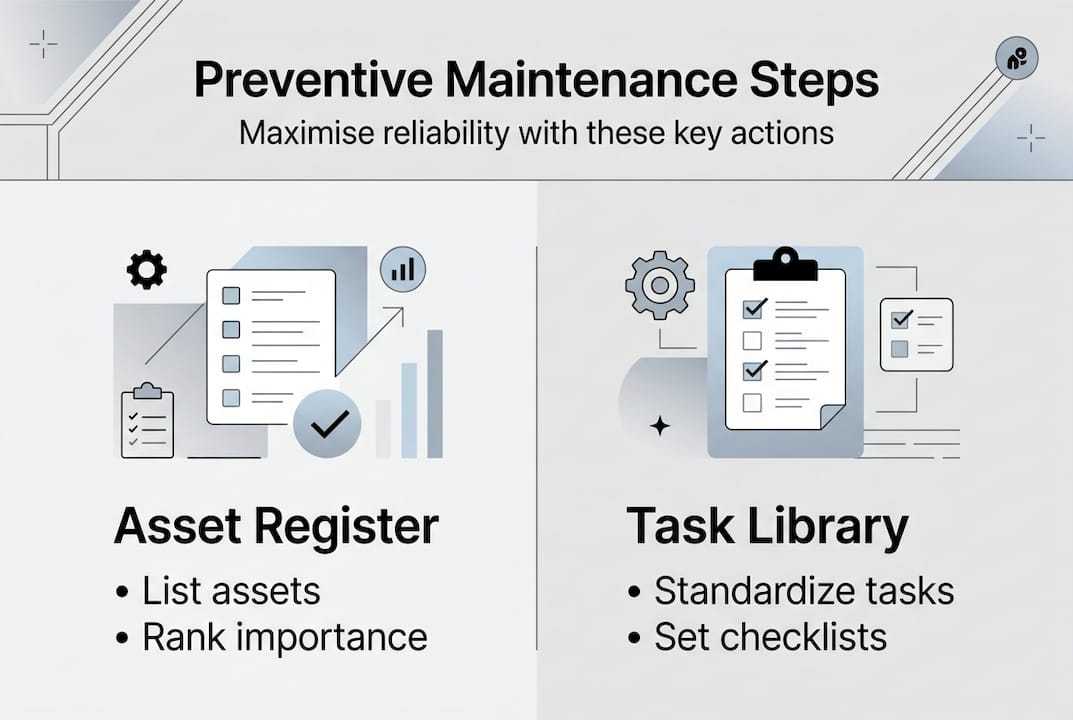
Core preventive maintenance steps start with building an asset register and ranking every item by criticality. This means documenting each asset, its location, condition, maintenance history, and its impact on production or safety. Once you have that foundation, criticality ranking tells you where to concentrate effort and budget.
A widely used approach is the A/B/C tiering model. Tier A assets, typically the top 10 to 15% of your inventory, account for around 50% of your PM spend because failure would halt production, create safety risks, or trigger regulatory consequences. Tier B assets are important but have redundancy or workarounds. Tier C assets are low-impact and can often be run to failure without significant consequence.
Here is a sample structure for your asset register:
| Asset name | Location | Criticality tier | Last maintenance date | Failure history | Responsible technician |
|---|---|---|---|---|---|
| Compressor Unit A | Plant Floor 1 | A | 12/03/2026 | 2 failures in 12 months | J. Davies |
| Conveyor Belt 3 | Warehouse B | B | 05/01/2026 | None recorded | T. Singh |
| Office HVAC Unit | Admin Block | C | 10/11/2025 | 1 minor fault | M. Costa |
When assigning criticality, consider these factors:
- Safety impact: Does failure create a risk to personnel or the public?
- Production impact: Would failure stop a key production line or process?
- Failure frequency: Does the asset have a history of recurring faults?
- Lead time for parts: Are spare parts readily available or subject to long delays?
- Regulatory exposure: Is the asset subject to compliance or inspection requirements?
Involving department heads and senior technicians in the validation stage ensures that priorities reflect operational reality, not just what looks important on paper. A well-structured asset tracking process also supports handover documentation and lifecycle planning.
Pro Tip: Review and update your asset register quarterly. Assets are decommissioned, upgraded, or repurposed regularly, and an outdated register quickly undermines your entire PM programme.
Standardise task libraries and maintenance checklists
Once assets are prioritised, the next step is ensuring maintenance teams know what, when, and how to inspect and service each item. Without standardised task libraries, even experienced technicians can miss steps, apply inconsistent procedures, or skip tasks under time pressure.
Standardised task libraries by equipment type, covering motors, electrical panels, and safety systems, are essential for consistent, auditable maintenance. A task library defines the specific actions required for each asset class, the tools and parts needed, the required competency level, and the expected duration.
For example, a motor task library might include vibration checks, lubrication intervals, bearing temperature readings, and belt tension assessments. An electrical panel library would cover breaker testing, thermal imaging, torque checks on connections, and insulation resistance testing.
Here is a simplified checklist structure by frequency:
| Frecuencia | Asset type | Task example |
|---|---|---|
| Daily | Conveyor systems | Visual inspection, lubrication check |
| Semanal | Motors | Vibration and temperature readings |
| Mensual | Electrical panels | Breaker test, thermal scan |
| Trimestralmente | HVAC units | Filter replacement, coil cleaning |
For broader guidance on HVAC preventive checklists y maintenance scheduling best practices, dedicated resources can help you build task libraries that are both practical and compliant. You can also reference basic checklist examples to understand how structured task lists translate into consistent field execution.
The benefits of standardised checklists are significant:
- Reduced human error: Step-by-step prompts prevent missed inspections, especially during shift changes.
- Improved compliance tracking: Digital checklists create an automatic audit trail for regulatory reviews.
- Faster onboarding: New technicians can follow established procedures from day one.
- Preparación para la auditoría: Documented task completion supports ISO and industry-specific certifications.
Pro Tip: Involve frontline technicians when building and refining task lists. They know which steps are genuinely necessary, which are redundant, and where safety risks are easy to overlook. Their input improves both accuracy and buy-in.
Optimise scheduling: time, meter, and condition-based triggers
Knowing what to maintain is only part of the answer. The next challenge is deciding when to act. Scheduling too frequently wastes resources; scheduling too infrequently allows failures to develop undetected.
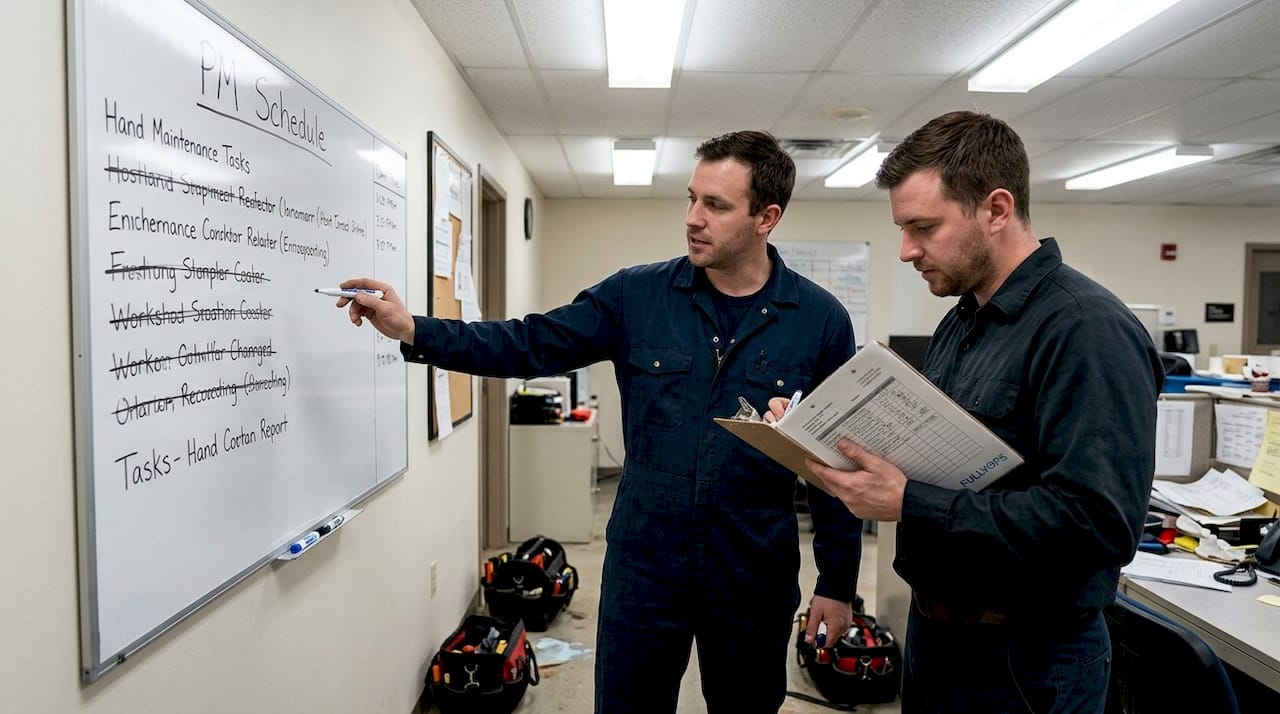
Effective preventive maintenance uses multi-trigger scheduling, combining time-based, meter-based, and condition-based approaches depending on asset type and operational context.
Time-based scheduling triggers maintenance at fixed calendar intervals, such as every 30 days or every quarter. It is straightforward to manage but can lead to unnecessary maintenance on underused assets or missed needs on heavily loaded ones.
Meter-based scheduling ties maintenance to usage counts, such as operating hours, production cycles, or kilometres travelled. This approach is more accurate for assets with variable utilisation.
Programación basada en condiciones uses sensor data, inspection findings, or vibration analysis to trigger maintenance only when specific thresholds are reached. It is the most efficient approach but requires investment in monitoring technology.
Here is a comparison of each trigger type:
| Trigger type | Más adecuado para | Ventaja | Limitation |
|---|---|---|---|
| Time-based | Low-cost, predictable assets | Simple to plan and communicate | Can over or under-maintain |
| Meter-based | Variable-use equipment | Aligned to actual wear | Requires reliable usage tracking |
| Condition-based | High-value, critical assets | Maximises asset life | Higher setup cost |
To implement each approach:
- Identify the asset class and its primary failure mode.
- Select the trigger type that best reflects how wear or degradation occurs.
- Set initial intervals based on manufacturer guidance or historical failure data.
- Review intervals after 6 to 12 months using actual failure and maintenance records.
- Apply hybrid triggers for Tier A assets, combining condition monitoring with a time-based backstop.
Generic scheduling wastes effort; data-driven triggers boost ROI by aligning maintenance activity to actual asset behaviour rather than arbitrary calendar dates.
Hybrid PM and predictive maintenance, supported by data-driven scheduling, is shown to improve ROI across industrial operations. Reviewing your maintenance scheduling frameworks regularly ensures that intervals remain accurate as operating conditions change.
Track execution, KPIs, and drive continuous improvement
With structured schedules in place, maintaining control over execution and results is essential for sustained reliability. A PM programme that is planned but not monitored quickly drifts into inconsistency.
Execution should be tracked with mobile checklists, with teams aiming for 90% or higher PM compliance and using KPIs such as OEE and MTBF to measure programme effectiveness. Digital work order systems allow you to open, assign, and close tasks with timestamps, technician signatures, and photographic evidence, creating a complete audit trail.
The most impactful KPIs to monitor include:
- PM compliance rate: The percentage of scheduled tasks completed on time. Target 90% or above.
- Tiempo medio entre fallos (MTBF): Measures how long assets run before an unplanned failure. Rising MTBF indicates a healthy programme.
- Overall equipment effectiveness (OEE): Combines availability, performance, and quality into a single measure of asset productivity.
- Unplanned downtime: Track hours lost to reactive repairs. Reducing this is the clearest sign that PM is working.
- Maintenance cost per asset: Monitors whether PM spend is delivering proportionate reliability gains.
Facilities achieving more than 90% PM compliance consistently report 20 to 30% lower unplanned downtime compared to industry averages. That is a measurable, bottom-line impact.
Continuous improvement comes from acting on what the data tells you. Use failure records to identify recurring fault patterns. Apply Weibull analysis to understand whether failures are infant mortality, random, or wear-related, then adjust your intervals accordingly. Review your KPI dashboard monthly, not annually.
Pro Tip: KPI dashboards do more than report performance. They reveal hidden bottlenecks, such as a technician consistently closing work orders late or a single asset generating disproportionate downtime, that would otherwise go unnoticed until they become serious problems.
For practical guidance on cost-saving workflow tips, tracking maintenance hours, and interpreting downtime reduction results, these resources support the analytical side of programme management.
The reality behind effective preventive maintenance
Having walked through the core steps, it is worth grounding these strategies in what actually happens in practice. Most PM programmes do not fail because of poor planning. They fail because of everyday gaps: asset registers that are built once and never updated, checklists that become checkbox exercises rather than genuine inspections, and KPI reviews that happen annually instead of monthly.
The uncomfortable truth is that simplicity outperforms sophistication in most industrial environments. A straightforward register that your team actually uses beats a complex system that nobody maintains. The same applies to checklists. Two pages of genuinely relevant tasks, reviewed with technicians, will deliver more compliance than a 20-page document assembled in isolation.
Leadership alignment is non-negotiable. When operations managers treat PM compliance as a genuine priority, technicians follow. When it is treated as an administrative burden, it becomes one. Embedding data review as a recurring operational habit, rather than a quarterly report nobody reads, is what separates high-performing maintenance teams from the rest. For teams working through overcoming PM challenges, the evidence consistently points to people and process discipline as the deciding factors, not the sophistication of the tools.
Take your preventive maintenance further with FullyOps
To put world-class preventive maintenance into action, dedicated digital solutions deliver greater consistency and insights. FullyOps supports operations managers and maintenance coordinators with tools designed to automate asset registers, streamline scheduling, and track compliance in real time. From resource allocation best practices to full asset lifecycle solutions, the platform brings every element of your PM programme into a single, connected view. Whether you are evaluating asset management system options or looking to improve your existing processes, FullyOps provides the analytical depth and operational clarity to move from reactive maintenance to sustained reliability.
Preguntas más frecuentes
What are the key steps in a preventive maintenance programme?
The core PM steps are creating an asset register, prioritising by criticality, building standardised task libraries, optimising scheduling triggers, and tracking KPIs for ongoing improvement. Each step builds on the previous one to create a structured, auditable programme.
How often should preventive maintenance be scheduled?
Frequency depends on asset type, usage intensity, and criticality tier. PM schedules should use a mix of time-based, meter-based, and condition-based triggers to align maintenance activity with actual wear patterns.
What metrics are most important for preventive maintenance?
The most important metrics include PM compliance, mean time between failures (MTBF), overall equipment effectiveness (OEE), and unplanned downtime hours. Together, these give a complete picture of programme health and asset reliability.
How does digital tracking improve preventive maintenance?
Mobile checklists and KPI dashboards ensure higher task compliance, create accurate audit trails, and allow faster identification of recurring failure patterns or underperforming assets. Digital tracking removes the ambiguity that paper-based systems leave behind.
Why do preventive maintenance programmes sometimes fail?
They most often fail due to neglected asset registers, generic scheduling that does not reflect actual asset behaviour, and the absence of regular data review and staff engagement. Consistent follow-through matters more than the quality of the initial plan.
Recomendado
- Cómo superar los retos de la adopción del mantenimiento preventivo: Un proceso en cinco pasos - FullyOps
- Dominar el proceso de mantenimiento preventivo de los activos de HVAC
- Qué es el mantenimiento preventivo: guía para gerentes de operaciones
- Planificación del mantenimiento paso a paso: Reduzca el tiempo de inactividad en 30%
- How to maintain your stairlift safely and affordably