

Poor inventory management costs industrial operations more than most managers realise. Unplanned downtime and excess stock drive up operational costs, tie up capital, and leave maintenance teams scrambling for parts at the worst possible moment. If you are an operations manager or maintenance administrator, you already know the pressure of keeping assets running while controlling spend. This article walks you through a practical, evidence-based inventory management process, from preparation and ordering through to auditing and continuous improvement, so you can reduce disruption, improve asset utilisation, and cut unnecessary costs.
Table des matières
- Understanding the inventory management process
- Preparation: Laying the groundwork for effective inventory control
- Execution: Step-by-step inventory management process for industry
- Verification and optimisation: Auditing, analytics, and continuous improvement
- Optimise your operations with the right tools
- Questions fréquemment posées
Principaux enseignements
| Point | Détails |
|---|---|
| Process clarity | Breaking inventory management into clear steps drives reliable results and minimises risk. |
| Hybrid strategies | Combining lean, risk-based, and ABC/XYZ methods tailors inventory control to your operational needs. |
| Intégration des systèmes | ERP or CMMS integration enables real-time tracking and ongoing optimisation. |
| Continuous auditing | Regular cycle counts and analytics improve accuracy and help prevent costly errors. |
Understanding the inventory management process
An inventory management process is the structured set of activities your organisation uses to plan, acquire, track, and replenish stock. In industrial settings, this is not just about counting parts on a shelf. It directly affects whether a critical machine stays running or sits idle waiting for a spare.
The core objectives are straightforward: maximise asset utilisation, prevent stock-outs on critical items, and keep holding costs under control. Getting all three right simultaneously is where most operations struggle. The good news is that a clear framework makes it achievable.
The inventory management steps typically follow a five-stage cycle. Here is a high-level overview:
- Planning and forecasting — Anticipate demand based on maintenance schedules, asset history, and seasonal patterns.
- Ordering and stocking — Source parts from reliable suppliers, set reorder points, and maintain accurate records.
- Tracking and monitoring — Keep real-time or periodic visibility of stock levels, locations, and movements.
- Replenishment and fulfilment — Trigger restocking automatically or manually when stock hits minimum thresholds.
- Auditing and reporting — Verify accuracy, identify discrepancies, and generate actionable reports.
| Étape | Key goal | Primary benefit |
|---|---|---|
| Planning and forecasting | Predict demand accurately | Fewer stock-outs and overstock situations |
| Ordering and stocking | Reliable supply at right cost | Reduced lead times and procurement spend |
| Tracking and monitoring | Real-time stock visibility | Faster response to shortages |
| Replenishment and fulfilment | Maintain optimal stock levels | Continuous operations with minimal disruption |
| Auditing and reporting | Ensure data accuracy | Informed decisions and compliance |
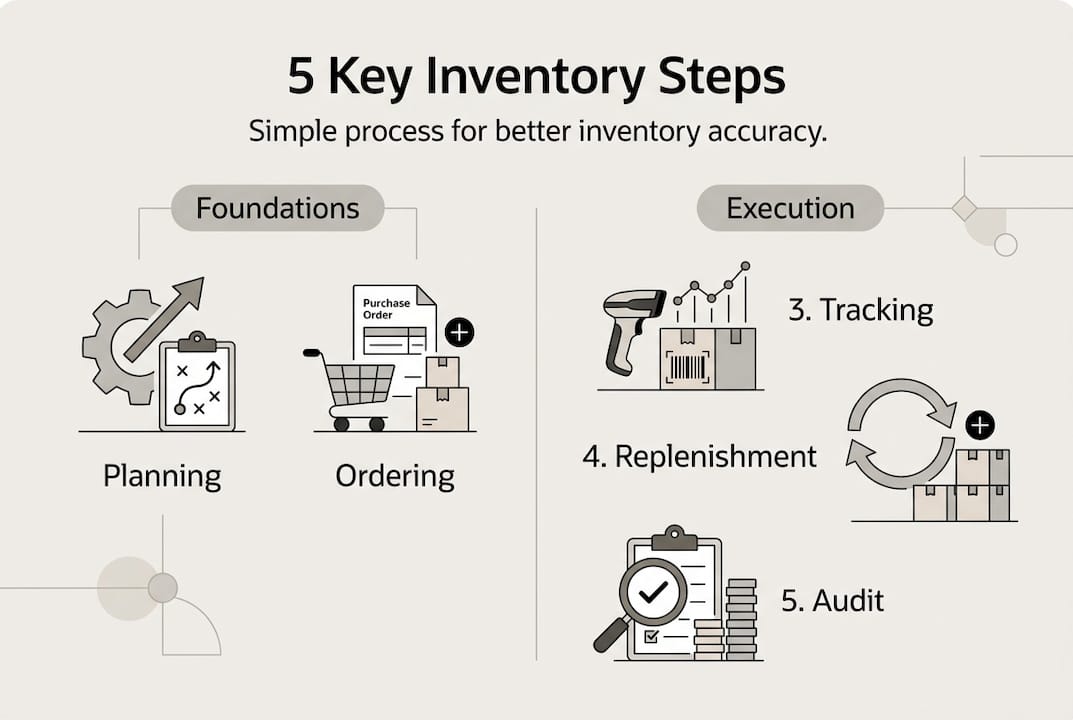
Think of this cycle as a field service management checklist for your storeroom. Each step feeds the next, and skipping one creates compounding problems downstream.
Preparation: Laying the groundwork for effective inventory control
Most inventory failures are not execution problems. They are preparation problems. Teams order the wrong quantities, stock the wrong items, or have no idea which parts are truly critical until a machine breaks down at 2am.
Start with demand forecasting. For MRO (maintenance, repair, and operations) spares, look at your asset maintenance history. A compressor that requires a specific seal every six months is predictable. Fast-moving consumables like filters or lubricants follow usage patterns tied to production volume. Treat these two categories differently from the outset.
Next, classify your inventory. The ABC/XYZ hybrid method combined with asset criticality scoring is the recommended approach for balancing availability against risk. Here is how it works in practice:
- ABC classification ranks items by value: A items are high-value and low-volume, C items are low-value and high-volume.
- XYZ classification ranks items by demand variability: X items have stable demand, Z items are highly unpredictable.
- Asset criticality scoring overlays the question: what happens if this part is unavailable? A critical spare for a single-point-of-failure asset scores high regardless of its ABC/XYZ rating.
Combining these three lenses gives you a prioritised list. Your A/X/critical items need tight stock control and safety stock buffers. Your C/Z/non-critical items can tolerate longer lead times and leaner holdings.
Before placing a single order, also review your liste de contrôle de suivi des actifs to confirm that every asset is correctly catalogued and linked to its associated parts. Gaps here cause mismatches between what the system says you need and what you actually need.
Pro Tip: Document your critical items list and schedule a quarterly review. Asset criticality changes as your plant evolves, and a part that was non-critical last year may now be essential.
Execution: Step-by-step inventory management process for industry
With preparation done, active management begins. This is where precision matters most, because errors here translate directly into downtime or wasted spend.

Step 1: Ordering and stocking
Set reorder points based on lead times and average consumption. If a supplier takes ten days to deliver and you use three units per week, your reorder point is at least four to five units. Build in a safety stock buffer for critical items. Maintain digital records for every transaction, including supplier performance data, so you can identify reliability issues before they become crises.
Step 2: Tracking and monitoring
Real-time tracking is the gold standard. Barcode scanning, RFID, or QR-code systems linked to your CMMS (computerised maintenance management system) give you instant visibility. Periodic manual checks work for low-criticality items, but for anything on your critical spares list, real-time asset tracking methods are worth the investment. Consider reviewing an asset tracking step-by-step guide to implement the right approach for your facility.
Step 3: Replenishment and fulfilment
Automate replenishment triggers wherever possible. Min-max levels set in your system remove the human error of forgetting to reorder. For high-value A items, manual approval before ordering adds a useful cost-control layer without slowing things down significantly.
Choosing the right replenishment strategy matters. Here is a comparison of the three main approaches:
| Approche | Comment cela fonctionne-t-il ? | Convient le mieux à | Key risk |
|---|---|---|---|
| Lean/JIT (Just-in-Time) | Order only when needed, minimal stock held | High-volume, predictable demand | Stock-outs if supply chain disrupted |
| Risk-based | Stock levels set by asset criticality and failure probability | Critical spares, long lead-time items | Higher holding costs |
| Hybrid | Combines JIT for fast-movers with risk-based for critical items | Most industrial operations | Requires robust data and system support |
For most industrial operations, a hybrid approach delivers the best balance. Warehouse benchmarks set the bar high: on-time shipments at or above 99.5%, inventory accuracy above 99.68%, and dock-to-stock times under 3.5 hours. These are achievable targets when your process is well-structured.
Pro Tip: Use digital tools to maintain instant visibility across all stock locations. A single misplaced part that delays a repair by four hours costs far more than any software subscription.
Verification and optimisation: Auditing, analytics, and continuous improvement
Running the process is not enough. You need to verify it is working and continuously improve it. This is where many operations teams fall short, relying on annual stock counts that are too infrequent to catch problems early.
Cycle counts are preferable to annual audits for maintaining ongoing accuracy. Rather than counting everything once a year, cycle counting divides your inventory into segments and counts a portion each week or month. A items might be counted monthly, C items quarterly. This keeps your records accurate without the disruption of a full shutdown count.
Key auditing and analytics practices to embed in your process:
- Scheduled cycle counts tied to item criticality and ABC classification.
- Inventory spot checks triggered by discrepancies in work order records or supplier deliveries.
- Slow-mover reports to identify stock that has not moved in 90 or 180 days, freeing up capital.
- Demand change alerts that flag when consumption patterns shift significantly from forecast.
- Maintenance reporting integrated with inventory data to connect part usage directly to asset performance.
System integration is not optional at this stage. ERP/CMMS integration is essential for real-time tracking and meaningful analytics. Without it, your inventory data and your maintenance data live in separate silos, and you lose the ability to make informed decisions quickly. Explore how integrations drive efficiency across asset management to understand the full value of a connected system.
In 2026, AI-powered predictive analytics tools are increasingly accessible for mid-sized industrial operations. These tools analyse historical consumption, supplier lead times, and asset failure patterns to generate demand forecasts that are significantly more accurate than manual methods. Early adopters are reporting reductions in both stock-outs and excess inventory simultaneously, which was previously considered a difficult trade-off to resolve.
For ongoing optimisation, review your process quarterly. Ask three questions: Where did we run out of stock unexpectedly? Where are we holding too much? Where did our data let us down? The answers drive targeted improvements rather than broad, unfocused changes.
Optimise your operations with the right tools
A well-defined inventory management process gives you the framework. The right software gives you the speed, accuracy, and visibility to execute it consistently. Maintenance software for field teams connects work orders directly to stock levels, so technicians always know what is available before they start a job. Pair that with a structured tutoriel sur l'allocation des ressources to ensure your team and your parts are always in the right place at the right time. FullyOps brings together inventory management, asset tracking, and maintenance reporting in one integrated platform, giving operations managers and maintenance administrators the real-time control they need. Explore the range of systèmes de gestion d'actifs available to find the right fit for your operation and start reducing downtime today.
Questions fréquemment posées
What are the five key steps in the inventory management process?
The five primary steps are planning and forecasting, ordering and stocking, tracking and monitoring, replenishment and fulfilment, and auditing and reporting. The five-step cycle ensures continuous control over stock levels and operational costs.
How often should cycle counts be carried out in industrial settings?
Cycle counts should be scheduled regularly, preferably weekly or monthly depending on item criticality, to maintain high inventory accuracy. Cycle counts outperform annual audits by catching discrepancies early and keeping records consistently reliable.
What is the advantage of integrating ERP or CMMS for inventory management?
Integration enables real-time data tracking, automated stock alerts, and improved analytics for better asset utilisation. ERP/CMMS integration eliminates data silos and supports faster, more accurate decision-making across maintenance and procurement teams.
Which benchmarks should operations managers aim for in inventory accuracy?
Aim for inventory accuracy above 99.68% and dock-to-stock times under 3.5 hours according to WERC benchmarks. These targets are achievable with a structured process and the right digital tools in place.
Recommandé
- Workflow pour la maintenance préventive : Réduire les coûts de 30% en 2026
- Suivi des actifs, étape par étape, pour une gestion efficace du chauffage, de la ventilation et de la climatisation (CVC)
- 7 étapes pour une liste de contrôle efficace de la gestion des ordres de travail