

Many operations managers believe that throwing more technicians at a maintenance backlog will solve delays. Yet facilities with double the workforce often still miss deadlines and face unplanned downtime. The real issue isn’t headcount but how you allocate resources across competing tasks. Resource scheduling is the process of planning and assigning personnel, equipment, and materials to maintenance activities over time to optimise usage, minimise conflicts, and meet operational targets. For industrial operations managers, mastering this discipline directly impacts asset uptime, cost control, and service delivery reliability.
Índice
- Why resource scheduling matters for industrial maintenance
- Core principles and components of resource scheduling
- Common methodologies and tools for resource scheduling
- Handling complexity: Real-world scheduling challenges and solutions
- Best practices for operations managers: Getting started and scaling success
- Enhance your maintenance workflows with the right scheduling tools
- Perguntas mais frequentes
Principais conclusões
| Ponto | Detalhes |
|---|---|
| Reduce downtime | Effective resource scheduling cuts machine and labour downtime, boosting productivity on the plant floor. |
| Optimise resource usage | Balancing people, equipment, and priority ensures high-value maintenance without resource overloads. |
| Adapt to real-world changes | Robust scheduling enables rapid adjustment when breakdowns or rush jobs hit, protecting your KPIs. |
| Use the right methods | Combining digital tools like CMMS with practical heuristics delivers quick wins and scales with your operation. |
Why resource scheduling matters for industrial maintenance
Poor resource scheduling creates a cascade of operational failures. Technicians arrive at sites without the right spares, critical equipment sits idle waiting for personnel, and overtime costs spiral as managers scramble to cover gaps. These aren’t isolated incidents but symptoms of systemic planning weaknesses that erode profitability and compliance.
The financial impact is substantial. Facilities implementing structured preventive maintenance scheduling see reactive maintenance drop by 30%, whilst criticality-based allocation cuts downtime by 47% and lifts Overall Equipment Effectiveness (OEE) by 6%. Finite capacity scheduling alone boosts on-time delivery rates by 15 to 25%. These aren’t marginal gains but transformational improvements that separate high-performing operations from struggling ones.
Operations managers face relentless pressure on three fronts: meeting maintenance deadlines, controlling labour and material costs, and ensuring regulatory compliance. Resource scheduling sits at the intersection of all three. When you schedule preventive maintenance during planned production pauses, you avoid emergency shutdowns. When you assign the right technician with the right skills to the right asset, you complete jobs faster and reduce rework. When you track compliance rates and backlog duration, you spot bottlenecks before they become crises.
Two metrics matter most: OEE and unplanned downtime. OEE measures how effectively your assets produce value, combining availability, performance, and quality. Unplanned downtime directly erodes availability and signals scheduling failures. Effective resource scheduling improves both by ensuring technician deployment efficiency e optimising maintenance schedules around asset criticality and production demands.
Dica profissional: Track the ratio of planned to reactive maintenance monthly. If reactive work exceeds 30%, your scheduling process needs immediate attention. This single metric reveals whether you’re controlling your maintenance workload or merely reacting to failures.
The distinction between planned and reactive maintenance is crucial. Planned maintenance follows a schedule based on asset condition, manufacturer recommendations, or predictive data. Reactive maintenance responds to breakdowns. Poor resource scheduling forces even well-intentioned preventive programmes into reactive mode because technicians lack time, tools, or access to complete planned tasks. The result is a vicious cycle where deferred maintenance creates more emergencies, consuming resources that should address root causes. Breaking this cycle requires disciplined scheduling that protects planned maintenance time whilst building flexibility for genuine emergencies.
Core principles and components of resource scheduling
In industrial maintenance, a resource is anything required to complete a work order: technicians with specific skills, diagnostic equipment, replacement parts, or even access windows when production lines must stop. Each resource type has constraints. Technicians work fixed hours and possess varying expertise. Equipment may serve multiple sites. Spares have lead times and storage costs. Effective scheduling balances these constraints against maintenance priorities.
Two fundamental approaches shape how you schedule:
Time-constrained scheduling fixes deadlines and adjusts resources to meet them. If a regulatory inspection must occur by month-end, you assign enough qualified technicians to complete preparatory maintenance on time, even if that means overtime or contractors.
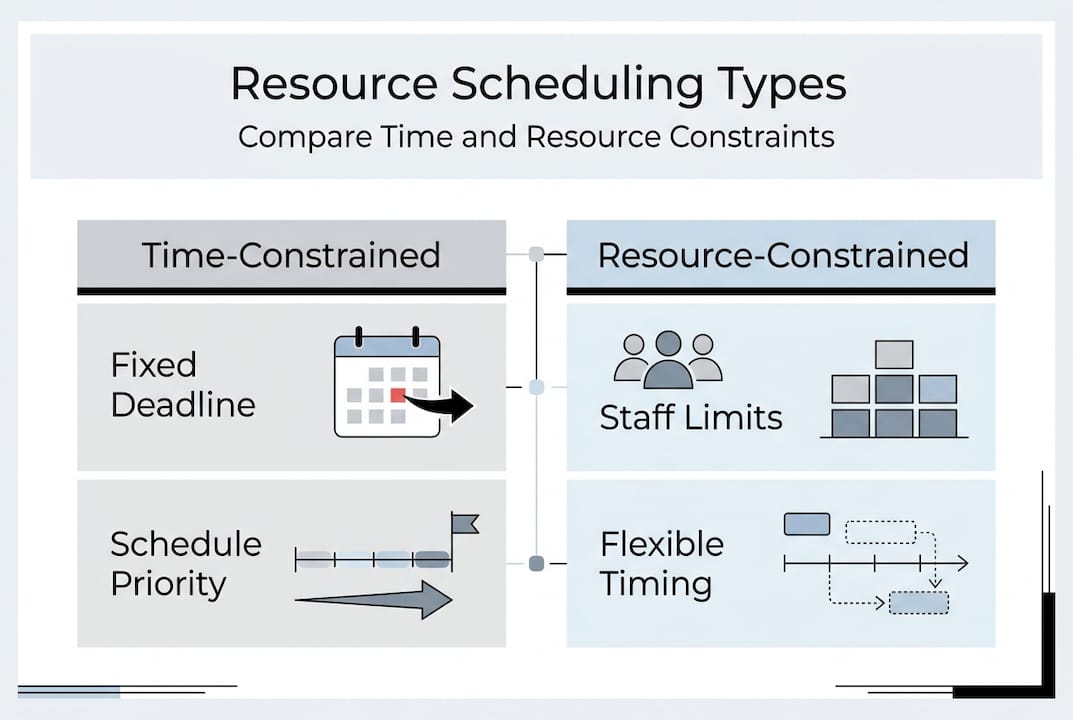
Resource-constrained scheduling fixes available resources and adjusts timelines accordingly. With three technicians and fifty assets, you sequence maintenance tasks to maximise their productivity, accepting that lower-priority work may slip.
Most industrial operations blend both approaches, applying time constraints to critical assets and compliance work whilst managing routine maintenance within resource limits.
| Approach | When to use | Key advantage | Main risk |
|---|---|---|---|
| Time-constrained | Regulatory deadlines, critical asset maintenance, customer commitments | Ensures compliance and uptime targets | Higher costs from overtime or contractors |
| Resource-constrained | Routine maintenance, non-critical assets, stable operations | Controls labour costs, maximises existing capacity | Potential backlog growth if demand spikes |
| Hybrid | Most industrial settings | Balances cost control with operational priorities | Requires sophisticated planning to avoid conflicts |
Finite capacity scheduling acknowledges real-world limits. Your CMMS shows three technicians available Tuesday, but one is on training and another finishes a job at a distant site at 14:00. Finite scheduling accounts for travel time, skill requirements, and actual availability. Infinite capacity scheduling ignores these constraints, generating plans that look perfect on paper but collapse in practice when technicians can’t be in two places simultaneously.
O resource allocation explained guide details how to map skills, certifications, and equipment access rights to maintenance requirements, ensuring your scheduling decisions reflect operational reality rather than wishful thinking.
Standard KPIs for resource scheduling include:
- Schedule compliance rate: Percentage of planned maintenance completed on time (target: above 90%)
- Backlog duration: Weeks of pending maintenance work (healthy range: 2 to 4 weeks)
- Wrench time: Percentage of technician hours spent on actual maintenance vs travel, waiting, or administrative tasks (target: above 55%)
- Emergency work ratio: Percentage of total maintenance hours spent on unplanned breakdowns (target: below 20%)
These metrics reveal whether your scheduling process creates productive, predictable workflows or chaotic firefighting. Creating reliable maintenance schedules requires tracking these indicators weekly and adjusting resource allocation when trends deteriorate.
Dica profissional: Always start with real constraints when building schedules. Overly optimistic plans that ignore travel time, part availability, or skill gaps create false confidence and erode trust when reality intervenes. Build buffers for critical paths and accept that perfect utilisation is impossible in dynamic environments.
Common methodologies and tools for resource scheduling
Manual scheduling using whiteboards or spreadsheets works for small teams managing fewer than twenty assets. You see the whole picture, adjust quickly, and communicate changes face-to-face. But manual methods break down as complexity grows. Tracking hundreds of assets, dozens of technicians, and thousands of parts across multiple sites demands digital tools.
Rule-based heuristics offer a middle ground. First-Come-First-Served (FCFS) sequences work orders by arrival time, ensuring fairness but ignoring urgency. Shortest Processing Time (SPT) prioritises quick jobs to maximise throughput. Earliest Due Date (EDD) focuses on deadlines. These rules are simple to implement and explain, making them popular for routine scheduling decisions. However, they lack sophistication for complex scenarios involving multiple constraints and competing priorities.
Algorithmic and AI-driven methods represent the current frontier. Advanced Planning and Scheduling (APS) systems use mathematical optimisation to evaluate thousands of scheduling permutations, identifying solutions that minimise costs, maximise asset availability, or balance workload across teams. These systems integrate maintenance scheduling with production planning, ensuring maintenance windows align with production pauses and material availability.
Computerised Maintenance Management Systems (CMMS) automate much of the scheduling burden. A CMMS stores asset histories, tracks work orders, manages spare parts inventory, and generates preventive maintenance schedules based on time, usage, or condition triggers. For industrial maintenance, work order planning through CMMS enables criticality-based ranking, multi-model preventive maintenance strategies, and production-maintenance integration that manual methods cannot match.

| Method | Best for | Pontos fortes | Limitações |
|---|---|---|---|
| Manual (boards, spreadsheets) | Small teams, under 20 assets | Flexible, intuitive, low cost | Doesn’t scale, prone to errors, limited visibility |
| Rule-based heuristics | Medium complexity, stable workflows | Simple, transparent, fast decisions | Ignores multiple constraints, suboptimal for complex scenarios |
| CMMS | Most industrial operations | Automates routine scheduling, tracks compliance, improves data quality | Requires clean data input, change management, ongoing maintenance |
| APS/AI systems | High complexity, integrated operations | Optimises across multiple constraints, adapts to changes, integrates with production | High implementation cost, requires data maturity, complex to configure |
O benefits of digital scheduling extend beyond automation. Digital systems create audit trails for compliance, enable mobile access for field technicians, and generate analytics that reveal scheduling patterns and improvement opportunities. However, digital adoption succeeds only when data inputs are accurate and complete. Garbage in, garbage out applies ruthlessly to scheduling systems.
Dica profissional: Phase your CMMS rollout by starting with a single asset class or site. Fix data quality issues, train users, and prove value before expanding. This approach builds confidence, identifies problems early, and creates internal champions who drive broader adoption.
Handling complexity: Real-world scheduling challenges and solutions
Even the best scheduling plans face disruption. Equipment fails unexpectedly. Rush orders arrive. Key technicians call in sick. The question isn’t whether disruptions will occur but how quickly and effectively you respond.
Unplanned downtime remains the nemesis of industrial operations. A critical pump fails at 03:00, halting production. Your schedule shows no available technicians until 08:00, and the required spare part sits at a supplier 200 kilometres away. Industry 4.0 technologies and predictive maintenance aim to prevent such scenarios by detecting failures before they occur, but prediction isn’t perfect. When breakdowns happen, event-driven rescheduling becomes essential.
Event-driven rescheduling means your system automatically adjusts remaining tasks when disruptions occur. If a breakdown consumes four hours of a technician’s day, the system reassigns or delays lower-priority work, notifies affected stakeholders, and updates resource availability. This dynamic response prevents cascading delays and ensures critical work still gets done.
Resource conflicts arise when multiple high-priority tasks compete for the same limited resources. Two critical assets need the same specialist technician simultaneously. A rush order requires equipment already allocated to planned maintenance. Resolving these conflicts requires clear prioritisation criteria:
- Safety-critical work always takes precedence
- Regulatory compliance deadlines cannot slip without legal consequences
- Production-critical assets that directly impact revenue generation rank above support equipment
- Manutenção preventiva on high-criticality assets outweighs routine work on low-criticality equipment
Sequence-dependent setups add another layer of complexity. In job shops and multi-product facilities, the order in which you perform maintenance tasks affects total time and cost. Cleaning and reconfiguring equipment between different maintenance procedures consumes time. Grouping similar tasks or scheduling maintenance in logical sequences reduces these changeover penalties.
Flexibility and re-optimisation separate resilient operations from brittle ones. Static schedules that cannot adapt to reality create frustration and workarounds. Build flexibility through:
- Buffer time at bottleneck resources (typically 10 to 15% of capacity)
- Cross-trained technicians who can cover multiple asset types
- Emergency response protocols that define who makes rescheduling decisions and how quickly
- Regular re-optimisation cycles (daily or weekly) that adjust schedules based on actual progress and new information
Research on multi-resource scheduling demonstrates that facilities using event-driven rescheduling with heuristic rules achieve 20 to 35% better resource utilisation than those relying on static weekly schedules. The key is balancing stability (so teams can plan their work) with adaptability (so disruptions don’t derail everything).
Best practices for operations managers: Getting started and scaling success
Implementing effective resource scheduling doesn’t require a complete operational overhaul. Start with these practical steps:
-
Audit your current state. Document how scheduling decisions are made today, who makes them, and what information they use. Identify the biggest pain points and bottlenecks.
-
Prioritise critical assets. Apply the 80/20 rule. Focus scheduling rigour on the 20% of assets that drive 80% of production value or risk. These assets justify sophisticated scheduling methods and tighter controls.
-
Clean your data. Accurate asset registers, up-to-date skill matrices, and reliable parts inventory are prerequisites for effective scheduling. Dedicate time to data quality before implementing new tools.
-
Define clear prioritisation rules. Document how you’ll resolve resource conflicts. Make these rules transparent so technicians and supervisors understand why certain work takes precedence.
-
Implementar um preventive maintenance workflow for your highest-criticality assets first. Prove the value of structured scheduling on a manageable scope before expanding.
Track these KPIs weekly to measure progress:
- Schedule compliance rate: Are you completing planned work on time?
- Backlog trend: Is pending work growing or shrinking?
- Emergency work ratio: Are you reducing reactive maintenance?
- Technician utilisation: Are you maximising productive wrench time?
Phased CMMS implementation reduces risk and accelerates value realisation. Month one: Configure the system and migrate data for one asset class. Month two: Train users and run parallel with existing processes. Month three: Go live and monitor closely. Month four: Expand to the next asset class. This incremental approach builds competence and confidence whilst limiting disruption.
Dica profissional: Build buffers at bottleneck resources. If a specialist technician is your constraint, schedule them at 85% capacity, not 100%. This buffer absorbs variability and prevents one delay from cascading through your entire schedule. Overloading bottlenecks creates the illusion of efficiency whilst guaranteeing missed deadlines.
Continuous improvement matters. Review scheduling performance monthly with your team. What worked? What didn’t? Which assumptions proved wrong? Use these insights to refine prioritisation rules, adjust buffer sizes, and improve data quality. Scheduling excellence is a journey, not a destination.
Enhance your maintenance workflows with the right scheduling tools
Effective resource scheduling transforms maintenance from a cost centre into a strategic capability that protects asset value and enables reliable operations. The difference between reactive firefighting and proactive asset management often comes down to how well you plan and allocate resources across competing demands.
For operations managers ready to elevate their scheduling practices, exploring proven frameworks and purpose-built digital tools offers a clear path forward. The tutorial de atribuição de recursos provides step-by-step guidance on mapping skills, equipment, and materials to maintenance requirements. The scheduling maintenance for uptime guide details how to balance preventive and corrective work whilst minimising production disruption.
Understanding the broader context of gestão de activos helps you see resource scheduling not as an isolated task but as part of an integrated approach to maximising asset lifecycle value. Modern CMMS platforms connect scheduling with work order management, inventory control, and performance analytics, creating a unified view of maintenance operations that supports better decisions at every level.
Perguntas mais frequentes
What is the main goal of resource scheduling in maintenance?
The main goal is to allocate the right resources (people, equipment, materials) to the right tasks at the right time to reduce downtime, avoid conflicts, and meet maintenance targets.
How does digital scheduling software like CMMS help industrial companies?
CMMS automates task planning, improves data accuracy, and enables fast adjustment to breakdowns, cutting reactive work by up to 30%.
What’s the difference between finite and infinite capacity scheduling?
Finite capacity accounts for real equipment and staff limits, whilst infinite assumes unlimited resources and can result in overload or missed deadlines.
Which KPIs should I track to measure effective scheduling?
Track on-time completion, compliance rates above 90%, backlog duration, and OEE improvement to measure resource scheduling success.
How do I handle resource conflicts when multiple urgent tasks compete?
Apply clear prioritisation criteria: safety-critical work first, then regulatory compliance, then production-critical assets, then preventive maintenance on high-criticality equipment.
Recomendado
- Maintenance scheduling guide to optimise asset uptime
- Guia de afetação de recursos para a manutenção industrial
- Guia de Agendamento de Serviço de Campo para Implantação Eficiente de Técnicos
- Dominar a criação de calendários de manutenção para activos fiáveis