

TL;DR:
- Preventive maintenance significantly reduces costs and boosts equipment reliability.
- Building a structured, data-driven PM programme requires asset assessment, proper tools, and continuous review.
- Focus on critical assets, prioritize quality over quantity, and use digital platforms for optimal results.
Equipment failures do not just disrupt production schedules — they erode margins, strain teams, and accelerate asset deterioration. For operations managers in industrial settings, the difference between a reactive and a proactive maintenance culture is measurable in both cost and reliability. Research confirms that structured preventive maintenance programmes can deliver a 20–35% reduction in maintenance costs and a 25–40% improvement in equipment reliability. This guide walks you through the practical steps, tools, and verification routines needed to build a preventive maintenance programme that produces consistent, measurable results across your facility.
Índice
- Understanding preventive maintenance: Why it matters
- Preparing for success: Tools, resources, and planning essentials
- Implementing robust preventive maintenance: Step-by-step process
- Common mistakes and verification: Ensuring sustainable results
- Why most preventive maintenance fails — and how to get it right
- Transform your preventive maintenance with advanced asset management
- Preguntas más frecuentes
Principales conclusiones
| Punto | Detalles |
|---|---|
| Importante ahorro de costes | Preventive maintenance delivers 20-35% cost reduction in industrial operations. |
| Reliability boost | Optimised PM boosts equipment reliability by up to 40%. |
| Focus on critical assets | Prioritising high-impact equipment maximises the benefit of maintenance efforts. |
| Data-driven scheduling | Use failure history to fine-tune maintenance intervals and reduce wasted effort. |
Understanding preventive maintenance: Why it matters
Preventive maintenance (PM) is the practice of servicing equipment at planned intervals, based on time, usage, or condition data, before failures occur. Unlike reactive maintenance, which responds to breakdowns after the fact, PM is designed to keep assets operating within their intended parameters and extend their useful life.
The operational case for PM is well supported by data. Studies report a 20–35% cost reduction and a 25–40% reliability improvement when PM replaces reactive approaches. One fertiliser plant achieved a 26% reduction in PM costs alongside an OEE (Overall Equipment Effectiveness) improvement from 77.6% to 83.7%, demonstrating that the gains are achievable in real industrial environments, not just in theory.
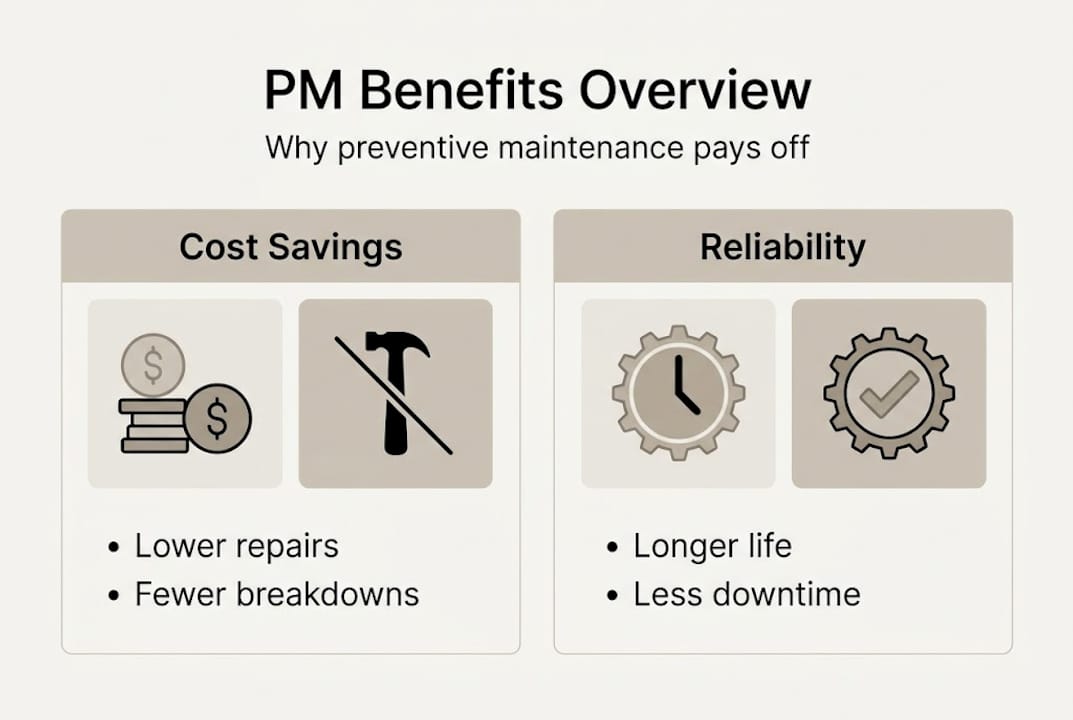
To understand why PM outperforms reactive maintenance, consider what reactive approaches actually cost. Each unplanned breakdown typically involves emergency labour, expedited spare parts, lost production time, and potential safety incidents. PM eliminates most of these costs by addressing wear and degradation before they escalate. You can read more about cutting PM costs by 30% in practice.
Summary of key PM benefits
| Métrica | Reactive maintenance | Mantenimiento preventivo |
|---|---|---|
| Reducción de costes | Baseline | 20–35% lower |
| Equipment reliability | Variable | 25–40% higher |
| OEE improvement | 77.6% (example) | 83.7% (example) |
| MTTR reduction | Baseline | Up to 30.5% lower |
| MTBF improvement | Baseline | Up to 25% higher |
The operational advantages of a structured PM programme include:
- Reduced unplanned downtime and production losses
- Extended asset lifecycle and lower capital replacement costs
- Improved safety compliance and reduced incident risk
- More predictable maintenance budgets and resource planning
- Higher workforce productivity through planned, organised work orders
“Preventive maintenance is not simply about fixing things before they break. It is about building a system where failure becomes the exception, not the norm.”
For operations managers, the shift from reactive to preventive is not just a technical change. It is a cultural and organisational one that requires commitment, data, and the right tools.
Preparing for success: Tools, resources, and planning essentials
A PM programme is only as strong as its foundation. Before scheduling the first task, operations managers need to assess their current state, gather the right tools, and align their teams around a clear plan.
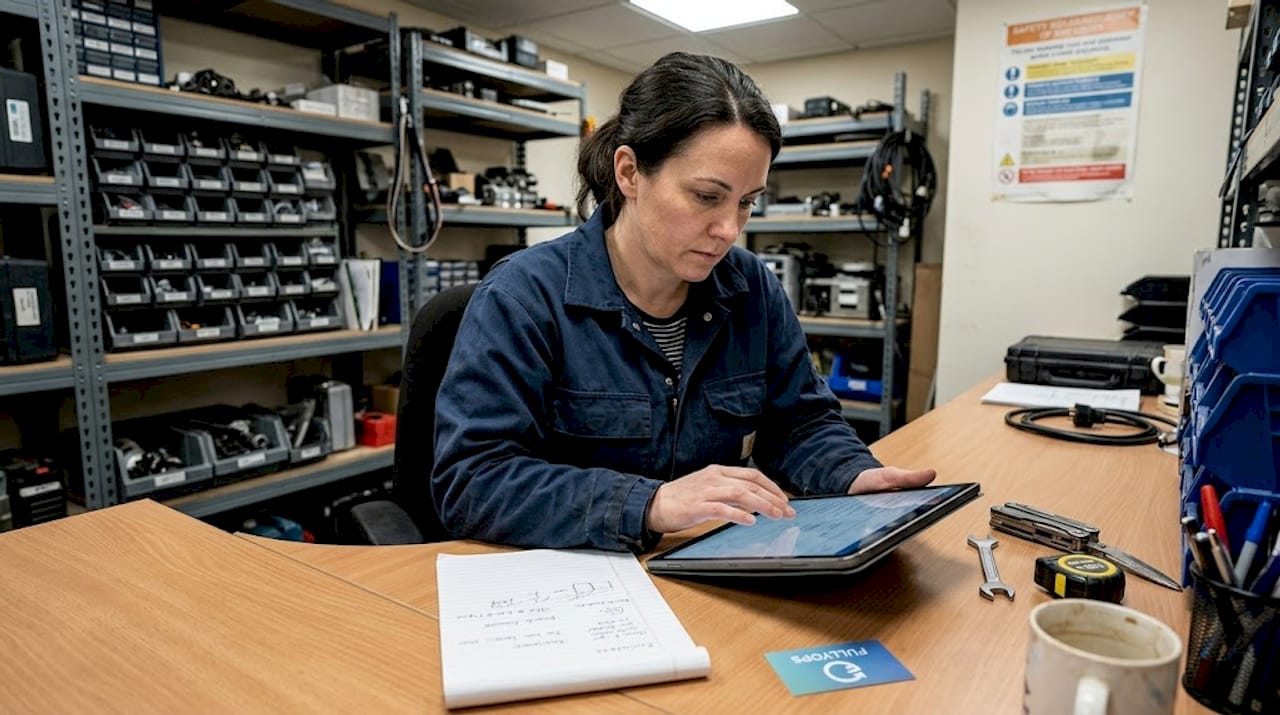
Data-driven PM programmes consistently deliver a 26% cost reduction, but only when accurate data and structured planning underpin every decision. Guesswork at the planning stage leads to inefficient schedules, wasted labour, and missed failure events.
Here is a stepwise approach to PM readiness:
- Conduct an asset inventory. List every asset in your facility, including make, model, age, and current condition. This forms the baseline for all subsequent planning.
- Assess asset criticality. Rank assets by their impact on production, safety, and cost if they fail. High-criticality assets receive more frequent and thorough PM tasks.
- Gather manufacturer data and failure history. Combine OEM service intervals with your own historical failure records to set realistic task frequencies.
- Select your CMMS (Computerised Maintenance Management System). A CMMS centralises scheduling, work orders, and reporting. Without one, PM programmes quickly become unmanageable at scale.
- Equip your technicians. Ensure your team has calibrated hand tools, condition monitoring sensors (vibration, temperature, oil analysis), and access to digital checklists.
Traditional vs. digital PM programme essentials
| Element | Traditional approach | Digital approach |
|---|---|---|
| Programación | Paper-based calendars | CMMS automated scheduling |
| Work orders | Manual forms | Digital, mobile-accessible |
| Asset history | Filing cabinets | Searchable database |
| Informes | Spreadsheets | Automated dashboards |
| Condition monitoring | Manual inspection | Sensor-integrated alerts |
For guidance on creating robust maintenance schedules y optimising scheduling for uptime, structured resources are available to support your planning process.
Pro Tip: Before investing in new tools, audit your existing data quality. Inaccurate asset records or incomplete failure histories will undermine even the most sophisticated PM software. Clean data is the most valuable input to any PM programme.
Implementing robust preventive maintenance: Step-by-step process
With the foundation in place, the next stage is designing and executing your PM programme with precision. The following steps reflect best practices for industrial environments where asset complexity and production pressures are significant.
- Prioritise assets by criticality and failure impact. Focus initial PM resources on assets whose failure would cause the greatest disruption. This prevents resource dilution across low-priority equipment.
- Develop an optimised PM schedule using data. Use manufacturer recommendations as a starting point, then refine intervals using your own failure history and, where applicable, Weibull analysis to model failure probability over time.
- Define tasks clearly for each asset. Each PM task should specify what to inspect, measure, lubricate, or replace, along with acceptance criteria so technicians know when a finding requires escalation.
- Assign roles and responsibilities. Designate task owners for each asset group. Ambiguity in ownership is one of the most common reasons PM tasks are skipped or completed poorly.
- Execute and document every intervention. Record completion times, findings, and any corrective actions taken. This data feeds back into schedule optimisation.
- Monitor and adjust intervals continuously. Review failure data regularly and adjust intervals via failure data to prevent unnecessary work and avoid over-servicing low-critical assets.
The results of a disciplined implementation are significant. A real-world fertiliser plant achieved a 25% MTBF increase and a 30.5% reduction in MTTR after implementing a structured PM programme, demonstrating what consistent execution delivers.
For complex asset types, a stepwise PM process for complex assets y key steps to boost reliability provide additional operational guidance.
Pro Tip: Over-maintenance is a real cost driver. If an asset consistently passes its PM inspection with no findings, consider extending its service interval. Failure data and condition monitoring readings should drive this decision, not habit or caution alone.
Statistic to note: A 30.5% reduction in MTTR means your team spends significantly less time on repairs, freeing capacity for higher-value maintenance activities and reducing production downtime per incident.
Common mistakes and verification: Ensuring sustainable results
Even well-designed PM programmes can deteriorate over time if common pitfalls are not actively managed. Knowing where programmes typically fail is as important as knowing how to build them.
The most frequent PM mistakes include:
- Over-maintenance on low-critical assets. Applying the same intensity of PM to every asset regardless of criticality wastes labour and budget. Adjusting PM tasks and intervals via failure data prevents this.
- Missed or skipped tasks. Without a reliable tracking system, tasks slip through the cracks, particularly during peak production periods when maintenance is deprioritised.
- Incomplete documentation. Failing to record findings means losing the feedback loop that makes PM programmes smarter over time.
- Static schedules. Treating PM intervals as fixed rather than data-driven leads to either over-servicing or under-servicing assets as their condition and usage patterns change.
- Lack of management visibility. When operations managers cannot see PM completion rates and key metrics in real time, issues go undetected until they become failures.
“A PM programme that is never reviewed is just a schedule. A PM programme that is continuously refined using real failure data is a reliability strategy.”
To sustain results, establish the following verification routines:
- Review PM completion rates weekly and investigate any tasks not completed on schedule.
- Track MTTR, MTBF, and OEE monthly to confirm the programme is delivering measurable improvement.
- Conduct quarterly reviews of task intervals and procedures, using failure data to justify any changes.
- Use maintenance reporting for asset reliability to generate structured feedback that informs management decisions.
- Carry out annual programme audits to assess whether asset criticality rankings remain accurate as your facility evolves.
Verification is not a one-time activity. It is the mechanism that keeps your PM programme aligned with operational reality and prevents the gradual drift back towards reactive maintenance.
Why most preventive maintenance fails — and how to get it right
Conventional PM advice tends to focus on building exhaustive checklists and scheduling every possible task. In practice, this approach often collapses under its own weight. Teams become overwhelmed, technicians rush through tasks to meet volume targets, and the quality of each intervention drops.
The operations managers who achieve lasting results take a different approach. They treat PM as a prioritisation exercise, not a completeness exercise. They concentrate resources on the assets that matter most, use real-world PM cost reductions as evidence that focused programmes outperform broad ones, and build feedback loops that continuously refine their schedules.
The uncomfortable truth is that a smaller, well-executed PM programme consistently outperforms a large, poorly maintained one. Fewer tasks done correctly, with proper documentation and follow-through, generate better reliability outcomes than comprehensive checklists that are routinely skipped or rushed.
Pro Tip: Start with your top 20% of assets by criticality. Get those PM tasks right first, measure the results, and then expand the programme. This builds confidence, demonstrates value to leadership, and prevents the resource overload that kills most PM initiatives in their first year.
Transform your preventive maintenance with advanced asset management
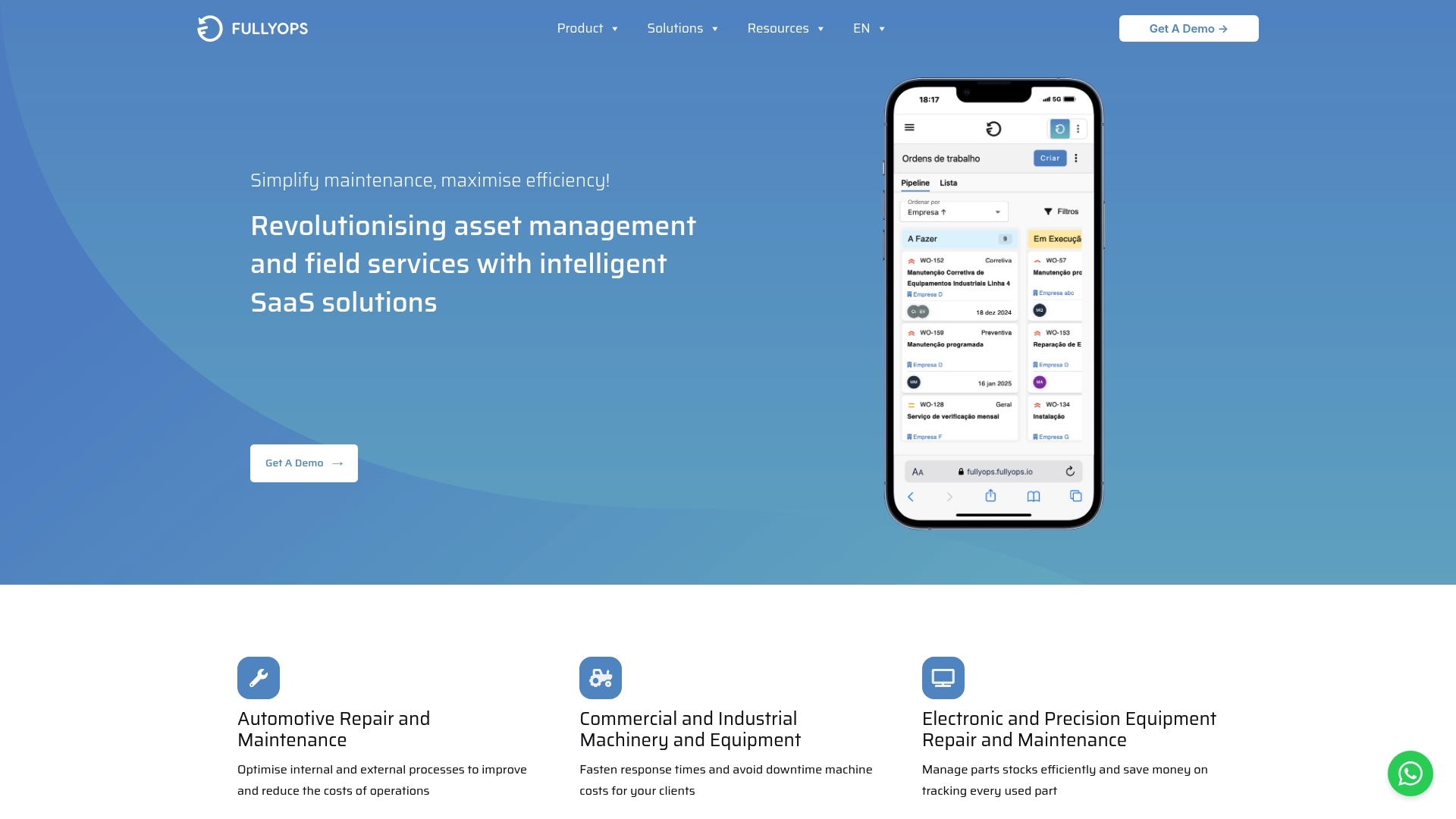
The strategies outlined in this guide are most effective when supported by the right digital infrastructure. FullyOps provides a SaaS platform built specifically for industrial operations managers who need to move beyond spreadsheets and paper-based systems. With features covering work order management, automated scheduling, efficient resource allocation, and real-time reporting, FullyOps gives your team the visibility and control needed to execute PM programmes at scale.
Explore the best maintenance management software options available, or review how to choose asset management systems that align with your facility’s specific requirements. The right platform turns your PM data into actionable insight.
Preguntas más frecuentes
What is the main benefit of implementing preventive maintenance?
Preventive maintenance reduces costs by 20–35% and improves equipment reliability by 25–40% compared to reactive approaches, delivering measurable gains in both financial and operational performance.
How often should preventive maintenance tasks be reviewed?
Task intervals should be reviewed regularly using equipment failure data, with adjustments based on failure data to eliminate unnecessary work and align schedules with actual asset behaviour.
What key metrics should operations managers track for PM?
MTTR, MTBF, and OEE provide clear benchmarks for PM effectiveness, while PM cost trends help identify where the programme is delivering value and where further optimisation is needed.
How does preventive maintenance software add value?
Software centralises scheduling, work order management, and reporting, making PM programmes more consistent, scalable, and responsive to real-time operational data across multiple assets and sites.
What common mistake should be avoided in PM programmes?
Avoid over-maintenance on low-critical assets by reviewing task frequencies against actual failure data, ensuring your maintenance effort is proportionate to each asset’s true risk profile.
Recomendado
- Essential preventive maintenance steps: maximise reliability
- What is preventive maintenance: operations manager’s guide
- Maintenance scheduling guide to optimise asset uptime