

En resumen:
- El mantenimiento colaborativo implica información compartida en tiempo real entre equipos, lo que reduce errores y costos. Vincula la planificación, la ejecución y la retroalimentación a través de herramientas digitales unificadas, fomentando una cultura de responsabilidad y mejora continua. La implementación de procesos eficaces y el apoyo del liderazgo garantizan un éxito sostenido en la minimización del tiempo de inactividad y la maximización de la confiabilidad de los activos.
Las decisiones de mantenimiento deficientes rara vez provienen únicamente de la ignorancia técnica. En la mayoría de las operaciones industriales, el verdadero culpable es la información fragmentada, donde un equipo actúa basándose en registros obsoletos mientras que otro ya ha identificado la causa raíz. Información de mantenimiento compartida en tiempo real mejora la coordinación para la ejecución del mantenimiento preventivo y reduce de forma mensurable los errores y malentendidos entre equipos. Para los jefes de operaciones y directores de mantenimiento, comprender por qué falla la colaboración y cómo solucionarlo ya no es opcional. Es la diferencia entre la resolución reactiva de problemas y una estrategia de gestión de activos genuinamente resiliente.
Índice
- ¿Qué es el mantenimiento colaborativo y en qué se diferencia?
- El impacto empresarial: Cómo la colaboración reduce el tiempo de inactividad y los costos
- Factores habilitantes clave: Herramientas, procesos y cultura para la colaboración sostenible
- Poner la colaboración en práctica: Pasos para los gerentes de operaciones
- Por qué fracasa la colaboración en el mantenimiento y qué es lo que realmente funciona
- Optimiza tu mantenimiento con las herramientas adecuadas
- Preguntas más frecuentes
Principales conclusiones
| Punto | Detalles |
|---|---|
| La colaboración reduce costos | Ampliar el conocimiento y el trabajo en equipo entre los equipos de mantenimiento puede generar importantes ahorros en los costos de servicio y un mejor rendimiento de los activos. |
| La información unificada es crucial | La información compartida en tiempo real garantiza que todos operen a partir de los mismos hechos, lo que reduce los errores y acelera las resoluciones. |
| El éxito necesita más que herramientas | La verdadera colaboración sostenible depende de la cultura del equipo, el liderazgo y la vinculación de la planificación con la ejecución diaria, no solo del software. |
| Empieza con pasos claros | Adoptar el mantenimiento colaborativo comienza con acciones prácticas como la comunicación actualizada y el compromiso proactivo entre roles. |
¿Qué es el mantenimiento colaborativo y en qué se diferencia?
El mantenimiento colaborativo es la práctica de coordinar todas las actividades de mantenimiento a través de procesos compartidos y habilitados por la tecnología que mantienen a cada parte interesada trabajando desde la misma fuente de información en tiempo real. No se trata simplemente de tener a varios técnicos trabajando codo a codo. Significa que los planificadores, técnicos, supervisores y equipos de adquisiciones contribuyen a una única base de conocimiento unificada, y se benefician de ella, en lugar de mantener registros separados, hojas de cálculo o informes verbales.
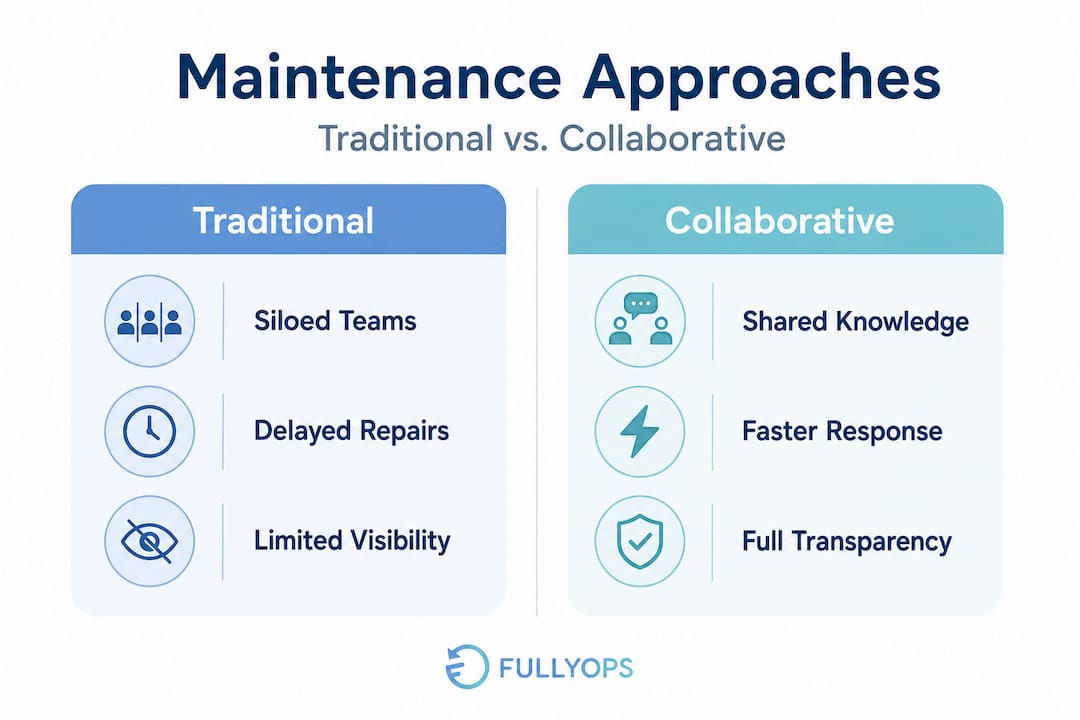
Los enfoques de mantenimiento tradicional se definen por compartimentos estancos. Un planificador crea una orden de trabajo sin visibilidad de los niveles actuales de inventario. Un técnico cierra un trabajo sin registrar los códigos de fallo que ayudarían al siguiente ingeniero. Un gerente revisa datos de rendimiento que ya tienen una semana de antigüedad. Estas brechas no son excepciones raras; son el patrón estructural predeterminado en muchas organizaciones que aún no han invertido en procesos de mantenimiento conectados.
| Mantenimiento tradicional | Mantenimiento colaborativo |
|---|---|
| Órdenes de trabajo y registros aislados | Gestión unificada de órdenes de trabajo digitales |
| Comunicación reactiva entre equipos | Actualizaciones de estado y alertas en tiempo real |
| Conocimiento poseído por los individuos | Base de conocimientos compartida accesible para todos |
| Informes de rendimiento retrasados | Paneles en vivo e informes instantáneos |
| Planificación manual desconectada de la ejecución | Planificación vinculada directamente a los datos de ejecución |
La brecha entre estos dos enfoques tiene una consecuencia financiera directa. Según un Punto de referencia de servicio de campo 2026, escalar el conocimiento entre equipos y reducir las operaciones aisladas puede generar ahorros de dos dígitos en los costos de servicio y un número significativamente menor de resoluciones fallidas por visita. Esa sola cifra debería llevar a cualquier gerente de operaciones a reexaminar cómo fluye la información entre sus equipos de mantenimiento.
“Ampliar el conocimiento en toda la plantilla y reducir los silos operativos puede suponer un ahorro de hasta el 26% en costes de servicio”. — Informe de referencia sobre el servicio de campo de Aquant para 2026
Simplemente seguir los procedimientos operativos estándar ya no es suficiente. En entornos industriales con una complejidad de activos cada vez mayor, mayores expectativas de tiempo de actividad y equipos más reducidos, la colaboración se ha convertido en una competencia operativa fundamental, y no en una mejora prescindible. Para un enfoque estructurado en la construcción de estos procesos, revisar un sólido guía de planificación de mantenimiento es un punto de partida práctico.
Las características clave que definen el mantenimiento colaborativo incluyen:
- Órdenes de trabajo digitales compartidas visible en todos los roles relevantes en tiempo real
- Programación integrada que tiene en cuenta la disponibilidad de los técnicos, el inventario de piezas y la criticidad de los activos
- Historial de fallas documentadas accesible para cada ingeniero, no guardado en el cuaderno de una sola persona
- Comunicación interdisciplinaria que conecta las operaciones, el mantenimiento y las compras
- Bucle de retroalimentación continua por lo tanto, el análisis informa la planificación futura sin demora
El impacto empresarial: Cómo la colaboración reduce el tiempo de inactividad y los costos
With collaboration defined, it is critical to see its real effect across operations, budgets, and team performance. The performance gap between collaborative and non-collaborative maintenance is not theoretical. It shows up in downtime duration, resolution speed, parts consumption, and ultimately in cost per asset over its operational lifecycle.
| Métrica de rendimiento | Without collaboration | With collaboration |
|---|---|---|
| Mean time to repair (MTTR) | High, due to delayed information | Reduced by faster diagnosis and resource coordination |
| Tipo fijo por primera vez | Low, due to incomplete job preparation | Improved through pre-shared failure history and parts availability |
| Unplanned downtime frequency | Higher, preventive actions poorly coordinated | Lower, with aligned preventive scheduling |
| Coste de mantenimiento por activo | Escalating, driven by rework and duplication | Contained, with shared knowledge reducing repeat visits |
| Technician productivity | Fragmented, with time lost seeking information | Increased through clear, pre-loaded work instructions |
The numbers reinforce this picture. Field service analytics confirm that organisations which scale knowledge across teams can achieve up to 26% reduction in service costs, a figure that compounds significantly across large asset portfolios.
The top drivers of cost reduction in collaborative maintenance include:
- Eliminating duplicate work caused by poor communication between shifts
- Reducing the frequency of unnecessary return visits through better first-time information
- Improving parts procurement accuracy by linking work orders to live inventory data
- Accelerating root cause analysis with historical data shared across teams
- Lowering training overhead because documented knowledge is reusable across the workforce
To make this concrete, consider a numbered scenario of how collaborative maintenance resolves a real industrial problem:
- A production line vibration sensor flags an anomaly at 06:00. The alert is automatically routed to the on-call technician and the maintenance planner simultaneously.
- The technician accesses the asset’s full service history, including a similar fault resolved six months prior, directly from their mobile device.
- The planner confirms that the required replacement bearing is in stock and assigns it to the work order before the technician reaches the equipment.
- The technician completes the repair in one visit, records the failure code and corrective action, and closes the work order with full documentation.
- The maintenance manager reviews the completed job and the updated failure pattern data in a live dashboard later that morning, with no manual reporting required.
This kind of outcome is not exceptional. It is what consistently well-structured collaborative maintenance delivers. Strategies to reduce downtime in planning and to cut maintenance costs are both grounded in the same principle: connected teams working from accurate, shared information produce faster, cheaper, and more reliable results.
Factores habilitantes clave: Herramientas, procesos y cultura para la colaboración sostenible
The positive results are clear, but only achievable if the right enablers are in place, from software to team alignment. Three distinct dimensions must work together: digital tools, integrated processes, and organisational culture.
Digital tools
A Computerised Maintenance Management System (CMMS) is the operational backbone of any collaborative maintenance programme. It centralises work orders, asset records, maintenance histories, parts inventories, and scheduling into a single platform accessible to every relevant team member. Shared dashboards provide real-time visibility into asset status, open jobs, and team workload, removing the lag and distortion that occur when information passes through manual handoffs.

Como modern reliability-centred approaches recommend, the CMMS must do more than store records. It should link reliability logic directly into work orders and job plans so that every technician operates from the same analytical framework, and so that every completed job feeds back into performance tracking automatically.
Integrated processes
Technology alone does not produce collaboration. Processes must be designed to connect planning with execution at every stage. This means that preventive maintenance schedules are built from live asset data, not annual calendars. It means failure analysis findings are recorded in formats that inform future planning, not filed away in reports that nobody reads. And it means procurement decisions are triggered automatically by work order requirements rather than waiting for manual requests.
Well-designed maintenance scheduling integrates all these connections, ensuring that each stage of the maintenance cycle informs the next without human delay or translation errors.
Culture and change management
This is the enabler that most organisations underestimate. Even well-structured maintenance methodologies can fail due to culture and budget constraints, which means that collaboration and alignment efforts must be managed as organisational change, not just process redesign. If senior technicians resist logging their work because they view it as a bureaucratic burden, the shared knowledge base degrades quickly. If managers treat the CMMS as a reporting tool rather than an operational aid, adoption stalls.
Common barriers and their practical solutions:
- Budget constraints: Start with a phased implementation that demonstrates measurable ROI before requesting full investment
- Entrenched silos: Involve team leads from multiple departments in the design of new workflows, not just the rollout
- Legacy attitudes toward documentation: Frame data entry as a professional contribution, not administrative overhead
- Lack of leadership sponsorship: Secure visible commitment from operations directors before launching any change initiative
- Tool complexity: Choose platforms with role-appropriate interfaces so technicians, planners, and managers each see what is relevant to them
Pro Tip: Build trust in your collaborative process through daily transparent updates at team level, not just monthly performance reports. When technicians see their input reflected in improved scheduling and fewer repeat callouts, they become the strongest advocates for the system.
Poner la colaboración en práctica: Pasos para los gerentes de operaciones
It is time to translate what works into concrete next actions, whether starting from scratch or upgrading existing habits. The following steps provide a practical roadmap for initiating or strengthening collaborative maintenance in any industrial organisation.
-
Audit your current information flows. Map where maintenance data is created, stored, and shared today. Identify the specific points where information breaks down or is delayed between teams.
-
Define a single source of truth. Choose a platform that centralises work orders, asset records, and scheduling. Every team member should access the same system, not local spreadsheets or separate departmental databases.
-
Set up real-time information sharing. Configure alerts and notifications so that relevant stakeholders receive updates as they happen, not after the fact. Shared maintenance information at the point of execution reduces coordination errors and keeps preventive programmes on track.
-
Engage stakeholders across functions. Collaborative maintenance requires input from operations, maintenance, procurement, and management. Run structured sessions to align on shared goals and clarify each team’s responsibilities within the new process.
-
Establish documentation standards. Define what data must be captured at each stage of a work order, from fault description to resolution notes, and make this a non-negotiable part of job closure.
-
Create feedback loops. Schedule regular reviews where performance data from the CMMS informs planning adjustments. Make it routine for maintenance outcomes to feed directly back into future scheduling and resource allocation.
-
Measure and communicate progress. Track key metrics such as first-time fix rate, mean time to repair, and planned versus unplanned maintenance ratio. Share results with all teams to reinforce the value of the collaboration effort.
A well-structured approach to creación de programas de mantenimiento supports several of these steps directly, particularly in aligning preventive work with accurate asset and resource data.
Pro Tip: Start with one asset group or production line rather than attempting a full organisational rollout. Document the performance improvements clearly, then use those results to build internal support for wider adoption. Incremental wins are far more persuasive than theoretical business cases.
Por qué fracasa la colaboración en el mantenimiento y qué es lo que realmente funciona
Most organisations approach collaborative maintenance the same way they approach a software implementation. They purchase a platform, run a training session, and expect behaviour to change. It rarely does. The honest assessment is that the primary reason collaborative maintenance programmes fail is not the technology, it is the absence of genuine organisational accountability.
Even well-structured maintenance methodologies fail when culture and budget constraints are not addressed head-on. This is not a peripheral concern. It is the central variable. A CMMS with excellent features becomes little more than an expensive filing system if team leaders do not model the behaviours they expect from their technicians.
What actually works is a combination of leadership visibility, clearly defined accountability, and small wins that build momentum. When a maintenance director personally reviews and acts on data from the shared platform every morning, that behaviour signals to the entire team that the system matters. When a technician’s documented fault history prevents a costly repeat failure two months later, and that story is shared in a team briefing, adoption accelerates without any further mandate.
The other critical insight is that linking planning with daily execution is not a technical challenge. It is a discipline challenge. Reliability logic sitting in an analysis document that never reaches the technician’s work order is wasted effort. The organisations that see sustained results are those that enforce the discipline of connecting every insight from the analysis layer to the execution layer, and then measuring whether that connection produced the expected outcome.
Collaboration is not a software feature. It is a team sport with rules, referees, and a scoreboard. The organisations that treat it as such, investing in leadership alignment as seriously as they invest in platform selection, consistently outperform those that rely on technology alone to drive the change.
Optimiza tu mantenimiento con las herramientas adecuadas
If you are ready to move from theory to action, the practical next step is selecting tools and resources that match your operational context. Reviewing the leading maintenance software for industrial companies gives a clear view of which platforms best support collaborative work order management, real-time visibility, and integrated reporting. Pairing that with a structured approach to resource allocation strategies ensures your teams are not just connected but also working with optimally deployed assets and personnel. For a broader view of how digital infrastructure supports long-term asset reliability, exploring the range of sistemas de gestión de activos available for industrial maintenance provides a solid strategic foundation for your next investment decision.
Preguntas más frecuentes
¿Cómo reduce el mantenimiento colaborativo los costes operativos?
El mantenimiento colaborativo permite a los equipos compartir conocimientos en tiempo real y resolver problemas más rápidamente, lo que minimiza los errores, previene la duplicación y puede reducir los costos de servicio en dos dígitos, según los datos de referencia del servicio de campo. Menos visitas iniciales fallidas y una menor repetición de trabajos se cuentan entre los beneficios financieros más directos.
¿Cuáles son las barreras más comunes para el mantenimiento colaborativo?
Las principales barreras son una cultura organizacional arraigada, la falta de apoyo por parte del liderazgo y herramientas obsoletas, las cuales pueden socavar incluso metodologías de mantenimiento bien diseñadas si no se abordan como parte de un programa de gestión del cambio. Las limitaciones presupuestarias son una barrera secundaria pero significativa para muchas organizaciones industriales.
¿Cómo permite la tecnología el mantenimiento colaborativo?
Los sistemas digitales como el GMAO conectan todos los datos y actualizaciones en tiempo real, garantizando que cada miembro del equipo trabaje con la misma información precisa. Los datos de mantenimiento compartidos en tiempo real mejoran específicamente la coordinación durante la ejecución del mantenimiento preventivo y reducen los errores de comunicación que conducen a costosos retrabajos.
¿Funciona el mantenimiento colaborativo para equipos pequeños?
Yes, even small maintenance teams benefit significantly from shared knowledge and aligned processes, particularly in environments where one technician’s expertise would otherwise be inaccessible to colleagues handling similar assets. The overhead of implementing collaborative tools scales proportionally, so smaller teams often see faster returns on their investment.
Recomendado
- Guía de flujos de trabajo de mantenimiento de activos para una eficiencia óptima
- Reduce maintenance costs for efficient asset management
- Tendencias de gestión de activos que impulsan la eficiencia en 2026